







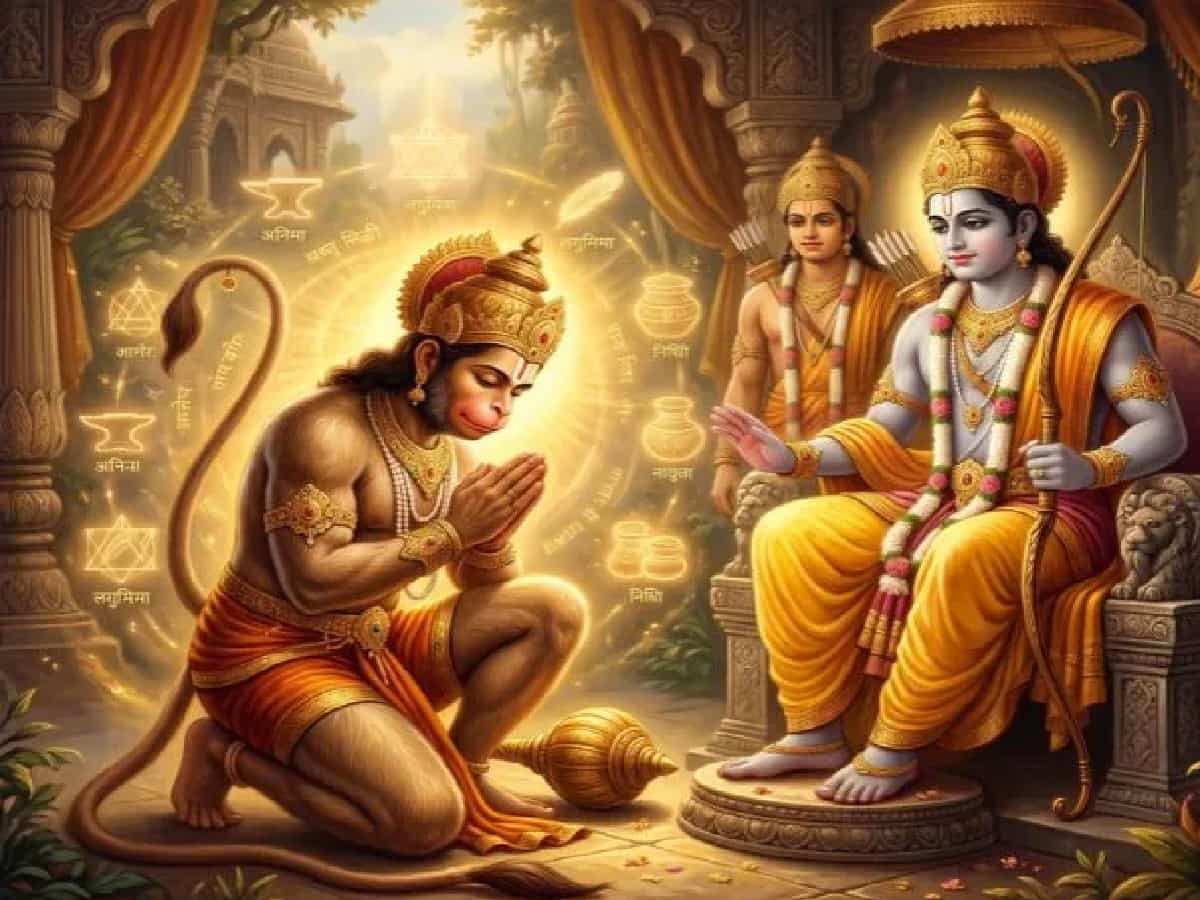
Why Lord Hanuman Calls Himself 'Shri Ram Das' Despite 8 Siddhis, 9 Nidhis
Every Tuesday across millions of households and temples in India and around the world, devotees recite Goswami Tulsidas's timeless hymn, the Hanuman Chalisa, pausing with deep reverence at the celebrated couplet: "Ashta Siddhi Nav Nidhi Ke Daata, As Bar Deen Janaki Mata." Translated literally, the verse proclaims that Mother Sita (Janaki Mata) blessed Lord Hanuman with the supreme authority to bestow the eight spiritual attainments (Ashta Siddhis) and the nine celestial treasures (Nav Nidhis) upon deserving seekers. Yet despite possessing cosmic powers at whose slightest gesture all material abundance and supernatural mastery appear, Hanuman never claims sovereignty for himself; instead, in the very next breath of the hymn—"Ram Rasayan Tumhare Paasa, Sada Raho Raghupati Ke Daasa"—he joyfully identifies himself as 'Shri Ram Das', the eternal, humble servant of Lord Rama. In Hindu spiritual philosophy and Vedic tradition, this deliberate contrast carries one of life's most transformative lessons: true greatness does not lie in accumulating power or wealth, but in anchoring every capability in humility, self-discipline, and selfless devotion (bhakti). Alongside its philosophical depth, Tuesday worship of Lord Hanuman also holds major significance in Vedic astrology (Jyotish), where Hanuman is closely linked with both Mars (Mangal)—the planet of courage, vitality, and decisive action—and Saturn (Shani), the planet of karma, endurance, and justice. For devotees, spiritual seekers, astrology followers, and readers across New Delhi, Ayodhya, Varanasi, Prayagraj, Lucknow, Kanpur, Jaipur, Chitrakoot, Bengaluru, and Mumbai, understanding why the master of Ashta Siddhis and Nav Nidhis chooses servitude over supremacy illuminates the real spirit of the Hanuman Chalisa.
Meaning of 'Ashta Siddhi Nav Nidhi Ke Daata': The 8 Siddhis and 9 Treasures
When Mother Sita witnessed Hanuman's fearless devotion in Ashok Vatika during her captivity in Lanka, she conferred upon him the boon to grant eight yogic siddhis and nine divine nidhis. Far from mere worldly riches, each siddhi and nidhi symbolizes a distinct dimension of inner mastery, protection, and spiritual abundance:
| Category | Sacred Names in Hindu Tradition | Spiritual & Symbolic Meaning |
| Ashta Siddhis (8 Spiritual Powers) | 1. Anima | 2. Mahima | 3. Garima | 4. Laghima | 5. Prapti | 6. Prakamya | 7. Ishitva | 8. Vashitva | Anima: becoming microscopic; Mahima: expanding infinitely; Garima: becoming immeasurably heavy; Laghima: becoming weightless; Prapti: attaining anything sought; Prakamya: realizing noble intentions; Ishitva: supreme lordship; Vashitva: serene self-control and positive influence. |
| Nav Nidhis (9 Divine Treasures) | 1. Mahapadma | 2. Padma | 3. Shankha | 4. Makara | 5. Kachchhapa | 6. Mukunda | 7. Kunda | 8. Nila | 9. Kharva | Mahapadma & Padma: immense prosperity and spiritual purity; Shankha: auspiciousness and sacred sound; Makara: strength and protection; Kachchhapa: stability and endurance; Mukunda: liberation and bliss; Kunda: fulfillment; Nila: rare auspicious fortune; Kharva: hidden resources and unexpected gains. |
Why Hanuman Values 'Ram Rasayan' Above All Siddhis and Nidhis
In classical yoga and Vedanta, even extraordinary siddhis can become subtle traps if they feed ego or pride. Lord Hanuman exemplifies the exact opposite: he used Anima to enter Lanka undetected, Mahima to leap across the ocean and confront demons, and Laghima to soar effortlessly through the skies—yet never once used a single power for personal glory.
As Tulsidas reveals in the verse "Ram Rasayan Tumhare Paasa, Sada Raho Raghupati Ke Daasa," Hanuman possesses the supreme elixir (rasayan) of Lord Rama's name. To Hanuman, being Shri Ram Das is infinitely higher than ruling over the eight siddhis and nine nidhis, because material treasures and yogic powers are instruments of service, whereas pure Ram Bhakti unites the soul directly with the Divine.
Hanuman Ji's Sacred Connection With Mars (Mangal) and Saturn (Shani)
Beyond devotion, Tuesday worship of Lord Hanuman occupies a unique place in Vedic astrology due to his connection with Mars and Saturn. Mars (Mangal), the ruling planet of Tuesday, governs physical courage, willpower, and the strength to overcome fear—making Hanuman Chalisa recitation a traditional remedy for those navigating challenging Mars placements.
At the same time, Hindu legend recounts that when Shani Dev (Saturn) was imprisoned by Ravana in Lanka, Lord Hanuman rescued him. In deep gratitude, Shani Dev pledged that his harsh karmic afflictions would never trouble sincere devotees of Lord Hanuman—reminding worshippers that courage backed by humility and righteous duty conquers every obstacle in life.




