







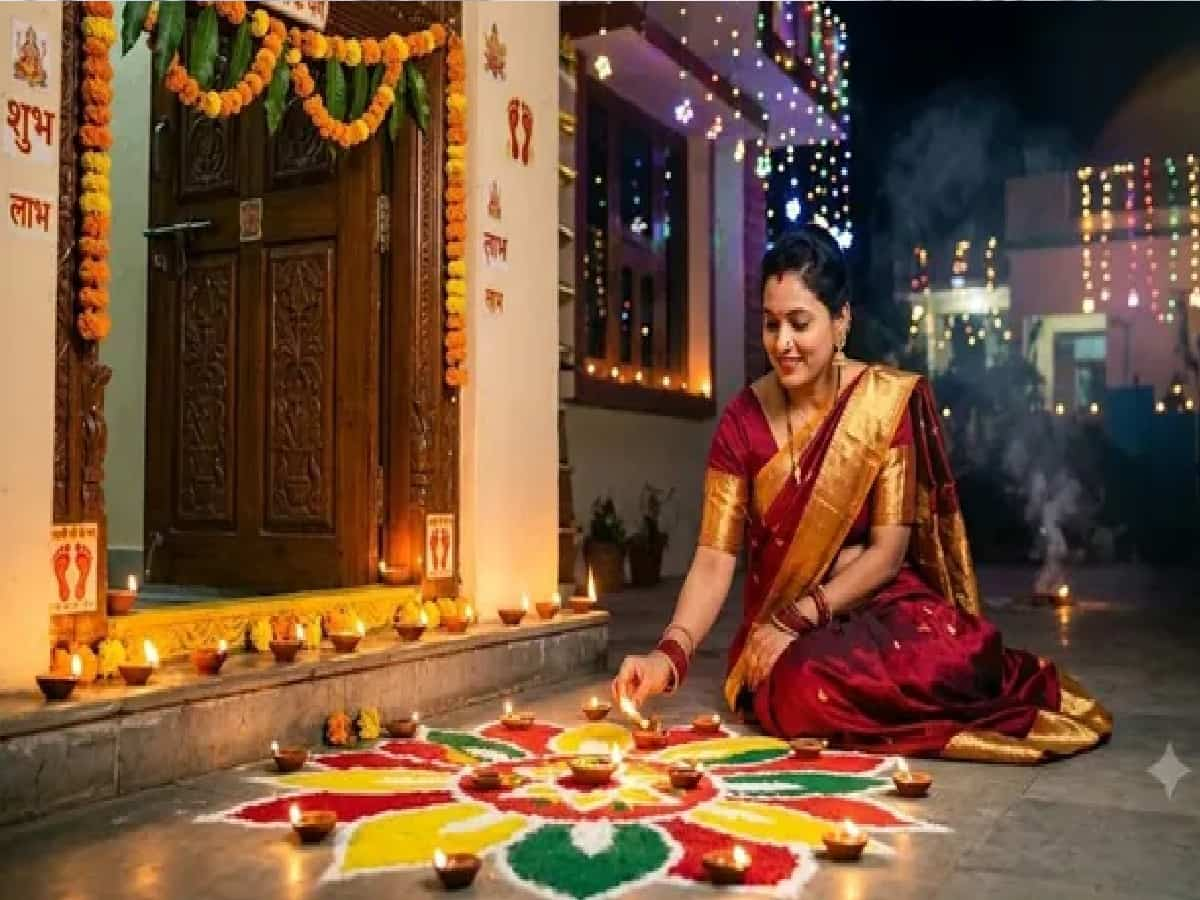
The Main Door Secret of Diwali Night: Why Lighting Lamps at Your Entrance
Uncover the sacred Vastu Shastra and Vedic principles behind lighting mustard and sesame oil lamps at your main entrance on Diwali night to invite Goddess Lakshmi, pacify Vastu defects, appease Yamaraj, and shield your household from negative energies.
On the sacred night of Deepavali, as millions celebrate the victory of divine light over darkness, the main threshold of the household transforms into the single most important spiritual focal point of the entire celebration. Rooted in classical Sanatan tradition and ancient Vastu Shastra wisdom, the entrance (chaukhat) functions as an energetic perimeter and the primary conduit for cosmic vibrations entering the living space. According to sacred scriptures, Goddess Lakshmi, the deity of fortune and spiritual abundance, descends upon Earth during the dark new moon night of Kartik Amavasya to visit purified homes, crossing directly through the main doorway. Illuminating this threshold with sacred earthen lamps serves as an auspicious beacon of welcome, signaling domestic purity and the family's readiness to receive lasting blessings of prosperity.
The Vastu Energy Shield: Purging Negative Vibrations, the Evil Eye, and Poverty
Beyond divine hospitality, ancient architectural treatises regard the home entrance as a primary defense line that protects domestic balance from negative exterior influences. Lighting lamps at the main doorway neutralizes low vibrational frequencies that tend to linger around unlit corners, functioning as an energetic shield that wards off the evil eye (buri nazar), lingering misfortunes, and chronic financial scarcity (daridrata). In Vastu Shastra, orientation imbalances or spatial flaws—collectively known as Vastu doshas—frequently manifest at entryways where cardinal alignments conflict with natural elemental energies. The concentrated thermal and spiritual radiance generated by consecrated oil flames actively harmonizes these subtle spatial discrepancies, stimulating the flow of positive prana (life energy) throughout the house and establishing an energetic barrier against psychic and emotional disruption.
Appeasing Yamaraj and Essential Ritual Rules: Oil Choice, Sacred Asana, and Cardinal Alignments
In addition to inviting auspicious fortune, illuminating the doorstep with lamps fueled by pure mustard oil (sarson ka tel) or sesame oil (til ka tel) serves as an ancient ritual of respect dedicated to Lord Yamaraj, the cosmic arbiter of justice and mortality. This protective offering safeguards the household against sudden catastrophes, severe health crises, and the shadow of untimely death (Akaal Mrityu). To maximize spiritual efficacy and maintain scriptural purity, practitioners must adhere to key traditional guidelines:
-
Never Place Lamps Directly on the Bare Floor: An illuminated diya should never touch the ground directly; it must always rest upon a sacred bedding (aasana) of unbroken white rice (akshat) or fresh flower petals to prevent spiritual energy dissipation.
-
Symmetrical Bilateral Placement: Lamps should be installed in pairs, positioning one diya on the left side and one on the right side of the threshold to maintain balanced energy polarity.
-
Flame Directionality: The wicks should be aligned so that the flame points toward either the North—the directional realm of Lord Kubera and wealth expansion—or the East, the cardinal sector of solar energy, longevity, and vitality.




