







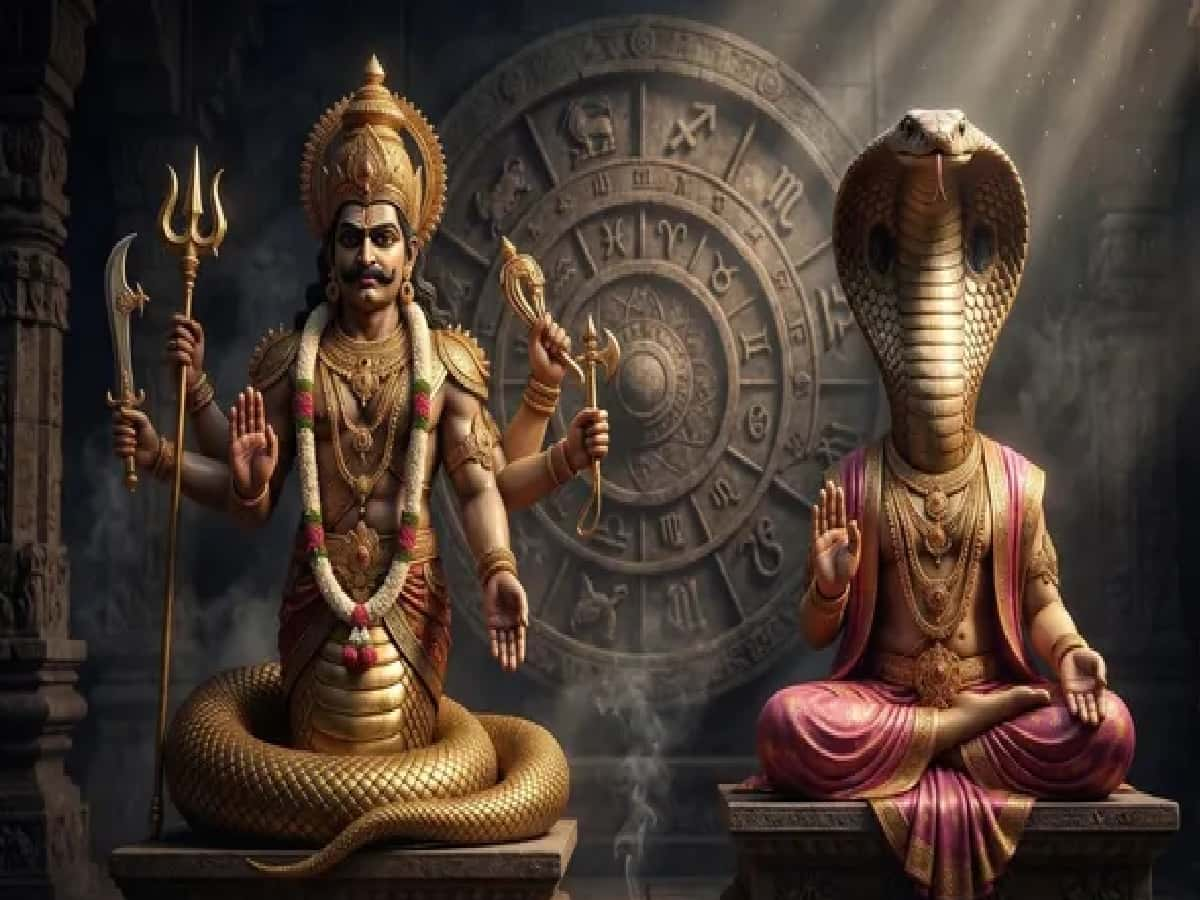
Rahu and Ketu Origin: How Svarbhanu Became Shadow Planets in Jyotish
In Vedic astrology (Jyotish), few celestial forces spark as much curiosity—or shape life's sudden turns as dramatically—as Rahu and Ketu. Highlighted across spiritual, cultural, and astrology desks on Thursday, November 26, 2026, ancient Hindu scriptures and Puranic lore explain that unlike the physical luminaries of the Navagraha—such as the Sun (Surya), Moon (Chandra), Mars (Mangal), Mercury (Budh), Jupiter (Brihaspati), Venus (Shukra), and Saturn (Shani)—Rahu and Ketu are chaya grahas (shadow planets) representing the north and south lunar nodes where the Moon's orbital path intersects the Sun's apparent ecliptic. Yet their mythological origin begins with an act of cosmic deception during Samudra Manthan (the churning of the ocean of milk): when the asura (demon) Svarbhanu disguised himself among the devas to sip amrita (the nectar of immortality), Surya and Chandra alerted Lord Vishnu, who severed Svarbhanu's head with his Sudarshana Chakra—only for the already-ingested nectar to render both halves immortal, transforming his head into Rahu and his remaining torso/body into Ketu. Across pilgrimage and cultural centers in Varanasi, Ayodhya, Prayagraj, Lucknow, New Delhi, Mumbai, and Bengaluru, devotees and seekers also look to how this pair shapes fate over time—completing a full zodiac cycle in roughly 18.6 years, spending about 18 to 18.6 months per sign while moving retrograde, and preparing to shift into Capricorn (Makara) and Cancer (Karka) on December 5, 2026.
Origin of Rahu and Ketu: Samudra Manthan & Svarbhanu's Myth
To bring together how Svarbhanu's deception during Samudra Manthan gave rise to Rahu and Ketu, how Vedic astrology contrasts the symbolism of the head (Rahu) and torso/body (Ketu), and how their 18.6-year cycle and upcoming December 5, 2026 transit work, the tables below organize all verified mythological and astrological details:
Mythological & Symbolic Breakdown: Rahu vs. Ketu
| Aspect | Rahu (North Lunar Node) | Ketu (South Lunar Node) |
| Puranic Origin | Severed head of the demon Svarbhanu, rendered immortal after tasting amrita during Samudra Manthan just as Lord Vishnu wielded the Sudarshana Chakra. | Severed torso / body (and serpent tail in later lore) of Svarbhanu, also made immortal by the nectar of immortality. |
| Astrological Nature | Shadow planet (chaya graha) functioning as a powerful worldly amplifier—linked to intense ambition, unconventional paths, foreign connections, and sudden rises. | Shadow planet (chaya graha) associated with detachment, past-life mastery, spiritual introspection, and releasing what is no longer needed. |
| Eclipse Lore & Astronomy | Pursued Surya and Chandra after they exposed him; astronomically marks the ascending lunar node where eclipses occur. | Always sits 180 degrees opposite Rahu across the zodiac axis, completing the lunar nodal pair. |
Key Astrological Cycles & Upcoming December 2026 Shift
| Cycle / Transit Metric | Verified Jyotish Figure | Practical Reading in Vedic Astrology |
| Full Zodiac Cycle | Approximately 18.6 years to complete a full circuit around all twelve zodiac signs. | Marks a complete nodal return chapter in an individual's birth chart (kundli). |
| Stay in One Sign & Motion | Roughly 18 to 18.6 months per sign, moving predominantly in retrograde (vakri) motion. | Activates paired opposite houses of a horoscope simultaneously over an ~18-month window. |
| December 5, 2026 Transit | Mean-node transit on Saturday, December 5, 2026 moves Rahu into Capricorn (Makara) and Ketu into Cancer (Karka) until June 24, 2028. | Shifts focus across career ambition, public responsibility, emotional grounding, and family balance. |
Why One Has a Head and the Other a Torso in Vedic Symbolism
In traditional Jyotish interpretation, the contrast between Rahu's head and Ketu's torso is deeply symbolic rather than merely punitive. Rahu represents hunger, perception, desire, and outward reach, driving people to experiment and chase bold goals, while Ketu—lacking eyes or mouth in the myth—represents inner stillness, detachment, and quiet completion. Together, they remind seekers across Varanasi, Ayodhya, Prayagraj, Lucknow, New Delhi, and Mumbai that both ambition and letting go shape human destiny.
What Seekers Should Keep in Mind Ahead of the December 5, 2026 Shift
As Rahu and Ketu prepare for their December 5, 2026 mean-node sign transition into Capricorn and Cancer, traditional scholars note that individual transits always interact with a person's full kundli and active dasha periods rather than operating in isolation. Across Lucknow, Varanasi, Ayodhya, Prayagraj, and New Delhi, steady discipline, clear priorities, and mindful decision-making remain the most grounded response to any planetary shift.




