







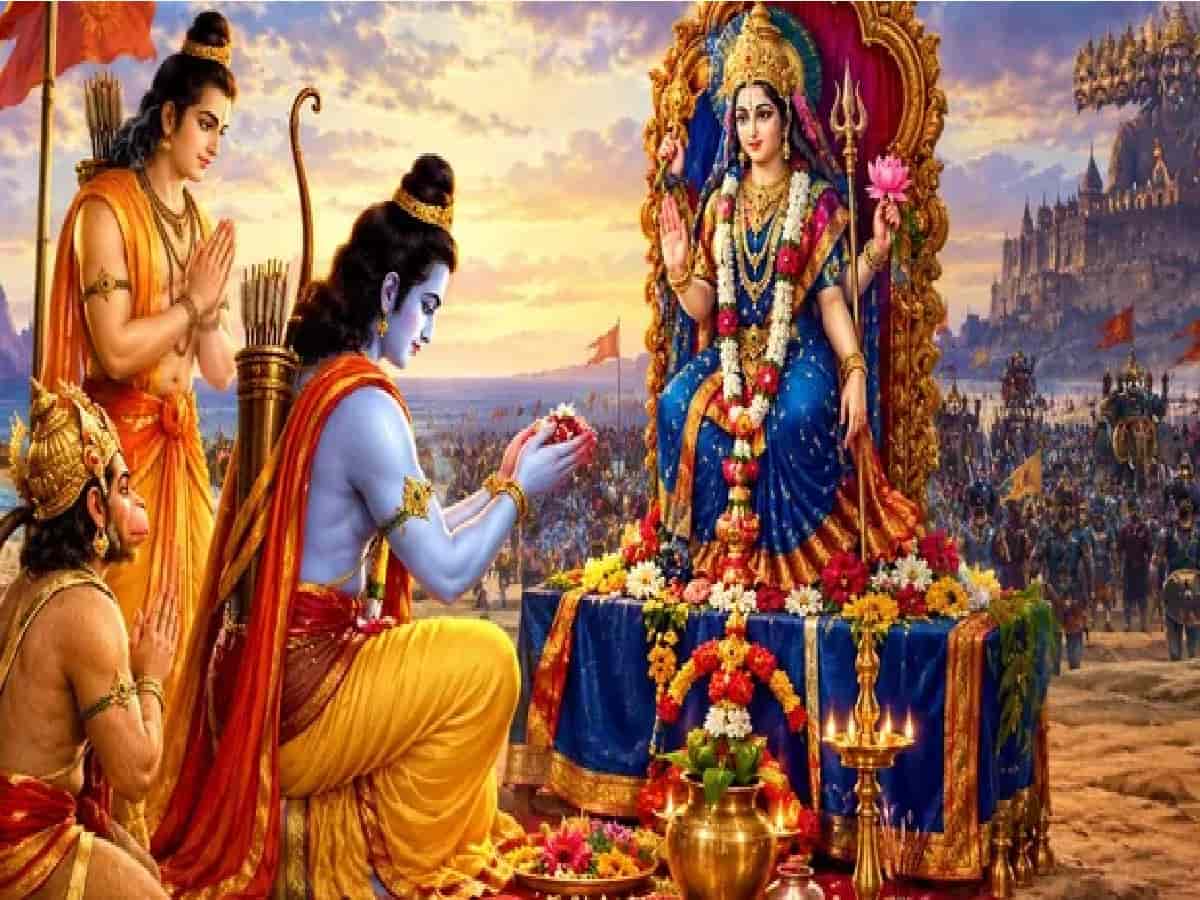
Dussehra Secret: Why Lord Rama Invoked Goddess Aparajita Before Slaying Ravana
Celebrated with profound devotion across the Indian subcontinent, the auspicious festival of Dussehra (Vijayadashami) stands as the supreme cosmic emblem of righteousness triumphing over unrighteousness and light vanquishing darkness. According to the classical verses of the Valmiki Ramayana, it was on the tenth day of the bright fortnight of the Hindu lunar month of Ashwin (Ashwin Shukla Dashami) that Lord Rama vanquished the demon king Ravana, concluding an epic war that liberated the three worlds from demonic tyranny—a milestone commemorated annually across millions of towns and cities through the ceremonial burning of gigantic effigies of Ravana, Kumbhakarna, and Meghnad. However, while common folklore predominantly remembers the final duel itself, sacred scriptures, particularly the ancient Varaha Purana, document a crucial celestial intervention: prior to stepping onto the final battlefield, Lord Rama performed elaborate sacred rites to invoke Goddess Aparajita, seeking her divine grace to dismantle the formidable sorcery and physical might of Lanka's monarch.
The Invincible Goddess: Meaning of Aparajita and the Varaha Purana Lore
In Sanskrit theological traditions, the holy name "Aparajita" literally translates to "She who can never be conquered or defeated," signifying the unyielding, supreme omnipotence of the Divine Mother. Revered as an exalted manifestation of Goddess Durga or Vaishnavi, Goddess Aparajita embodies the ultimate cosmic energy that safeguards dharma during critical existential crises. Scriptural narratives explain that Lord Rama, accompanied by his brother Lakshman, Sugriva, and the Vanara army, invoked Goddess Aparajita on the battlefield to seek invincible spiritual armor and guaranteed success against Ravana's seemingly impenetrable defenses. Modern spiritual teachers and Vedic scholars highlight that worshipping Goddess Aparajita on Vijayadashami carries immense spiritual fruits for household devotees as well; an individual who invokes her divine grace is believed to overcome insurmountable life hurdles, dissolve hidden chronic adversaries, eradicate lingering court or business rivalries, and establish long-lasting domestic harmony, material fortune, and spiritual peace.
Step-by-Step Aparajita Puja Vidhi: Auspicious Timings and Vijayadashami Rituals
To harness the supreme blessings of victory over internal weaknesses and external opposition, classical liturgical manuals recommend performing Aparajita Puja during the auspicious afternoon window (Aparahna or Vijaya Muhurat) on Dussehra. The sacred observance commences early in the morning with a purifying ritual bath, followed immediately by offering sacred water (Arghya) to the Sun God (Surya Dev) to invoke vitality and clarity. During the main worship ceremony, devotees should sit comfortably facing the auspicious northeast (Ishanya) direction and place a clean wooden platform (chowki) adorned with a sanctified cloth upon which the sacred idol or picture of Goddess Aparajita is ceremoniously installed. Devotees then consecrate the deity with sacred vermilion (roli), unbroken sacred rice grains (akshat), and fresh seasonal blossoms before igniting an unbroken flame utilizing pure cow ghee. After reciting dedicated victory stutis, waving the sacred aarti lamp, and presenting sanctified food offerings (naivedya or bhog), the consecrated prasad is reverently distributed among family members, sealing the practitioner’s endeavors with divine protection and unstoppable triumph.




