







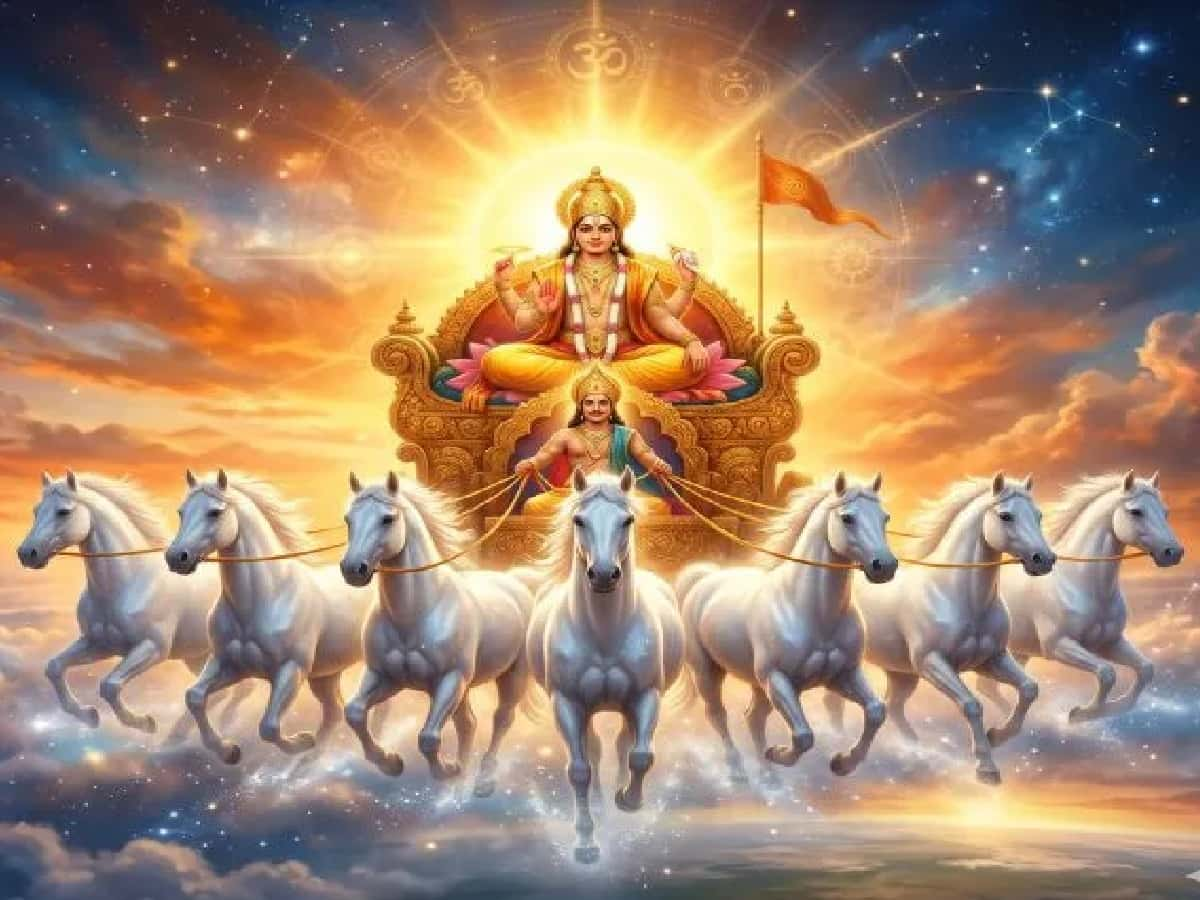
Chhath Puja: Why Lord Surya Rides a Chariot of 7 Horses
As the sacred month of Kartik enters its most spiritually profound phase, millions of devotees across Bihar, Jharkhand, Eastern Uttar Pradesh, and the global Indian diaspora are preparing for the grand four-day festival of Chhath Mahaparv, celebrated from November 13 to November 16, 2026. Dedicated to the worship of the Sun God, Lord Surya, and his divine cosmic consort Chhathi Maiya, the festival represents one of the oldest surviving nature-venerating traditions of Sanatan Dharma. While pilgrims prepare to stand waist-deep in flowing rivers at sunset and sunrise to offer Arghya, central to this devotion is the iconography of Lord Surya traversing the celestial realm in a resplendent golden chariot drawn by seven magnificent horses and navigated by his charioteer, Aruna. For centuries, this depiction has captivated spiritual seekers and scholars alike. Why does the Sun God specifically ride a chariot drawn by seven horses, rather than any other number? The answer is rooted in Vedic literature, astronomical science, human physiology, and metaphysical philosophy, revealing that this ancient imagery is a sophisticated representation of cosmic order, solar physics, and spiritual transformation.
The Vedic Chhandas: Sacred Names of the Seven Divine Steeds
In the canonical hymns of the Rigveda, Lord Surya is praised as the supreme life-giver, the cosmic eye of the universe, and the visible manifestation of divinity (Pratyaksha Devata). The scriptures explicitly name the seven horses that steer the solar chariot, and each corresponds to one of the seven foundational meters (Chhandas) of Vedic Sanskrit poetry: Gayatri, Brihati, Ushnik, Jagati, Trishtup, Anushtup, and Pankti. In Vedic philosophy, speech, sound, and sonic vibrations are regarded as the primary building blocks of cosmic creation. By depicting the horses of the sun as the Vedic meters, ancient seers conveyed that the physical journey of the sun across the sky is in harmony with the acoustic architecture of the cosmos.
These seven celestial steeds are also understood to represent the seven days of the week, pulling the chariot of time (Kala Chakra) through an endless cycle of dawn, noon, dusk, and night. Seated behind these powerful creatures, Lord Surya remains the silent, benevolent witness to the unfolding of time, while Aruna—the personification of the reddish morning twilight—holds the reins, symbolizing that gentle, focused discipline is required to guide and channel cosmic forces into sustained life on Earth.
Ancient Wisdom Meets Modern Optics: The Spectrum of Solar Rays
Beyond its poetic and scriptural significance, the imagery of the seven horses reflects an understanding of solar physics that predates modern scientific discoveries. In contemporary optics, sunlight appears white to the naked eye, yet passing it through a prism reveals that it is composed of seven distinct visible wavelengths: violet, indigo, blue, green, yellow, orange, and red (VIBGYOR). Classical iconography depicts the seven horses of Lord Surya with pristine white coats, symbolizing absolute purity, while simultaneously representing the seven primary rays or colors of the solar spectrum.
The white coat of the horses conveys a profound philosophical truth to the worshipper: while the manifest physical world displays countless diverse forms, colors, and variations, its ultimate origin is a singular, unblemished source of pure light. The ancient sages recognized that the sun’s rays are the foundation of all photosynthesis, seasonal shifts, and atmospheric circulation. By offering water from a copper vessel directly into the path of the rising or setting sun during Chhath Puja, devotees create a natural optical prism that refracts the morning rays, allowing beneficial wavelengths of light to be absorbed by the retina and skin, balancing human biological rhythms.
The Cosmic Blueprint: Why the Number Seven Defines Sanatan Dharma
The number seven holds a sacred and recurrent status across Hindu philosophy, functioning as an archetypal number that organizes both macrocosmic reality and human life. The seven horses of the Sun God mirror this foundational pattern, connecting solar worship to the wider structure of Sanatan Dharma. In astronomy and spiritual genealogy, Indian tradition reveres the Saptarishis—the seven celestial sages represented by the Great Bear constellation—who guide human civilization through cosmic ages.
Similarly, the sacred geography of India is defined by the Sapta Sindhu, the seven holy rivers (Ganga, Yamuna, Saraswati, Godavari, Narmada, Sindhu, and Kaveri) invoked during ritual ablutions to purify the mind and body. In traditional marriage ceremonies, the bride and groom take seven steps (Saptapadi) and make seven solemn vows around the sacred fire, signifying a union that traverses seven lifetimes. From the seven sacred musical notes (Sapta Swara: Sa, Re, Ga, Ma, Pa, Dha, Ni) that compose classical melody to the seven flames of sacrificial fire (Sapta Jihva) in Yajna rituals and the seven cosmic realms (Sapta Loka), the number seven signifies totality, harmony, and structural perfection in creation.
Awakening Within: Solar Energy and the Seven Kundalini Chakras
In the esoteric traditions of Yoga and Ayurveda, the outer cosmos corresponds directly to the inner anatomy of the human being (Yatha Pinde Tatha Brahmande). Just as Lord Surya’s seven horses energize the outer solar system, solar prana awakens the seven subtle energy centers, or Chakras, situated along the human spine: Muladhara (root), Swadhisthana (sacral), Manipura (solar plexus), Anahata (heart), Vishuddha (throat), Ajna (third eye), and Sahasrara (crown).
Among these, the Manipura chakra is explicitly known as the "solar plexus" or the inner sun, governing digestive fire (Jatharagni), willpower, vitality, and metabolic health. When a devotee undertakes the rigorous 36-hour waterless fast (Nirjala Vrata) during Chhath and stands in natural water bodies during dawn and dusk, the combination of fasting, cold-water immersion, and solar alignment activates these subtle energetic centers. The seven horses of Surya are thus seen as an allegory for the systematic elevation of consciousness from the primal instincts of the root chakra to the enlightened clarity of the crown chakra. The external warmth of the sun acts as a spiritual mirror, igniting the dormant spiritual energy within the practitioner.
Chhath Mahaparv 2026: A Four-Day Journey of Devotion and Discipline
The worship of Lord Surya during Chhath Puja carries this ancient solar philosophy into practical reality over four days of rigorous spiritual austerity. Beginning with Nahay-Khay on Friday, November 13, 2026, devotees cleanse their homes and consume a single satvik meal of bottle gourd and rice prepared on traditional clay stoves. This is followed on Saturday, November 14, by Kharna, a day of fasting that concludes in the evening with an offering of jaggery kheer and rotis to the Sun God.
The festival reaches its spiritual zenith on Sunday, November 15, with Sandhya Arghya, where families gather at ghats to offer obeisance to the setting sun, acknowledging gratitude for the completed cycle of life and sustaining crops. The festival concludes on Monday, November 16, with Usha Arghya, where prayers are offered to the rising sun, symbolizing rebirth, hope, and new beginnings. Uniquely in Indian culture, Chhath honors both the setting and rising sun equally, demonstrating that periods of darkness and rest are as necessary for the soul as seasons of radiant growth. By understanding the deeper meaning of Lord Surya’s seven horses, devotees standing upon the riverbanks this festive season do not merely participate in a traditional ritual, but align their lives with the eternal rhythms of the cosmos.




