







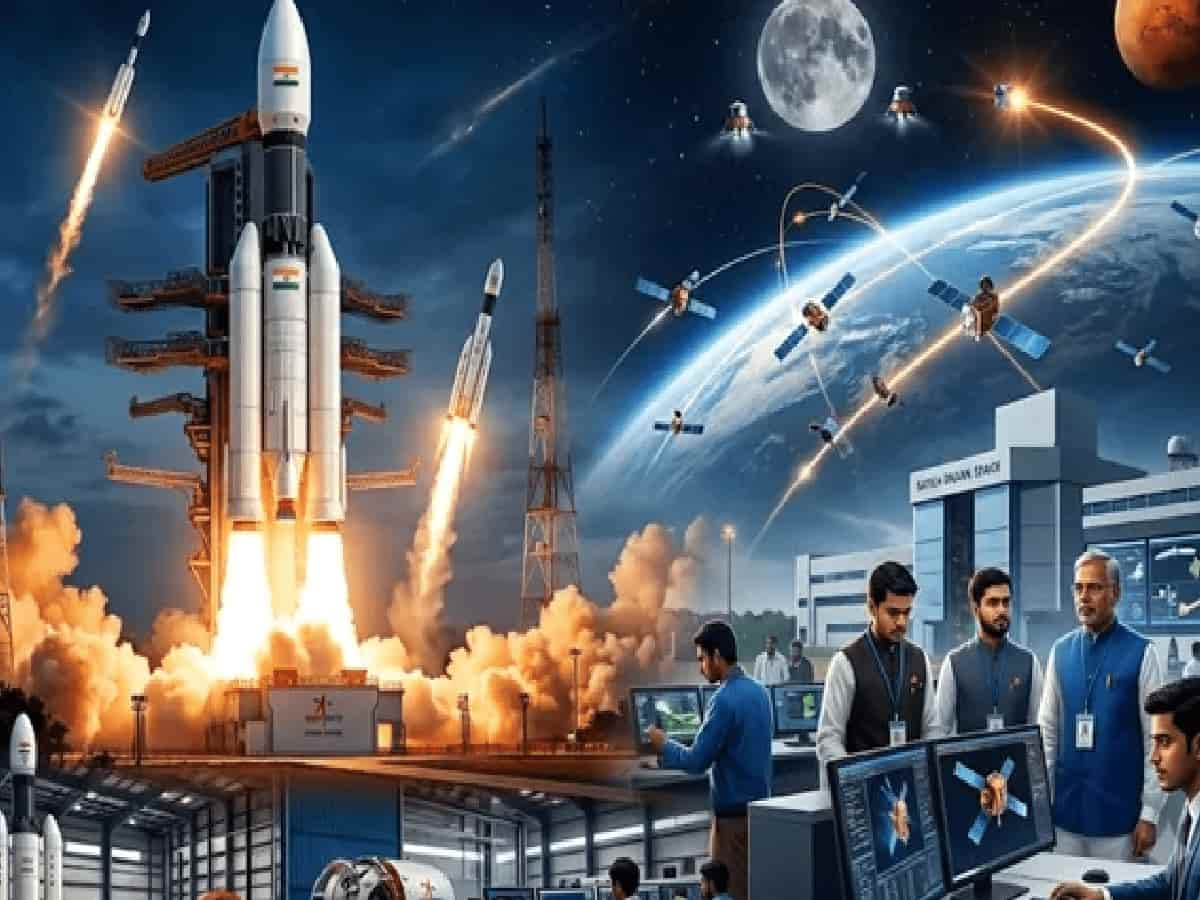
Beyond Launching Satellites: Where Does India Stand in Space Race
Space is no longer merely a peaceful canvas for pure scientific curiosity or occasional prestige missions; it has evolved into a strategic theater of national influence, geopolitical deterrence, and industrial scale. The global space architecture is accelerating into a high-stakes race, underscored by renewed American ambitions—reiterated by political leadership in Washington—to return humans to the lunar surface by 2028 and pave paths toward crewed Mars exploration. As the world watches superpowers marshal hundreds of billions into lunar orbital stations, deep-space communication nodes, and commercial megaconstellations, the fundamental question confronting policymakers in New Delhi is clear: where does India truly stand? For decades, the Indian Space Research Organisation (ISRO) earned global acclaim for its engineering thrift, delivering triumphs such as Chandrayaan-3 and Mars Orbiter Mission on shoestring budgets. Yet, in an era where global competitors launch rockets weekly and commercial players dictate launch economics, merely sending occasional satellites to low Earth orbit is no longer sufficient. India now stands at an inflection point where launch cadence, industrial self-reliance, and private enterprise will determine its long-term sovereignty above the atmosphere.
The Reality Check: ISRO's Launch Cadence and Recent Challenges
India’s space trajectory has historically relied on the proven reliability of workhorses like the Polar Satellite Launch Vehicle (PSLV) and the growing muscle of the Launch Vehicle Mark-3 (LVM3). However, the operational record of 2026 has brought pressing challenges into sharp relief. In the opening months of the year, India conducted three orbital launch attempts, securing two successful deployments while suffering one mission failure. While a single launch anomaly does not diminish decades of painstaking institutional brilliance, it serves as a wake-up call in an unforgiving commercial landscape.
Global space operations have shifted from isolated triumphs to high-frequency, factory-like rhythms. When launch opportunities are separated by months, any single setback creates long backlog queues, delays crucial Earth-observation and defense satellite constellations, and pushes prospective commercial customers toward overseas alternatives. Reliability in modern aerospace is not defined solely by an impeccable historical success rate; it demands launch velocity—the ability to turn around launchpads rapidly, build modular launch vehicles in series, and offer guaranteed payload slots on demand. For India, maintaining sovereign access to orbit means scaling up flight frequency to ensure national strategic assets never face launch bottlenecks.
The Paradigm Shift: From Pure Science to a Capital-Driven Industry
The fundamental economics of global spaceflight have undergone a profound structural transformation. Space is no longer governed by the Cold War model of government bureaus funding expendable rockets that splash down into the ocean after a single flight. The current era belongs to reusable rocketry, high-volume commercial rideshares, and mass-manufactured satellite mega-swarms.
The scale of this shift is visible in the metrics:
-
The Reusability Dividend: Commercial pioneers, led by SpaceX’s Falcon 9, have flown and landed orbital-class boosters hundreds of times, slashing orbital payload delivery costs from historical highs of over $18,000 per kilogram down to approximately $2,700 per kilogram.
-
Launch Dominance: The United States accounted for over half of all global orbital launches heading into 2026, driven predominantly by commercial private cadence.
-
China's Counter-Offensive: China has moved swiftly to validate its own reusable launch architectures, deploying sea-based net captures and landing boosters to narrow the cost gap.
If a nation lacks affordable, rapid domestic launch capabilities, its communication networks, surveillance infrastructure, and commercial satellite operators end up reliant on foreign launchers. India must accelerate its reusable launch vehicle programs, including the Next Generation Launch Vehicle (NGLV) and autonomous runway landing demonstrators, to ensure launch costs do not become an economic disadvantage.
Beyond ISRO: Why India’s Private Space Sector Must Lead the Charge
An inescapable reality of modern aerospace is that a single state agency, no matter how capable or dedicated its scientists, cannot carry the burden of an entire national space economy. ISRO’s institutional mission must increasingly pivot toward frontier scientific exploration, deep-space planetary research, and strategic defense technology, while commercial launch operations and satellite manufacturing migrate toward private industry.
Government reforms spearheaded by the Indian National Space Promotion and Authorisation Centre (IN-SPACe) have created an environment for private participation:
-
Domestic Rocket Builders: Startups like Skyroot Aerospace—which made history with its suborbital demonstrator and prepared the orbital Vikram-1 rocket—alongside Agnikul Cosmos, which validated 3D-printed semi-cryogenic engine architectures, have proven that homegrown private hardware can reach space.
-
Downstream Constellations: Earth-observation pioneers like Pixxel and satellite platform developers like Dhruva Space are building sovereign optical and communications capabilities, creating domestic demand for routine launches.
-
Infrastructure Sharing: Opening Sriharikota’s launchpads and testing facilities to non-governmental entities has lowered entry barriers, but private players must now transition from experimental prototypes to operational, revenue-generating orbital services.
Private space firms cannot remain sub-contractors handling outsourced components; they must evolve into prime contractors capable of bidding on global launch tenders and delivering commercial constellations.
Strategic Roadmap: What India Must Do to Win the New Race
Winning a seat at the high table of the new space age will not be achieved through bold political rhetoric or isolated records, but through systematic industrial execution. India does not need to duplicate every aspect of the American or Chinese models, nor does it need to mandate that every transistor be indigenously fabricated from day one. Instead, it must decisively secure the technological capabilities that cannot be compromised.
First, India must fast-track the operational deployment of heavy-lift and reusable launch platforms. Second, the domestic supply chain must be industrialized, encouraging private aerospace consortia to mass-produce rockets and satellites in dedicated manufacturing parks rather than relying on boutique laboratory assembly. Finally, access to venture capital and long-term defense procurement contracts must be expanded, providing young aerospace companies with the predictable domestic order books necessary to achieve scale. Science and engineering have proven that India can touch the Moon and reach interplanetary orbits; the challenge now is to build an industrial engine that makes reaching and staying in space a routine, commercially viable, and permanent national asset.




