







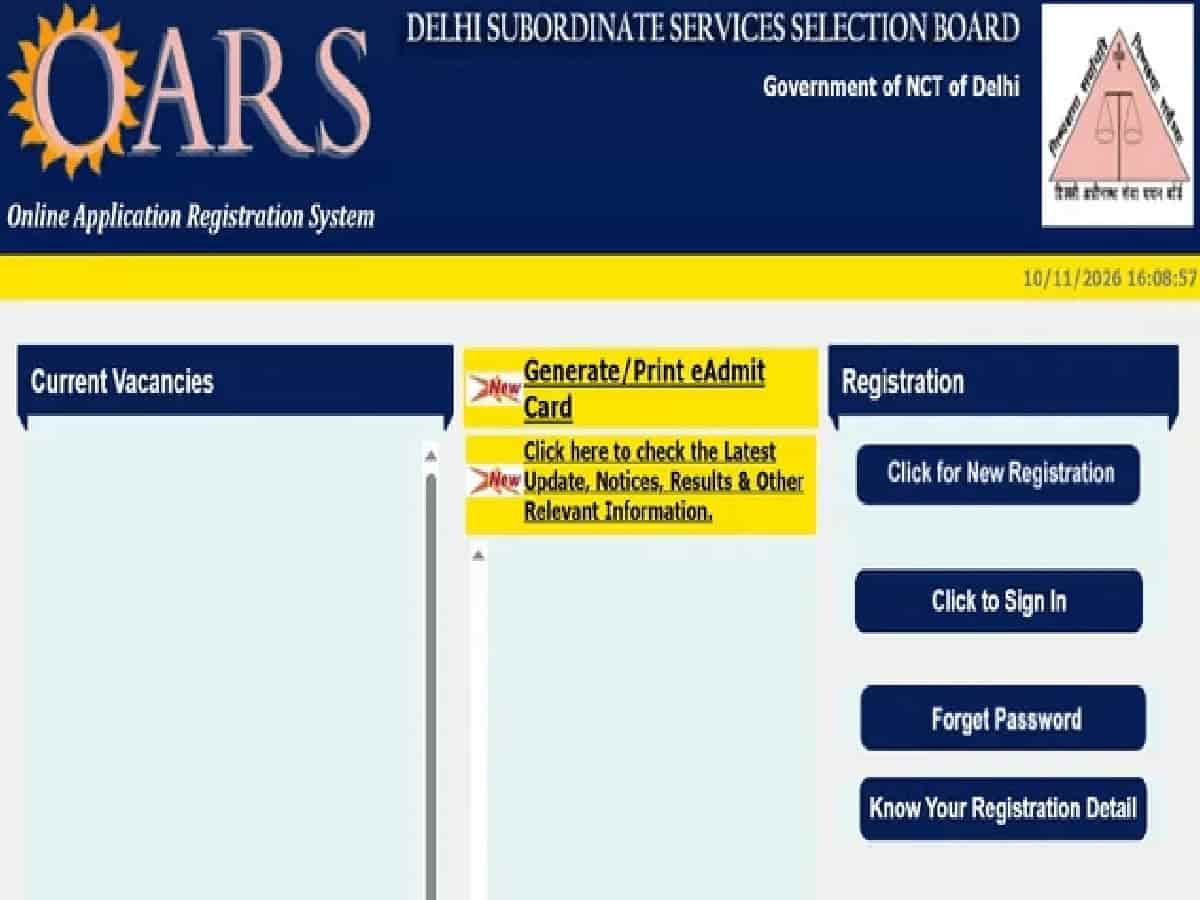
DSSSB Recruitment 2026: Apply Today for Delhi Court Posts
Job seekers across the National Capital Region targeting secure government positions have only hours left to act, as the Delhi Subordinate Services Selection Board (DSSSB) officially concludes its online application window today, Wednesday, November 11, 2026. The recruitment drive is aimed at filling crucial Group C support staff positions, specifically for the roles of Chowkidar (Watchman) and Safai Karamchari (Sweeper), within the establishment of the District and Sessions Courts of Delhi. Candidates holding a basic secondary education certificate (10th/Matriculation) who have not yet submitted their digital dossiers are advised to complete their filings immediately via the dedicated board portal at dsssbonline.nic.in before the midnight closure.
Administrative authorities at the board confirmed that the web portal will automatically deactivate the online registration interface once the deadline passes tonight, leaving no provision for offline paper submissions or delayed physical applications. The recruitment effort represents an important employment avenue for matriculate youth seeking long-term public sector stability, standard statutory retirement benefits, and structured promotion ladders within the judicial administration system of the capital city. Given the expected server load during the closing hours, technical officers have urged candidates to complete their registration forms, document uploads, and fee payments well before the final evening cutoff.
Essential Eligibility: Academic Criteria and Age Requirements Outlined
The baseline qualification framework established by the District and Sessions Court administration ensures broad accessibility for grassroots applicants. Prospective candidates must have successfully passed their Class 10 (Matriculation) examination or its recognized equivalent from an accredited state or central secondary education board. No advanced technical trade certification or prior administrative experience is mandated for these specific support staff posts, making it one of the most accessible public recruitment drives conducted by the Delhi municipal and judicial testing apparatus this year.
In terms of age limits, the recruiting body has laid down a clear eligibility window. As of the cutoff date of June 1, 2026, an applicant must have attained a minimum age of 18 years and must not exceed the upper age ceiling of 27 years. To uphold social equity and affirmative action directives, statutory age concessions are provided in accordance with official government guidelines. Candidates belonging to Other Backward Classes (OBC) of Delhi are eligible for an upper age relaxation of 3 years, while applicants from Scheduled Caste (SC) and Scheduled Tribe (ST) communities receive an upper age extension of 5 years. Persons with Benchmark Disabilities (PwBD) qualify for an age relaxation of up to 10 years, with additional cumulative exemptions available for qualifying ex-servicemen and departmental court employees.
Two-Stage Selection Mechanism: Written Examination and Oral Interview
The selection pipeline for these judicial positions is designed to evaluate both basic cognitive aptitude and practical suitability through a transparent, two-stage assessment model. The preliminary evaluation consists of an objective multiple-choice written examination, administered either through an optical mark recognition (OMR) format or a computer-based test (CBT) across test centers situated in Delhi-NCR. The written syllabus focuses on fundamental general awareness, basic quantitative arithmetic, reasoning ability, and elementary language comprehension in Hindi and English, calibrated to a 10th-standard educational benchmark.
Candidates who clear the written test by securing scores above the prescribed minimum qualifying cutoff will be shortlisted for the subsequent stage: an official oral interview and personality assessment conducted by the court selection board. The interview round is designed to evaluate character suitability, communicative competence, and reliability required for operational roles within court premises. Following the interview round, a consolidated final merit roster will be drafted, after which provisionally selected candidates will undergo standard physical document verification, biometric clearance, and mandatory medical fitness examinations at designated government hospitals in Delhi before receiving appointment letters.
Remuneration Profile, Pay Structure, and Career Prospects in Delhi Courts
Candidates successfully selected for these Group C positions will be inducted into a structured government pay matrix. The compensation package corresponds to the revised Pay Band PB-1 of ₹5,200 to ₹20,200, carrying a Grade Pay of ₹2,000 (corresponding to Level 3 under the 7th Central Pay Commission recommendations). Along with basic pay, appointed personnel are entitled to regular central government allowances applicable to staff working within the National Capital Territory of Delhi.
These financial entitlements include Dearness Allowance (DA) indexed to inflation, House Rent Allowance (HRA) calculated at premier metro rates, City Compensatory Allowance, and Transport Allowance (TA). Furthermore, employees receive comprehensive coverage under the central healthcare schemes, pension provisions under the applicable national pension framework, uniform allowances, and periodic performance-linked increments. Beyond the immediate financial compensation, serving within the District and Sessions Courts provides employees with a professional environment, workplace stability, and access to internal departmental promotions over time.
Step-by-Step Online Guide to Complete DSSSB Registration Before Midnight
To avoid technical errors or incomplete registrations during the final hours of the portal, candidates should carefully follow this systematic online application protocol:
-
Access the Official Portal: Open a secure web browser and navigate directly to the DSSSB online application website at dsssbonline.nic.in.
-
Complete New Registration: If applying for the first time, click on the "Click for New Registration" link. Provide primary details including date of birth, Class 10 roll number, year of passing, candidate's name, active mobile number, and valid email ID. The portal will generate a permanent user identification and login key.
-
Log In to Dashboard: Return to the home screen, enter the generated credentials, and access the active candidate dashboard. Select the specific notification for Chowkidar and Safai Karamchari positions in the District and Sessions Courts.
-
Enter Personal and Academic Details: Fill out the detailed online form with residential addresses, category status, parentage, and accurate marks scored in the 10th-grade examinations.
-
Upload Digital Documents: Upload clear scanned copies of a recent passport-sized color photograph, candidate signature, and left thumb impression in accordance with the specified pixel dimensions and file size limits (JPG/JPEG format).
-
Remit Application Fee: Male applicants falling under General, OBC, and Economically Weaker Section (EWS) classifications must pay a non-refundable application fee of ₹100 using integrated online banking facilities, UPI, debit cards, or credit cards. In alignment with administrative inclusion mandates, all female candidates, as well as applicants belonging to SC, ST, and PwBD classifications, are completely exempt from paying any fee.
-
Verify and Print Application: Conduct a final review of all filled details to correct typographical mistakes, click the final submit button, and immediately download and print multiple copies of the generated confirmation slip and filled application form for use during subsequent examination phases.




