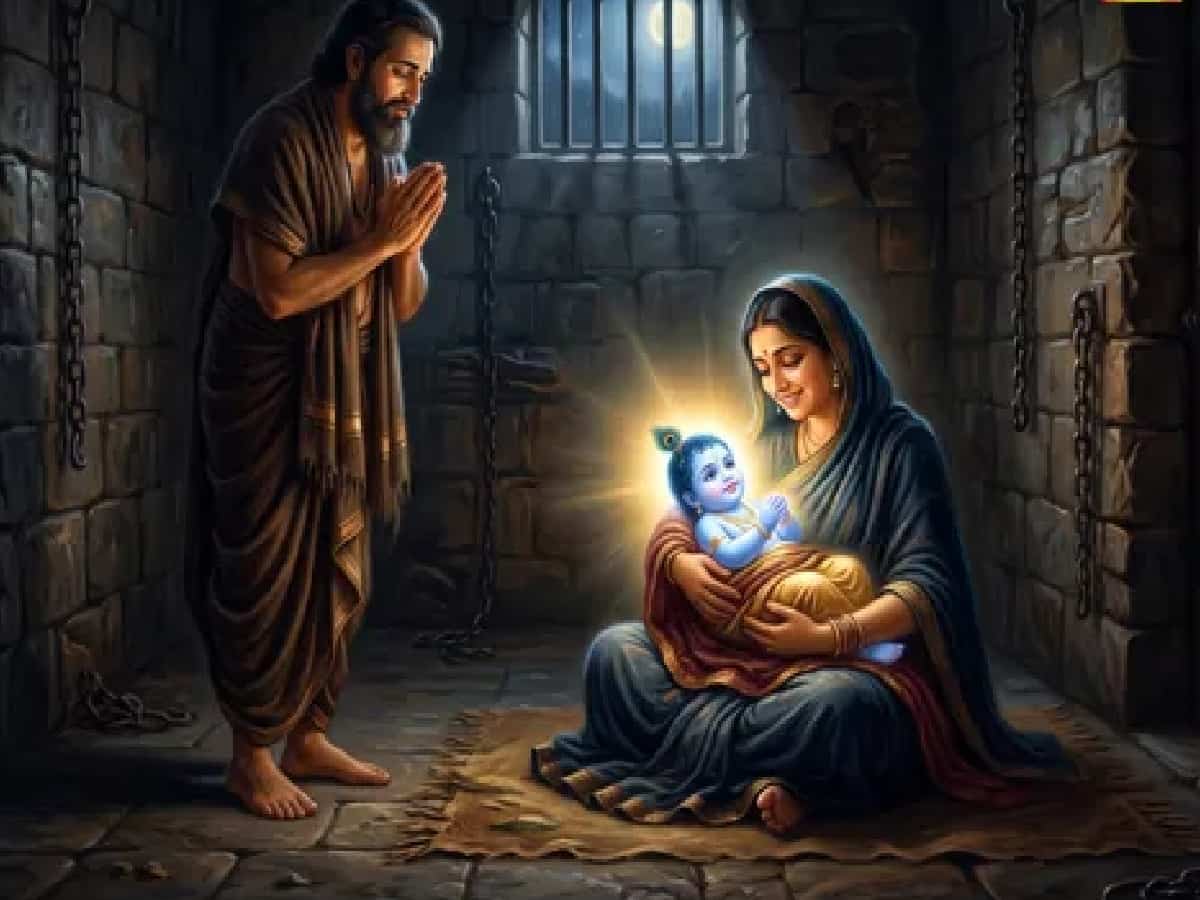
Divine Timing of the Divine: Why Lord Krishna Chose Midnight for His Birth on Janmashtami
As nationwide preparations peak for the celebration of Krishna Janmashtami on September 4, 2026, millions of devotees eagerly await the stroke of midnight to welcome the birth of Lord Krishna. While the festival is marked by vibrant festivities, fasting, and temple prayers, a profound question often arises: given that Lord Krishna is the supreme incarnation of Lord Vishnu, why did he specifically choose the dead of night—precisely 12:00 AM—to descend to Earth? According to sacred texts like the tenth canto of the Srimad Bhagavata Purana, this divine timing carries deep symbolic, spiritual, and historical significance that transcends a simple chronological account.
Dispelling the Darkness of Ignorance and Tyranny
Lord Krishna was born into the pitch-black darkness of midnight when Mathura was choking under the brutal tyranny and unrighteousness of King Kansa. The physical darkness enveloping the city mirrored the spiritual darkness of ignorance, fear, and oppression gripping society. By choosing midnight for his advent, the Lord delivered a timeless metaphysical message: when the darkness of negativity and adharma reaches its peak in human lives or the world, divine light inevitably emerges to show humanity the path of hope, truth, and liberation.
Escaping Kansa’s Clutches and Executing the Secret Journey
According to legendary accounts, Devaki and Vasudeva were locked deep inside Kansa's prison because a prophecy warned that their eighth child would cause the tyrant's downfall. To bypass the heavy security and ensure the survival of his divine incarnation, Krishna chose the quietest hour of midnight when the guards and King Kansa fell into a supernatural deep slumber.
Following his birth, Vasudeva had to execute the perilous, secret mission of carrying the infant across the turbulent Yamuna River to Gokul, handing him over to Nanda Baba and Yashoda. The stillness and isolation of the midnight hour provided the necessary cover for this miraculous nocturnal journey that altered the course of history.
The Spiritual Significance of the Nishita Kaal
In the traditional Hindu calendar, the sacred window around midnight is revered as the Nishita Kaal. Vedic and spiritual traditions consider this specific period to be uniquely potent for profound meditation, introspection, and spiritual awakening, free from the distractions of the daytime world. Celebrating Krishna’s birth during the Nishita Kaal aligns the devotee's consciousness with inner stillness, marked by the blowing of conch shells, ringing of temple bells, and joyous hymns echoing through the night.
The Ultimate Triumph of Dharma Over Adharma
The midnight birth of Shri Krishna serves as much more than an ancient narrative event; it stands as an eternal spiritual reassurance. The Lord's descent into a prison cell at midnight symbolizes that divine grace can penetrate the darkest, most confining circumstances of human existence. Ultimately, the timing reminds humanity that no matter how deep or oppressive the darkness of trials may seem, the dawn of righteousness and the victory of dharma are always certain.