







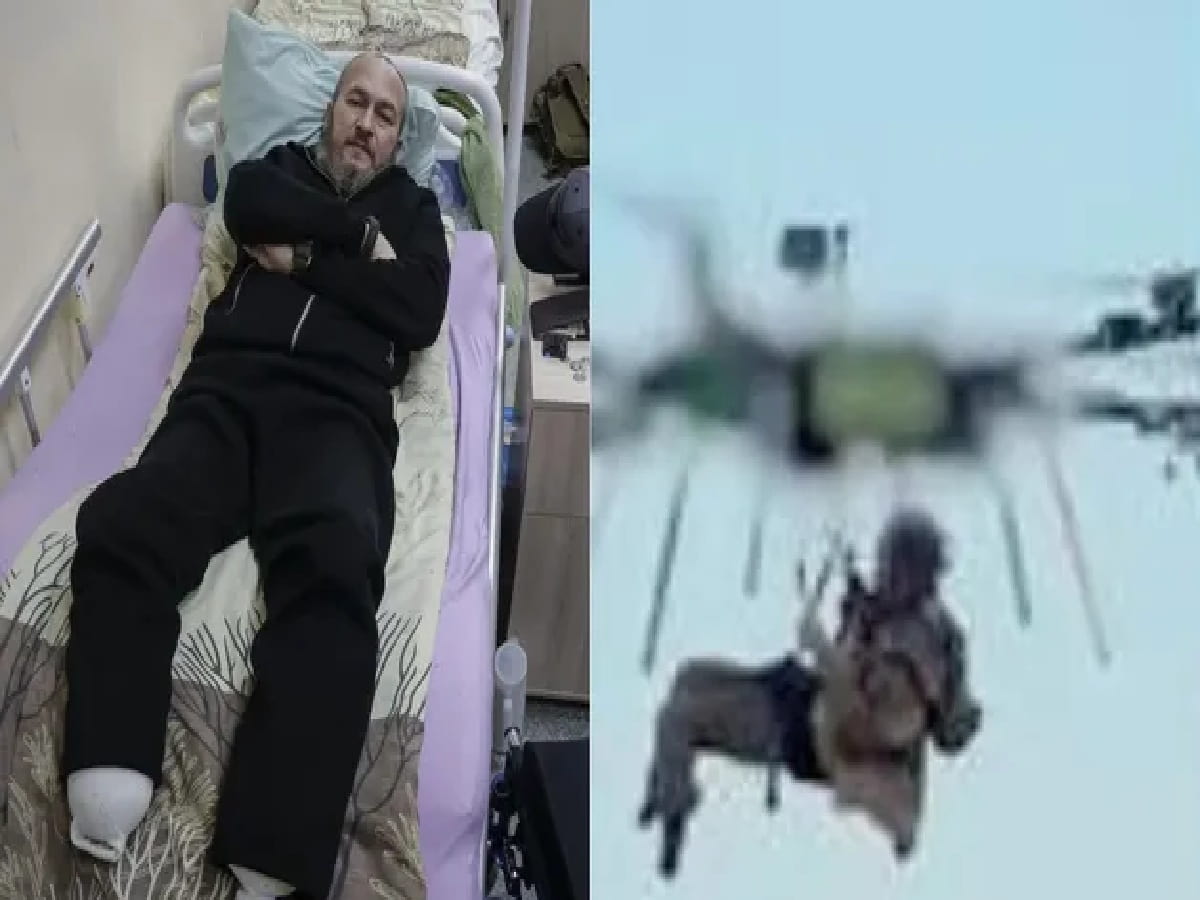
Wounded Ukrainian Soldier Who Cut Off Own Leg Rescued After 8-Month Ordeal
In what military historians and defense commanders are describing as the world's first recorded drone-assisted battlefield casualty evacuation, a 49-year-old Ukrainian soldier trapped behind enemy lines for nearly eight months was safely airlifted to friendly territory using an unmanned heavy-lift hexacopter. The serviceman, identified as Kostiantyn Vlasenko, had been stranded inside the desolate boiler room of a bombed-out school after enduring a harrowing 491-day frontline deployment. Severely wounded during a direct Russian drone strike that shattered his lower limb, Vlasenko performed an emergency self-amputation using a field knife to prevent fatal gangrene. His miraculous extraction on October 4 ended an agonizing cycle of isolation, concluding a high-risk mission that transported him 15 kilometers across active hostile airspace while suspended from a specialized safety harness 70 meters above the ground.
Solitary Ordeal in a Ruined Boiler Room: A Pocketknife and the Will to Live
Vlasenko's prolonged survival saga began in May of the previous year when he was deployed to an isolated frontline bunker alongside a fellow soldier named Baski. The two men operated under continuous aerial surveillance, relying entirely on periodic drone drops for food, water, and ammunition as Russian forces tightened their perimeter. The severity of the combat zone proved fatal for relief operations; two replacement squads dispatched to relieve them were intercepted and killed in transit, followed by the deaths of two additional recovery personnel sent to retrieve their bodies. When winter floods inundated their underground bunker in February, the duo relocated to a crumbling nearby schoolhouse, only for a Russian attack drone to hit their hideout shortly thereafter. The strike killed Baski on the spot and left Vlasenko pinned under debris with an exposed, compound fracture. Facing rapid infection and realizing no medical teams could reach him, Vlasenko took refuge underneath an industrial boiler and used his knife to sever the mangled limb, tightly bandaging the stump to halt arterial hemorrhaging in total isolation.
Why Ground Missions Failed: The Gurzuf Defense Heavy-Lift Solution
Traditional rescue doctrines proved impossible to execute as Russian reconnaissance and FPV (first-person-view) suicide drones maintained continuous aerial dominance over the sector, promptly destroying every armored vehicle, pickup truck, and robotic ground vehicle dispatched by the Ukrainian command. With conventional ground corridors closed, mission planners turned to an experimental aerial solution: a six-rotor heavy-lift multicopter engineered by domestic defense manufacturer Gurzuf Defense. Designed to transport payloads up to 90 kilograms across a 25-kilometer operational radius, the platform offered the only viable lifeline, particularly as months of severe food rationing had reduced Vlasenko’s body weight to approximately 70 kilograms. To prepare for the extraction, an auxiliary drone dropped a tactical harness, safety tethers, and an encrypted smartphone loaded with a video tutorial demonstrating how to fasten the carabiners securely around his torso.
70 Meters Above Active Fire: Decoy Swarms, Artillery Barrage, and a 15-Minute Flight
The extraction was executed on the morning of October 4 under extraordinary tactical shielding. As the Gurzuf heavy-lift drone descended over the roofless school ruins, Vlasenko locked his harness to the underbelly cargo hook, and the aircraft hauled him 70 meters into the sky. To prevent Russian air defense and counter-drone units from locking onto the hexacopter, the Ukrainian military deployed three smaller companion drones to create electronic diversionary signatures while artillery batteries and combat UAVs unleashed a continuous two-hour bombardment against hostile frontline positions. During the tense 15-minute aerial journey covering 15 kilometers, Vlasenko admitted his primary fear was not the dizzying altitude over the tree canopy, but traversing waterways, noting that his physical disability left him unable to swim if dropped. The success of this landmark operation signals a radical transformation in combat search and rescue (CSAR) doctrines, demonstrating that heavy autonomous drones are evolving beyond offensive strike roles to become frontline life-saving instruments under contested skies.




