







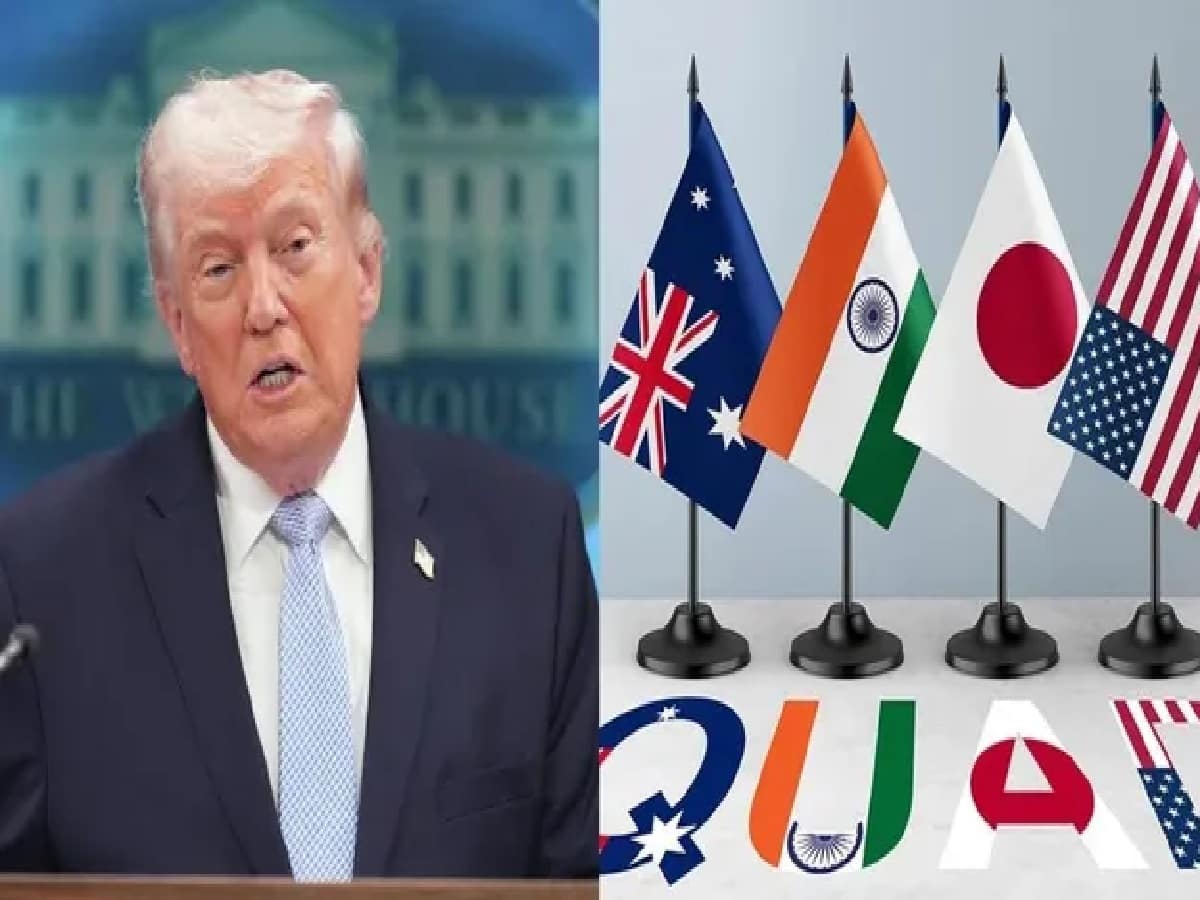
US Rejects Claims Quad Has Weakened Under Trump Ahead of Manila Summit
Washington has pushed back sharply against reports suggesting that the Quadrilateral Security Dialogue (Quad)—the strategic Indo-Pacific partnership uniting India, the United States, Japan, and Australia—has lost momentum under President Donald Trump's administration. Speaking just ahead of a much-anticipated gathering of Quad leaders in Manila, Philippines, on Tuesday, November 17, 2026, US Assistant Secretary of State Dylan Johnson dismissed a recent Politico report claiming the grouping was on "life support" as "completely fake news" and an "utterly ridiculous take." Pointing to sustained high-level diplomatic engagement, Johnson highlighted that US Secretary of State Marco Rubio made the Quad his very first official call upon assuming office, has formally met his Quad foreign minister counterparts five times—including three times in the past six months—and oversees monthly Quad Sherpa consultations. Meanwhile, the White House reaffirmed that under President Trump's leadership, the Quad has grown stronger as a "partnership of action" dedicated to peace, prosperity, and a free and open Indo-Pacific. For strategic analysts, diplomats, defense observers, and readers across New Delhi, Mumbai, Bengaluru, Chennai, Hyderabad, Kolkata, Pune, Ahmedabad, and Lucknow, the upcoming Manila summit—the first Quad leaders' meeting in two years—signals renewed top-level alignment across critical Indo-Pacific priorities.
Why Washington Slammed the Politico Report as 'Fake News'
The diplomatic rebuttal followed a November 14, 2026 Politico article quoting an unnamed Washington-based Asian diplomat who alleged that the Quad was faltering amid India–US trade frictions and President Trump's outreach toward Beijing. Assistant Secretary Dylan Johnson rejected that narrative point by point, emphasizing continuous ministerial and working-level coordination:
| Diplomatic & Strategic Metric | Verified Record Cited by US Officials | Significance for Indo-Pacific Cooperation |
| Quad Foreign Ministers' Meetings | 5 formal meetings under Secretary Marco Rubio (including 3 in the last 6 months) | Demonstrates uninterrupted ministerial alignment since January 2025 |
| First Official Outreach & Sherpa Track | Secretary Rubio's first official call in office was to Quad counterparts; monthly Sherpa calls continue | Keeps working groups active on maritime security, critical minerals, tech, and disaster relief |
| Manila Quad Leaders' Summit | Scheduled for Tuesday, November 17, 2026, on the sidelines of the ASEAN Summit | First Quad Leaders' Summit in two years (since September 2024 in Wilmington, Delaware) |
| Participating Quad Leaders | PM Narendra Modi (India), President Donald Trump (US), PM Anthony Albanese (Australia), and PM Sanae Takaichi (Japan) | Marks the first summit-level Quad gathering during Trump's second presidential term |
South China Sea Tensions and Agenda for the November 17 Manila Meeting
Upgraded to a summit-level forum in 2021, the Quad last convened at the leaders' level in September 2024 in Wilmington, Delaware. Although India was slated to host subsequent editions, scheduling complexities delayed a standalone summit—making Tuesday's gathering on the margins of the 49th ASEAN Summit in Manila particularly significant, even though it takes place in a non-Quad host nation.
In Manila, the four leaders are set to advance cooperation across maritime domain awareness and security, critical and emerging technologies, resilient supply chains, clean energy and climate resilience, public health, and regional infrastructure. Crucially, the meeting unfolds against heightened tensions between China and ASEAN chair the Philippines over overlapping territorial claims in the South China Sea. Reaffirming their commitment to a free, open, and rules-based Indo-Pacific anchored in the UN Charter, international law, sovereignty, and territorial integrity, the Quad leaders are expected to voice firm opposition to any unilateral attempt to alter the status quo in the East and South China Seas through force or coercion.
What the Manila Summit Means for India–US Ties and Regional Diplomacy
Beyond the four-nation plenary, diplomatic watchers are closely tracking whether Prime Minister Narendra Modi and President Donald Trump hold bilateral discussions on the sidelines in Manila—which would mark their first in-person interaction since the US midterm elections and come amid ongoing negotiations over a bilateral India–US trade agreement. Together, the Manila proceedings underscore that despite shifting global currents, the Quad remains a central pillar of Indo-Pacific stability.




