







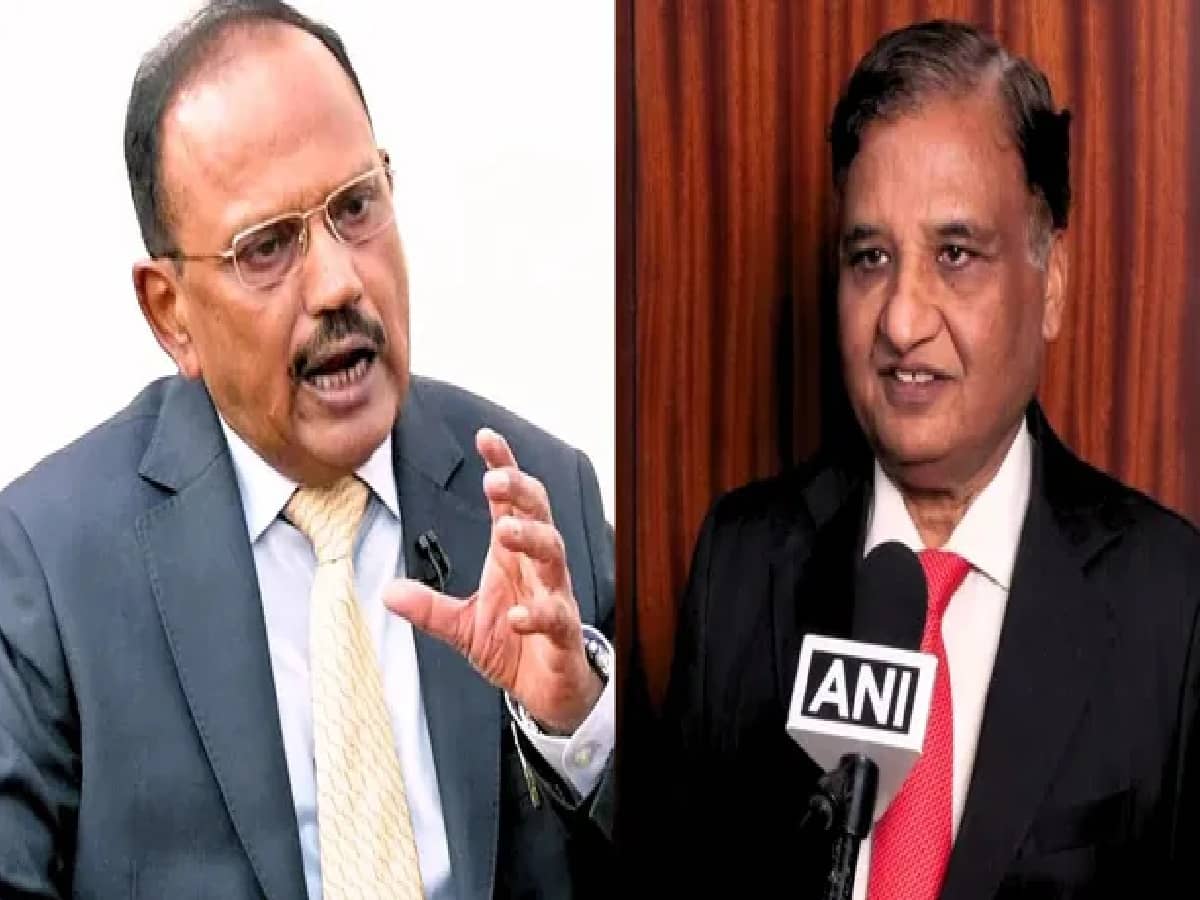
US Court Seeks Delhi Courts' Help to Summon Ajit Doval, Samant Goel
In a procedural development tied to a civil lawsuit pending in the United States, a federal court in New York has sought administrative cooperation from three district courts in Delhi to deliver legal summonses to India's National Security Advisor Ajit Doval and former Research and Analysis Wing (RAW) chief Samant Goel. Issued by US District Judge Katherine Polk Failla of the Southern District of New York, the order directs the US Court Clerk to transmit judicial documents via international mail or courier to Patiala House Courts, Dwarka Courts, and Tis Hazari Courts in New Delhi. The legal paperwork stems from a civil lawsuit initiated in September 2024 by Gurpatwant Singh Pannun, founder and legal counsel of the banned pro-Khalistan outfit Sikhs for Justice (SFJ), alleging an attempted murder-for-hire plot in New York in 2023. Crucially, legal analysts and diplomatic sources familiar with the matter have underscored that the US court's step is purely routine and procedural, carries no binding legal enforcement in India, and does not constitute any judicial finding on the merits of Pannun's allegations or sovereign immunity. Earlier, New Delhi had strongly rejected the lawsuit as "fabricated and malicious," with Ministry of External Affairs (MEA) spokesperson Randhir Jaiswal clarifying that judicial document requests in India can only be routed through India's designated central authority—the Union Ministry of Law and Justice. For diplomats, legal observers, and citizens across New Delhi, Lucknow, Chandigarh, Amritsar, Jalandhar, Mumbai, Bengaluru, and Washington, the development highlights the procedural mechanics and jurisdictional boundaries of cross-border civil litigation.
Inside the US District Court Order: Hague Convention Article 19 and Delhi Courts
To clarify why the New York federal court turned to an alternative service mechanism and what the order entails under international and Indian civil procedure, the table below summarizes the verified facts of the case:
| Case & Procedural Dimension | Verified Details & Timeline (November 2026) | Legal & Diplomatic Significance |
| Court & Presiding Judge | US District Court for the Southern District of New York; order issued by Judge Katherine Polk Failla (Nov 9 order, with proposed filing deadline of Nov 30). | Addresses purely the mechanics of serving foreign defendants in a private civil suit without ruling on allegations. |
| Designated Delhi District Courts | Court Clerk instructed to send judicial papers via international mail/courier to Patiala House, Dwarka, and Tis Hazari district courts in New Delhi. | Requests local court assistance to serve documents on NSA Ajit Doval and former RAW chief Samant Goel. |
| Why Alternative Service Was Invoked | An earlier attempt to serve the summonses through India's designated Central Authority under the Hague Convention was rejected. | Prompted the US judge to approve alternative delivery under Article 19 of the Hague Convention and India's Code of Civil Procedure (CPC). |
| Binding Effect & Prior Diplomatic Note | Legal experts confirm the summonses are not binding; earlier on Oct 9, the US State Department transmitted a separate diplomatic note for the Indian government to the Indian Embassy in Washington under the Foreign Sovereign Immunities Act, explicitly stating it took no position on the merits. | Mirrors a 2013 precedent when SFJ similarly attempted to serve a non-binding US civil summons on then-Prime Minister Manmohan Singh over 1984 anti-Sikh riots allegations. |
Why the Hague Convention Route Failed and India's Stance on Sovereignty
Under the 1965 Hague Convention on the Service Abroad of Judicial and Extrajudicial Documents in Civil or Commercial Matters, foreign courts typically route civil summonses through a signatory nation's designated Central Authority—in India's case, the Ministry of Law and Justice. However, after India's Central Authority declined the initial service request, Pannun's attorneys petitioned Judge Katherine Polk Failla to authorize an alternative channel under Article 19 of the Hague Convention, which allows transmission methods permitted under the domestic civil laws of the receiving country.
Responding earlier on November 10, MEA spokesperson Randhir Jaiswal firmly dismissed the civil litigation as a frivolous, fabricated, and malicious attack on senior Indian officials, reiterating that sovereign immunity and established statutory channels govern foreign judicial communications. Notably, the US government is not a party to Pannun's private civil damages lawsuit, which remains legally distinct from separate criminal proceedings in New York.
Historical Precedent: How Similar SFJ Summonses Played Out in the Past
Diplomatic historians note that attempting to use US civil courts to serve symbolic summonses on top Indian leaders is a well-worn tactic by Sikhs for Justice. In 2013, SFJ filed a comparable civil suit in New York targeting then-Prime Minister Manmohan Singh in connection with the 1984 anti-Sikh riots—a lawsuit that was ultimately dismissed on grounds of sovereign immunity. Similarly, legal experts emphasize that even if international courier packets arrive at Delhi's district courts, Indian courts are under no automatic compulsion to enforce foreign civil process against sitting or former national security officials protected by sovereign and functional immunity.




