







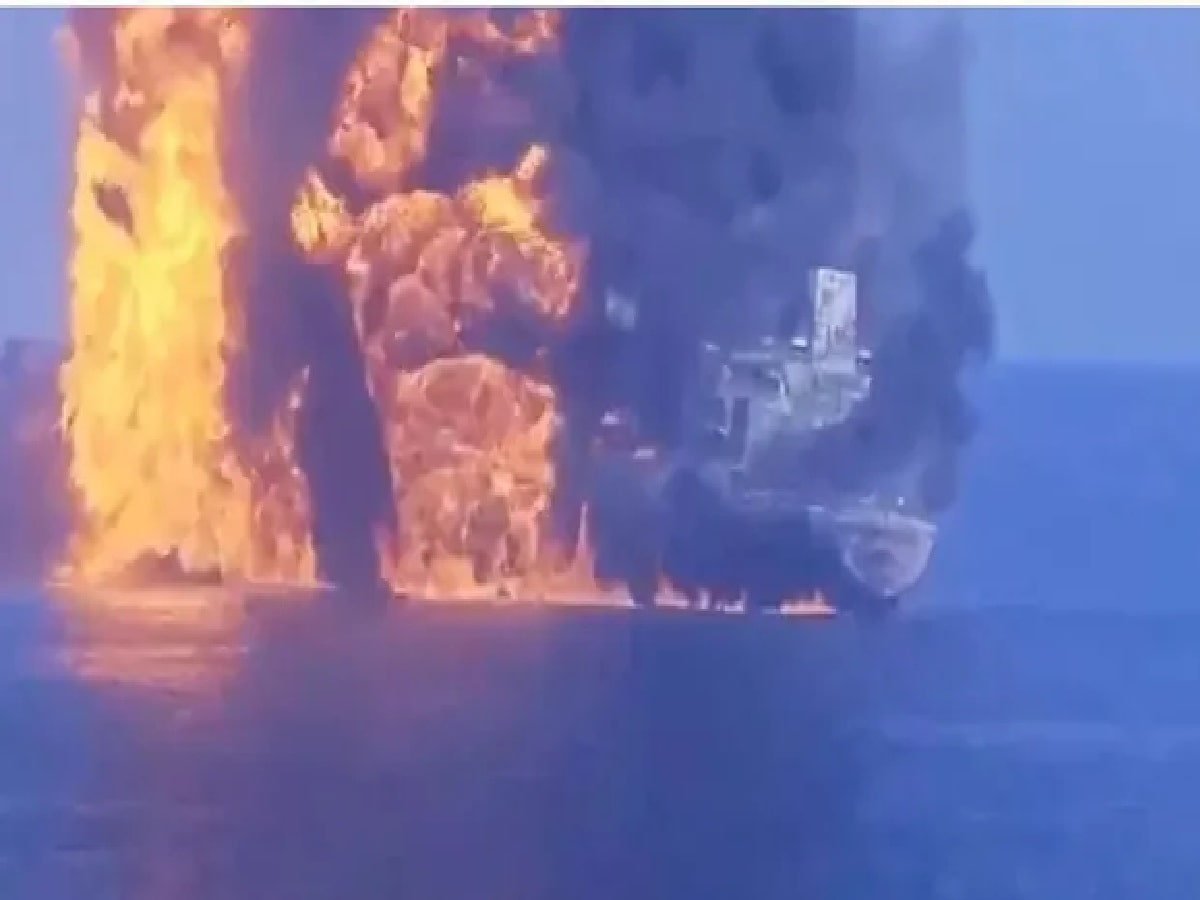
Three Oil Tankers Catch Fire in Hormuz After Hitting Mines: IRGC
Maritime security across one of the world's most vital energy chokepoints has deteriorated sharply after Iran's Islamic Revolutionary Guard Corps (IRGC) announced that three oil tankers erupted into flames after striking naval mines east of the Strait of Hormuz. According to official statements carried by Iran's state broadcaster IRIB and regional media outlets, the IRGC Navy alleged that the vessels ignored repeated warnings from Iranian naval forces, switched off their Automatic Identification System (AIS) navigation transponders, and sailed directly into restricted, unauthorized maritime corridors. One of the vessels reportedly exploded near the coastline of Ghanam Island, sending towering plumes of thick black smoke into the sky and illuminating the shoreline. Emphasizing that commercial vessels must coordinate strictly with Iranian maritime authorities before transiting the strategic waterway, Tehran warned shipping operators against relying on what it termed unauthorized or "illegal" US escort routes. The fiery maritime incidents unfold alongside direct military exchanges between Washington and Tehran: a United States military official confirmed that US fighter aircraft conducted precision strikes against an IRGC missile launch site on Iran's Qeshm Island in the Strait of Hormuz. Washington stated the operation was executed in self-defense after US Central Command (CENTCOM) intercepted multiple Iranian drones launched toward US radar installations at Isa Air Base in Bahrain. With at least five commercial ships reportedly damaged in recent days, shipping insurers, energy traders, and policymakers across New Delhi, Mumbai, Kochi, Visakhapatnam, Jamnagar, Lucknow, Tehran, Dubai, and Washington are closely monitoring the escalating crisis for potential disruptions to global crude oil supplies.
Escalation in the Strait of Hormuz: Key Incidents, Claims, and Military Responses
To present a clear, verified overview of the fast-moving maritime security incidents and retaliatory military actions in the Persian Gulf, the table below summarizes the key developments reported by Iranian and US authorities:
| Incident / Dimension | Verified Details & Official Claims (November 2026) | Strategic & Economic Significance |
| Three Oil Tankers Damaged in Hormuz | Iran's IRGC Navy stated that three oil tankers caught fire after striking naval mines east of the Strait of Hormuz (including an explosion near Ghanam Island). | Underscores acute physical hazards to commercial shipping in a narrow corridor through which roughly one-fifth of global petroleum passes. |
| Iran's Navigation & Transponder Allegations | Tehran alleged the vessels entered prohibited zones with navigation and tracking systems switched off despite Iranian naval warnings, blaming reliance on US maritime assurances. | Reinforces Iran's assertion of operational control over Strait transit rules while contesting US claims that the waterway remains freely navigable. |
| US Precision Strikes on Qeshm Island | US fighter jets struck an IRGC missile launch site on Qeshm Island using precision munitions in declared self-defense. | Demonstrates Washington's willingness to directly degrade coastal Iranian missile infrastructure threatening regional forces. |
| Bahrain Base Drone Attack & Aerial Clashes | Strikes followed IRGC drone launches targeting US radar systems at Isa Air Base in Bahrain (intercepted by CENTCOM without injuries), alongside Iranian claims of downing two US drones over the Strait. | Highlights a tit-for-tat cycle of aerial and naval confrontations across the Persian Gulf following stalled diplomatic talks. |
Contested Waters: Conflicting Narratives Between Tehran and Washington
The latest tanker explosions occur amid an intense war of narratives over freedom of navigation in the Persian Gulf. While the IRGC Navy insists that vessels following unauthorized southern corridors risk encountering floating or moored naval mines, US Central Command (CENTCOM) has previously disputed Tehran's claims of widespread mining, maintaining that US forces actively monitor and clear underwater explosives to keep international shipping lanes open. At the same time, maritime advisories have cautioned ship captains to refresh traditional celestial and visual navigation skills due to heightened satellite GPS jamming across the region.
Why the Strait of Hormuz Crisis Matters for India and Global Energy Markets
For major energy-importing nations like India—which sources a substantial share of its crude oil and liquefied natural gas (LNG) shipments through the Persian Gulf—any sustained spike in marine insurance premiums, vessel rerouting, or tanker attacks in the Strait of Hormuz carries immediate economic consequences. As retaliatory strikes between US forces and Iranian coastal units raise the specter of broader regional disruption, global markets remain on edge watching whether diplomatic backchannels can halt further escalation before commercial maritime traffic faces a prolonged blockade.




