







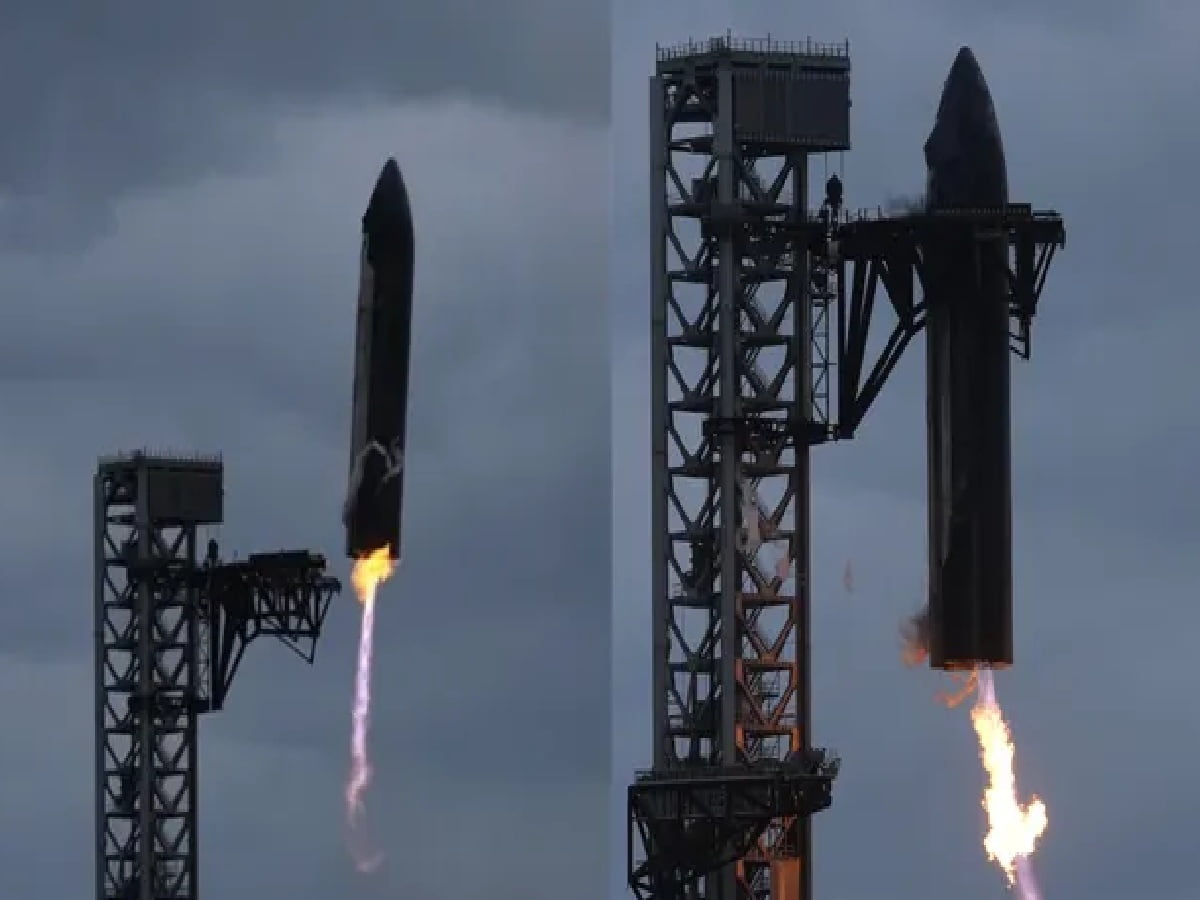
SpaceX Creates History: Catches Starship Mid-Air Returning From Orbit
SpaceX has shattered one of rocketry's toughest engineering barriers by catching its massive Starship upper-stage spacecraft mid-air as it returned from Earth orbit, bringing human spaceflight dramatically closer to full and rapid rocket reusability. On Saturday, November 14, 2026, roughly 22.5 hours after blasting off from Starbase in Boca Chica, South Texas, the towering Ship 42 upper stage descended through cloudy coastal skies, reignited its Raptor engines to hover vertically, and settled smoothly between the twin mechanical "chopstick" arms—known as "Mechazilla"—mounted on Orbital Launch Pad 2. While Elon Musk's aerospace company has spent the past decade routinely landing Falcon 9 first-stage boosters—and had previously caught Super Heavy boosters three times—every orbital rocket's upper stage in history had either burned up upon reentry or been discarded into the ocean. Capturing an orbital spacecraft directly back on its launch tower marks what SpaceX Communications Manager Dan Huot called "the missing link, the holy grail of spaceflight". For space enthusiasts, aerospace engineers, students, and science readers across New Delhi, Bengaluru, Hyderabad, Chennai, Mumbai, Pune, Kolkata, Ahmedabad, and Lucknow, the Flight 15 breakthrough signals a transformative leap for deep-space exploration, satellite constellations, and low-cost access to orbit.
How Ship 42 Survived Reentry and Landed in Mechazilla's Arms
Standing roughly 170 feet (52 meters) tall—part of the full 124-meter (407-foot) Starship-Super Heavy megarocket, the largest and most powerful launch vehicle ever constructed—Ship 42 spent 22 hours and 32 minutes circling the Earth 14 times at an altitude of roughly 260 to 276 kilometers and speeds exceeding 27,359 km/h (about 17,000 mph).
| Starship Flight 15 Mission Parameter | Verified Flight & Engineering Data | Mission Significance |
| Launch & Landing Timeline | Launched Nov 13, 2026 (4:47 PM CST); upper stage caught Nov 14, 2026 (3:20 PM CST / 4:20 PM EST) | Completed ~22.5-hour orbital flight and 14 Earth orbits at ~260–276 km altitude |
| Starship Upper Stage (Ship 42) | Caught mid-air by Mechazilla mechanical arms at Orbital Launch Pad 2, Starbase, Texas | First-ever orbital upper-stage tower catch in spaceflight history; heat shield performed well |
| Payload Deployment | Successfully deployed 26 next-generation Starlink V3 satellites in low-Earth orbit | Proved dual operational payload delivery alongside experimental full-reuse recovery |
| Super Heavy Booster (Booster 22) | Aborted tower catch ~6.5 minutes after liftoff due to low propellant/GNC alarm; diverted offshore to Gulf of Mexico | Autonomous safety systems protected launch pad; SpaceX investigating engine/propellant anomaly |
After firing its engines for a precision deorbit burn, the stainless-steel spacecraft endured scorching atmospheric friction across its upgraded thermal-protection heat shield while using four aerodynamic body flaps to steer toward South Texas. Moments above the launch mount, Ship 42 flipped upright, decelerated with a final Raptor engine burn, and latched onto Mechazilla's arms via two structural catch pins.
Why Super Heavy Booster 22 Aborted Its Catch Attempt
Although Flight 15—the 15th integrated Starship test flight—had aimed for an unprecedented double catch of both rocket stages, the lower Super Heavy booster (Booster 22) encountered a technical issue shortly after stage separation. According to SpaceX engineers, early telemetry indicated an engine dropout and a low propellant mass alarm that prompted the booster's guidance, navigation, and control (GNC) system to automatically abort its return to the tower, divert safely over the Gulf of Mexico, and activate its flight termination system.
Even with the booster loss, Ship 42 accomplished every orbital objective, including deploying 26 next-generation Starlink V3 satellites during its 14-orbit journey before returning intact.
Crucial Step for NASA's Artemis Moon Landings and Mars Ambitions
The milestone carries major implications for NASA's Artemis lunar programme, which relies on a human-rated Starship variant to land astronauts on the Moon—a mission architecture that will also require mastering orbital propellant transfer between tanker Starships in space. Congratulating SpaceX on X, NASA Administrator Jared Isaacman called the catch "almost magic" and remarked that the company is "making more believers by the day," while Google CEO Sundar Pichai also hailed the achievement. With Elon Musk signaling plans to attempt a full double catch on the next flight and expand Starship launch operations to Florida's Kennedy Space Center in the coming months, reusable deep-space transportation is rapidly moving from theory to reality.




