







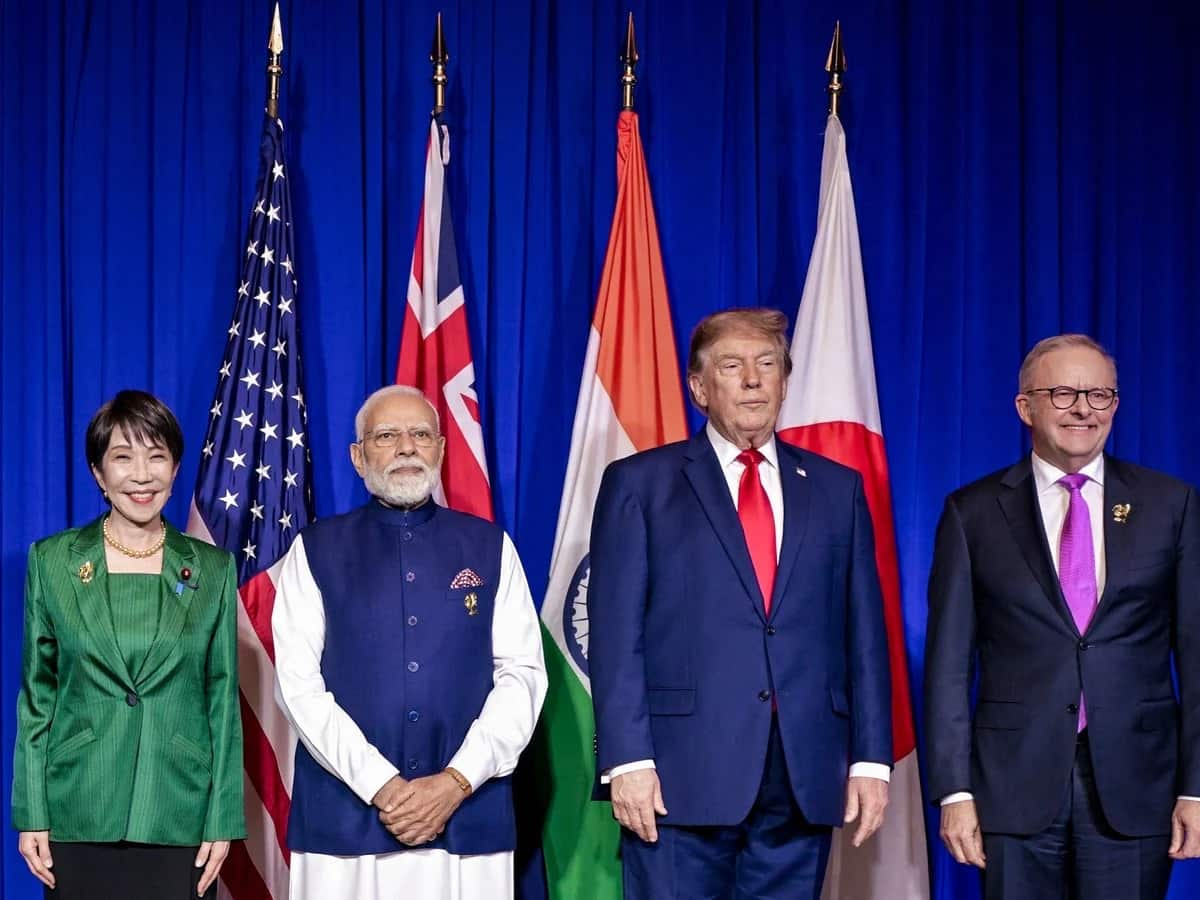
Quad Manila Summit Reaffirms Indo-Pacific Unity, Deals Blow to China
Speculation that shifting geopolitical equations between Washington and Beijing had sidelined the Quadrilateral Security Dialogue was decisively put to rest on Tuesday, November 17, 2026, as Prime Minister Narendra Modi, U.S. President Donald Trump, Japanese Prime Minister Sanae Takaichi, and Australian Prime Minister Anthony Albanese convened in Manila, the Philippines, for the first leader-level Quad Summit in more than two years. Held symbolically in the very city where the Quad was originally conceptualized in 2007—and amid heightened maritime friction between Beijing and host nation the Philippines—the summit occurred just ahead of President Trump's scheduled visit to China for talks with Chinese President Xi Jinping and Russian President Vladimir Putin. Far from signaling a retreat, the joint declaration issued by all four democracies reaffirmed an unwavering commitment to a free, open, inclusive, and rules-based Indo-Pacific, strongly opposing "destabilising or unilateral actions that seek to change the status quo, including by force or coercion" while voicing grave concern over economic coercion and arbitrary export restrictions. Although Beijing was not named explicitly, the message was unmistakable: sustained Indian diplomatic engagement—building on the Quad Foreign Ministers' meetings—has revitalized the grouping as a "partnership of action". Prime Minister Modi underscored that India views the Quad as "a partner in progress, a friend in crisis, and a source of confidence for the future", unveiling concrete deliverables spanning private-sector trade, artificial intelligence, aerial maritime patrol drills, and undersea cable resilience. For strategic analysts, civil services aspirants, business leaders, and readers across New Delhi, Mumbai, Lucknow, Kanpur, Varanasi, Prayagraj, Bengaluru, Hyderabad, Chennai, and Kolkata, the Manila summit demonstrates India's pivotal diplomatic role in anchoring Indo-Pacific stability.
Four Landmark Quad Initiatives Announced at the Manila Leaders' Summit
Moving well beyond symbolic declarations, the four Quad leaders rolled out concrete operational frameworks designed to secure supply chains, digital infrastructure, and sea lanes across the Indo-Pacific:
| Quad Initiative (Manila Summit, Nov 17, 2026) | Key Participating Entities & Timeline | Core Strategic & Economic Objectives |
| 1. Inaugural Quad Business Leaders' Forum (Mumbai) | Hosted by India in Mumbai in early 2027 (announced by PM Narendra Modi) | Brings together business leaders, government officials, and policy experts from India, the US, Japan, and Australia to forge commercial deals and resilient private-sector partnerships. |
| 2. Quad AI Accelerator Initiative | Endorsed by Quad leaders following Foreign Ministers' launch in Atlanta | Coordinates and funds efforts supporting trusted Artificial Intelligence (AI) access, deployment, and technical assistance across Indo-Pacific nations. |
| 3. Indo-Pacific Maritime Surveillance Collaboration | Joint naval aviation arms of India, US, Japan, and Australia beginning 2027 | Enhances Maritime Domain Awareness (MDA); in 2027, P-8 and P-3C maritime patrol aircraft from all four nations will fly together in a joint Quad maritime exercise for the first time. |
| 4. Cable Connectivity & Cyber Resilience Partnership | Quad governments & infrastructure partners (with expanded Australian energy-cable backing) | Expands secure undersea communications and electricity cable networks in the Indian Ocean and Indo-Pacific alongside enhanced Quad Cybersecurity Cooperation. |
How Indian Diplomacy Revived the Quad Ahead of the 2027 Australia Chairmanship
Following the September 2024 summit in Delaware, scheduling hurdles during 2025—combined with Washington's evolving trade and diplomatic posture—had prompted commentary questioning whether the Quad was losing momentum. Quiet, persistent diplomacy by New Delhi kept working groups active across critical minerals, health security, counterterrorism, and emerging technologies, culminating in Tuesday's full-fledged leaders' conclave in Manila.
Notably, Tuesday's gathering marked the first leader-level Quad Summit attended by President Donald Trump across both of his presidential terms. By standing shoulder-to-shoulder with Prime Minister Modi, Japanese Prime Minister Sanae Takaichi, and Australian Prime Minister Anthony Albanese—before handing over the 2027 Quad chairmanship to Australia—the United States reaffirmed that tactical bilateral diplomacy with Beijing will not come at the expense of Indo-Pacific alliances.
Why Mumbai's 2027 Quad Business Forum and Joint Maritime Patrols Matter
For India, securing the inaugural Quad Business Leaders' Forum in Mumbai in early 2027 translates strategic alignment directly into industrial investment, technology transfer, and supply-chain diversification. Simultaneously, the decision to fly Indian Navy P-8I aircraft alongside U.S., Japanese, and Australian P-8 and P-3C patrol planes in a dedicated 2027 Quad maritime exercise marks a major leap in operational interoperability—ensuring that freedom of navigation and international maritime law remain protected across vital trade arteries.




