







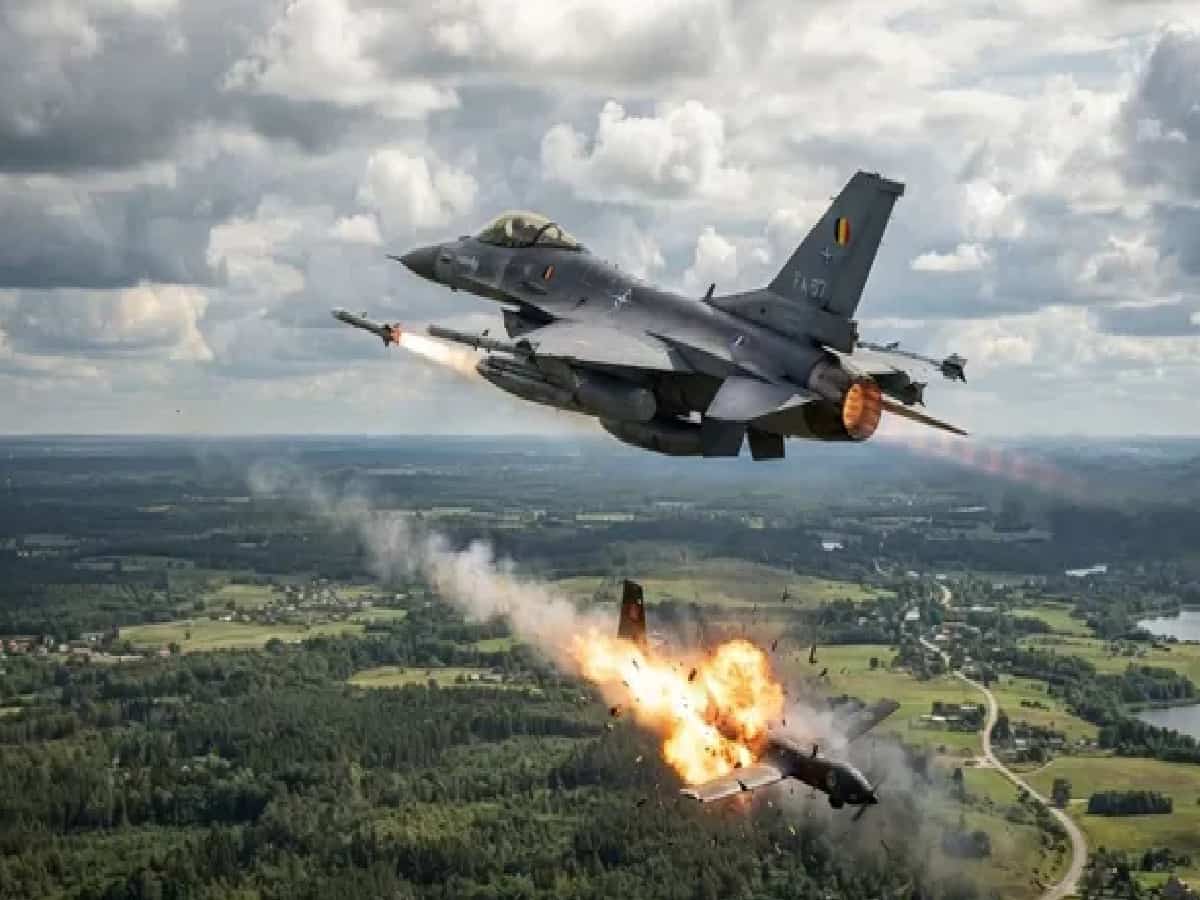
NATO Fighter Jet Downs Suspected Drone from Belarus Over Lithuania: Midnight Interception Near Kaunas
Tensions along the European Union's eastern frontier escalated dramatically after midnight on Tuesday as a NATO Quick Reaction Alert fighter jet intercepted and shot down an unidentified unmanned aerial vehicle (UAV) deep inside Lithuanian territory. The nocturnal aerial engagement, confirmed directly by Lithuania's National Crisis Management Center (NKVC), unfolded against mounting fears that the protracted conflict between Russia and Ukraine is increasingly spilling over sovereign NATO boundaries. Preceded by emergency air-raid and drone siren activations across the capital city of Vilnius and surrounding administrative districts, the rapid interception underscores heightened combat vigilance across the Baltic corridor, where allied air units remain on round-the-clock scrambled alert to counter unauthorized aerial intrusions.
Midnight Interception Near Pratkūnai Village: Air Alert Sounded Across Vilnius and Kaunas
According to official briefings released by the Lithuanian National Crisis Management Center, the hostile or stray aerial target was successfully intercepted and neutralized above the rural locality of Pratkūnai in southern Lithuania. The engagement occurred within close flight proximity to Kaunas, the country’s second-largest urban center and a critical transit hub. Preliminary flight-path tracking indicates that the unmanned aircraft breached sovereign airspace after crossing over from neighboring Belarus, a staunch military ally of the Russian Federation. While military forensic experts and defense units are currently sifting through crash debris at the impact zone to definitively establish the exact launch origins, airframe model, and payload specifications, regional defense forces maintained elevated readiness across surrounding municipal sectors throughout the morning hours.
NATO Baltic Air Policing Mission: Defending Flank Skies Since 2004
The immediate kinetic response executed over Lithuania falls directly under the jurisdiction of the long-standing NATO Baltic Air Policing mission, an integrated defense umbrella operational since 2004 when Lithuania, Latvia, and Estonia formally acceded to the transatlantic alliance. Lacking independent domestic supersonic interceptor fleets, the three Baltic nations rely on rotational fighter contingents dispatched from fellow NATO member states stationed at Šiauliai Air Base in Lithuania and Ämari Air Base in Estonia. This latest shootdown represents an accelerating sequence of border incidents; allied patrol jets previously neutralized stray Ukrainian unmanned systems over Estonian airspace in May, with subsequent aerial intercepts recorded over Latvian sovereign skies in both June and August.
The Impact of Escalating Electronic Warfare and Stray Combat Vectors
The recurring cross-border aerial incursions highlight the profound destabilizing effect of intense electronic warfare (EW) operations blanketing Eastern Europe and the wider Baltic Sea basin. As Ukrainian forces expand deep-strike drone campaigns against Russian military logistics hubs, refineries, and naval infrastructure, extensive GPS-spoofing and radio-frequency jamming deployed by Russian ground stations have routinely blinded navigational systems. These severe electromagnetic countermeasures frequently disrupt drone telemetry, forcing unguided, wayward airframes off course and into the domestic airspace of neighboring neutral or NATO territories, including Finland, Latvia, Lithuania, and Estonia. While Kyiv attributes these navigational diversions to aggressive Russian electronic counter-measures designed to redirect drone vectors toward civilian corridors, Baltic security officials warn that repeated airspace violations carry dangerous escalation risks that test the collective defense parameters of the NATO alliance.