







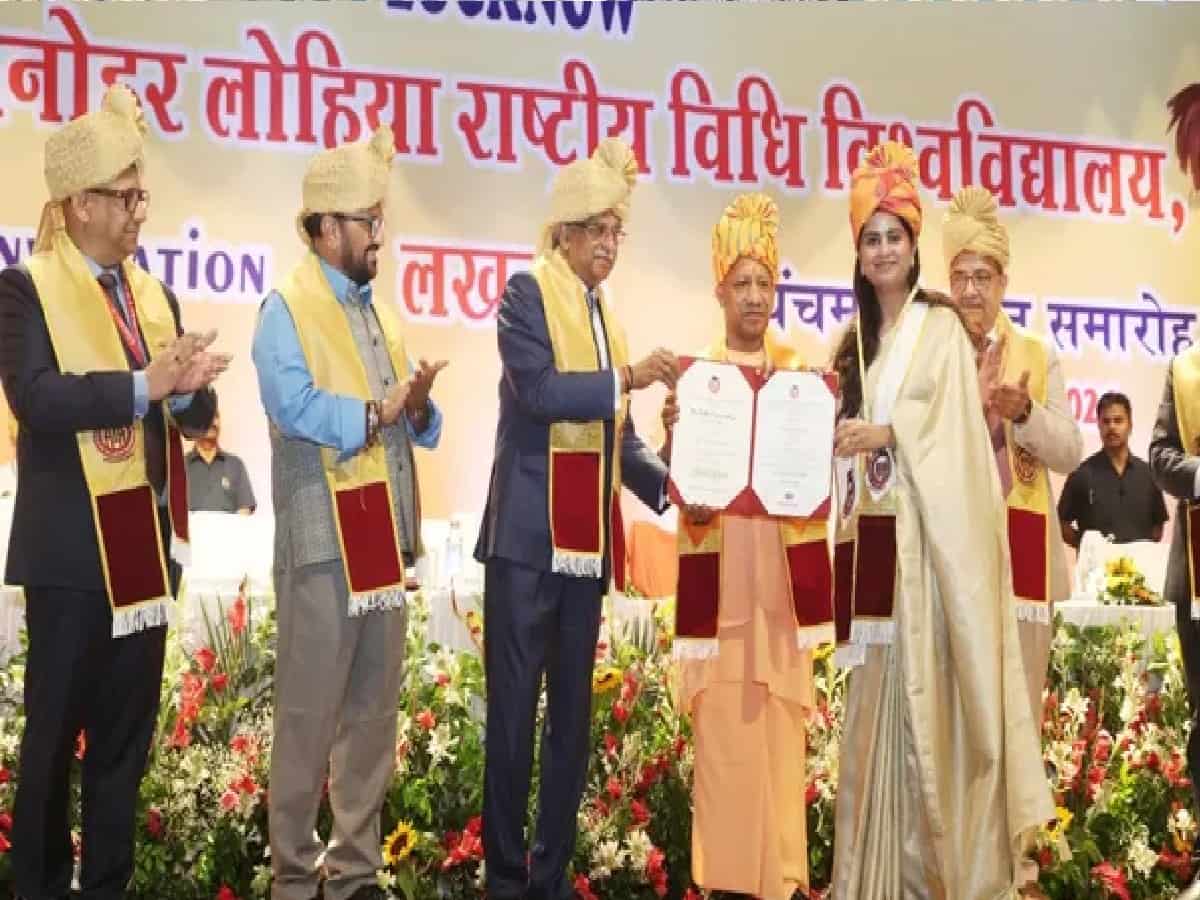
CM Yogi Urges RMLNLU Graduates to Champion India's 2047 Legal Vanguard
Addressing graduating legal scholars at the fifth convocation of the Dr. Ram Manohar Lohia National Law University (RMLNLU) in Lucknow, Uttar Pradesh Chief Minister Yogi Adityanath underscored that the true strength of the legal system rests not within dry statutes or procedural codes, but in the unshakeable confidence of ordinary citizens. Highlighting the state’s structural transformation over the past decade, the Chief Minister recalled an era prior to 2017 when Uttar Pradesh was burdened by the "sick state" (BIMARU) label, plagued by rampant mafia intimidation, administrative vulnerability, and deep investor skepticism. He noted that even senior constitutional convoys once yielded to organized crime bosses in places like Prayagraj, whereas today decisive political willpower and rigorous policing have established the supremacy of the rule of law. This institutional overhaul, Adityanath observed, has transformed Uttar Pradesh into a revenue-surplus state and positioned it among the top three state economies nationwide, creating a transparent commercial and social climate where marginalized citizens can secure accessible, prejudice-free justice.
The 'Viksit Bharat 2047' Lawsuit: Challenging the Status Quo Mindset with Decisive Reforms
Framing the nation’s civilizational march as a courtroom proceeding, Chief Minister Yogi characterized the vision of a "Developed India by 2047" as a monumental legal brief in which 1.4 billion Indian citizens are the primary petitioners, with young jurists serving as their chief advocates before the world. In this legal formulation, the Chief Minister identified the defendant not as any political opponent or specific organization, but as the entrenched status quo mindset that cynically resists systemic change and doubts national capability. Tracing India's legal trajectory through historic inflection points—from Independence in 1947 and the adoption of the Constitution in 1950 to the authoritarian overreach of the 1975 Emergency that underscored the vital distinction between the "rule of law" and the arbitrary "law of the ruler"—he pointed out that the post-2014 reform era has dismantled bureaucratic inertia. Highlighting regulatory overhauls such as the scrapping of over 1,500 obsolete colonial-era statutes, the decriminalization of 183 minor provisions across 42 commercial legislations under the Jan Vishwas Act, the enactment of the Insolvency and Bankruptcy Code, GST integration, and the Nari Shakti Vandan Act, Adityanath affirmed that these systemic updates form the launchpad for Uttar Pradesh’s targeted transformation into a one-trillion-dollar economy by 2029-30.
'AI as Co-Pilot, Not Charioteer': Guarding Judicial Conscience in the Digital Age
Focusing on the double-edged nature of disruptive technologies, Chief Minister Yogi urged the legal community to adopt artificial intelligence strictly as an administrative aid rather than an absolute arbiter of justice. While acknowledging that machine learning accelerates research, case analysis, and institutional logistics, he warned that synthetic deepfakes, automated bias, and borderless digital financial syndicates pose unprecedented threats to evidentiary integrity and fundamental human liberties. Illustrating his point through the philosophical framework of the Bhagavad Gita, Adityanath recounted how Lord Krishna imparted complete tactical and metaphysical wisdom to Arjuna, yet ultimately left the final battlefield decision to Arjuna's personal moral discretion—an ancient parallel to modern computer science’s "human-in-the-loop" principle. He cautioned that while algorithms can rapidly draft legal briefs, human negligence can cost innocent individuals their life and liberty; therefore, while machines write technical code, jurists must strictly follow an ethical code of conduct. Highlighting state infrastructure, the Chief Minister detailed that Uttar Pradesh has established specialized cyber police stations across all 75 districts, set up 1,583 localized cyber help desks, founded a state-level forensic institute, and launched the "AI Pragya" training program to upskill one million youth, ensuring that mandatory forensic protocols under the new criminal codes are matched by technologically adept legal officers.
The Antyodaya Standard: Four Moral Imperatives for Emerging Legal Practitioners
Asserting that genuine progress must be calibrated by the socioeconomic elevation of the most vulnerable—echoing Mahatma Gandhi’s Gram Swaraj, Pandit Deendayal Upadhyaya’s Antyodaya, and Goswami Tulsidas’s caution that a ruler whose subjects suffer is unworthy of power—Chief Minister Yogi issued four specific mandates to the graduating advocates. First, he commanded them never to remain passive spectators in the presence of systemic injustice, urging active advocacy for the aggrieved. Second, he appealed to graduates to remain organically connected to their rural roots, applying their legal acumen to peacefully mediate small-scale agricultural and domestic land disputes across village panchayats. Third, he insisted that young litigators preserve unimpeachable moral character and professional credibility, warning against ethical compromises and transactional shortcuts. Finally, he called for relentless self-study (Swadhyaya) and continuous mastery of amended statutes, reiterating that truth, righteousness, and academic rigor are non-negotiable professional foundations. The convocation was attended by distinguished dignitaries, including Supreme Court Justice Vikram Nath, Allahabad High Court Chief Justice Arun Bhansali, Higher Education Minister Yogendra Upadhyay, RMLNLU Vice Chancellor Professor Amar Pal Singh, Department Head Professor Manish Singh, and Registrar Keshav Kumar.




