







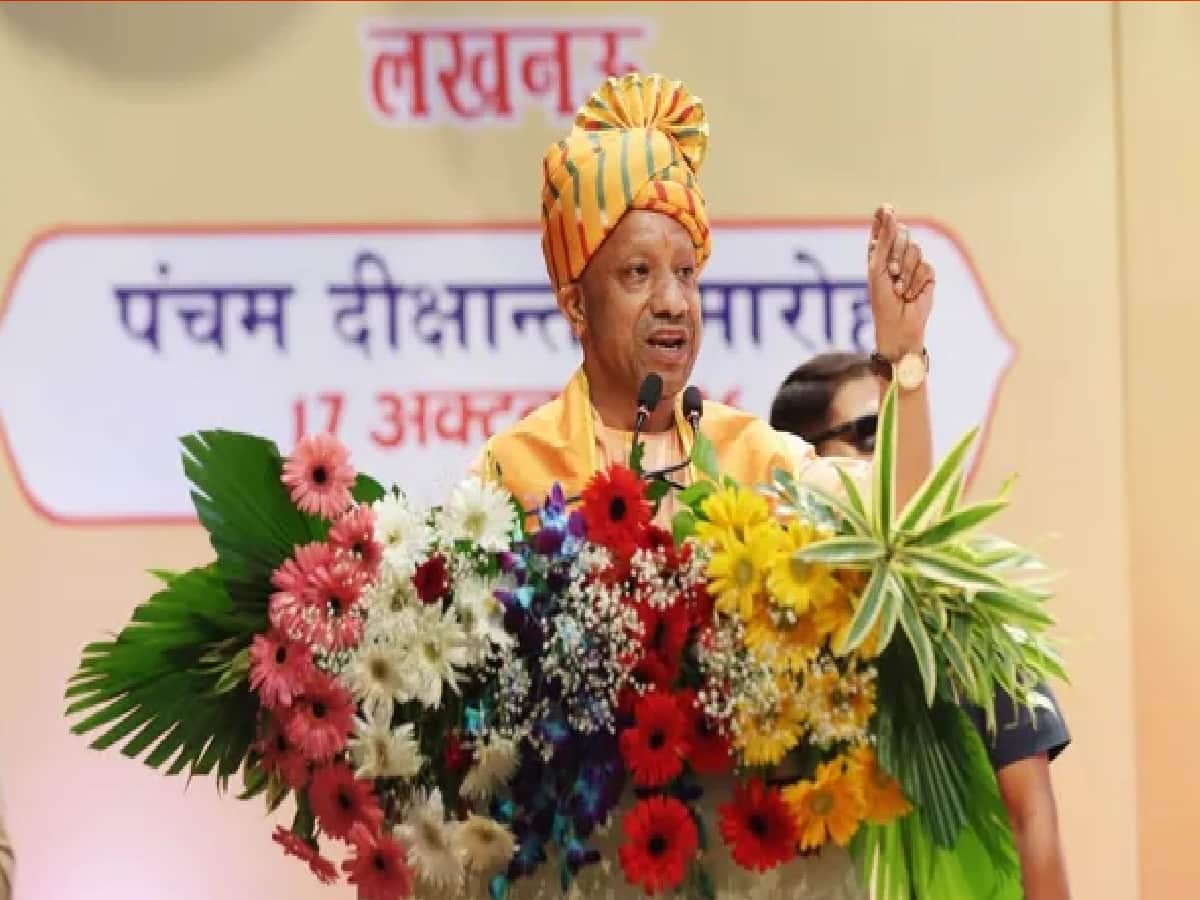
CM Yogi Addresses RMLNLU Convocation, Cites Emergency and Cautions on AI
Addressing graduating legal scholars at the fifth convocation of Dr. Ram Manohar Lohia National Law University (RMLNLU) in Lucknow on Saturday, Uttar Pradesh Chief Minister Yogi Adityanath stated that the state has decisively dismantled the "rule of the mafia" to establish the "rule of law." Highlighting the governance landscape prior to 2017, the Chief Minister recalled an era characterized by widespread skepticism regarding public safety, systemic corruption, and investment paralysis caused by organized crime syndicates. Adityanath affirmed that sweeping administrative and police reforms have restored institutional credibility across Uttar Pradesh, asserting that under a sovereign democratic framework, no individual, political seat, or administrative authority can stand above the Constitution of India. Inaugurating the ceremony alongside Supreme Court and High Court jurists by lighting the ceremonial lamp before Goddess Saraswati, the Chief Minister challenged the emerging generation of litigators to confront societal inequities head-on, reminding them that while history will inevitably pass final judgment, the moral responsibility to argue against injustice rests entirely in their hands.
Emergency Lessons and Moral Character: Defending Constitutional Values over the 'Ruler of Law'
Invoking key milestones in Indian constitutional history, the Chief Minister observed that alongside Independence Day on August 15, 1947, and Republic Day on January 26, 1950, the declaration of the Emergency on June 25, 1975, remains an essential historical lesson for preserving democracy. He explained that the Emergency established an indelible boundary separating the legitimate "rule of law" from the arbitrary "ruler of law," praising the historic dissent of Justice H.R. Khanna as proof that principled legal stands withstand political pressure and earn an enduring place in legal jurisprudence. Urging young lawyers to internalize ethical duty, Adityanath cited the ancient Vedic aphorism "Satyam Vad, Dharmam Char, Swadhyayanma Pramadah" (Speak the truth, practice righteousness, and never falter in continuous study), stressing that moral principles belong in an advocate's conscience rather than merely inscribed as decorative plaques on chamber walls. Quoting socialist thinker Dr. Ram Manohar Lohia, he envisioned the ideal jurist as possessing the intellectual depth of Shiva, the compassionate heart of Krishna, and the righteous eloquence of Rama, framing the national pursuit of a Viksit Bharat by 2047 as a monumental constitutional case that young legal minds must defend on behalf of 1.4 billion citizens while supporting Uttar Pradesh’s transition into a one-trillion-dollar economy by 2029-30.
Artificial Intelligence as a Co-Pilot: Guarding Judicial Discretion Against Deepfakes
Turning his focus to the evolving intersection of technology and jurisprudence, Chief Minister Yogi cautioned legal professionals against over-reliance on emerging automated platforms, asserting that artificial intelligence should function strictly as an operational assistant rather than the driver or "charioteer" of legal outcomes. He warned that mechanical or careless legal drafting driven by automated algorithms risks human liberties, while the rise of synthetic deepfakes and advanced cybercrimes poses unprecedented challenges to evidentiary authentication in courtrooms. Highlighting Uttar Pradesh's technological readiness, the Chief Minister noted that the administration has established specialized cyber police stations across all 75 districts and integrated cyber help desks into 1,583 local police stations, while simultaneously upskilling one million youth in digital competencies through the "AI Pragya" initiative. He called on legal professionals to protect their professional credibility, stay rooted in public service, resist external pressures to compromise professional standards, and dedicate their legal training to resolving land and domestic disputes across rural village communities.
Judiciary Commends Institutional Excellence: RMLNLU Celebrates Top Legal Achievers
Endorsing the societal role of the legal fraternity, Supreme Court Justice Vikram Nath observed that a law degree does not signify a final destination but the launch of an arduous journey, remarking that the true validity of legal education is tested outside university gates through the positive social impact advocates create for marginalized communities. Allahabad High Court Chief Justice Arun Bhansali lauded RMLNLU’s enduring contributions to judicial scholarship and public policy, expressing confidence that the new graduates will uphold the highest traditions of constitutional integrity. Presenting the institutional progress report, Vice Chancellor Professor Amar Pal Singh revealed that over the past two decades, RMLNLU has supplied more than 250 judicial officers to Uttar Pradesh and various state judicial cadres, proving that legal scholarship serves as an effective vehicle for social reform. The convocation conferred prestigious academic honors, with Rupali Jaiswal securing the Gold, Chitra Singh the Silver, and Soumya Giri the Bronze in the Master of Laws (LLM) program. In the undergraduate LLB (Hons) division, Tejaswini Kaushal clinched the overall Gold, followed by Isha Agarwal with Silver and Nisha Verma with Bronze. Isha Agarwal swept three distinguished sponsored awards—including the Justice OP Pradhan Memorial Gold Medal in Criminal Law, the Padmavati Mohanlal Jariwala Medal in Constitutional Law, and the Virendra Bhatia Gold Medal for Student of the Year. In other academic categories, Tanya Verma received the Pradeep Kumar Agarwal Memorial Medal in Taxation, while Malvika Pachauri earned the KK Luthra Memorial Gold Medal for Best Mooting. In the postgraduate diploma streams, Bhaskar Pandey, Jayant Agarwal, and Chirag Nigam claimed the top three honors in Cyber Law; Aashi Pandey, Ritesh Mehta, and Isha Asthana earned top medals in Intellectual Property Rights; and Anshuman Singh alongside Santosh Sonkar received gold and silver distinctions in Media Law, celebrated in the presence of Higher Education Minister Yogendra Upadhyay, Head of Department Prof. Manish Singh, and Registrar Keshav Kumar.




