







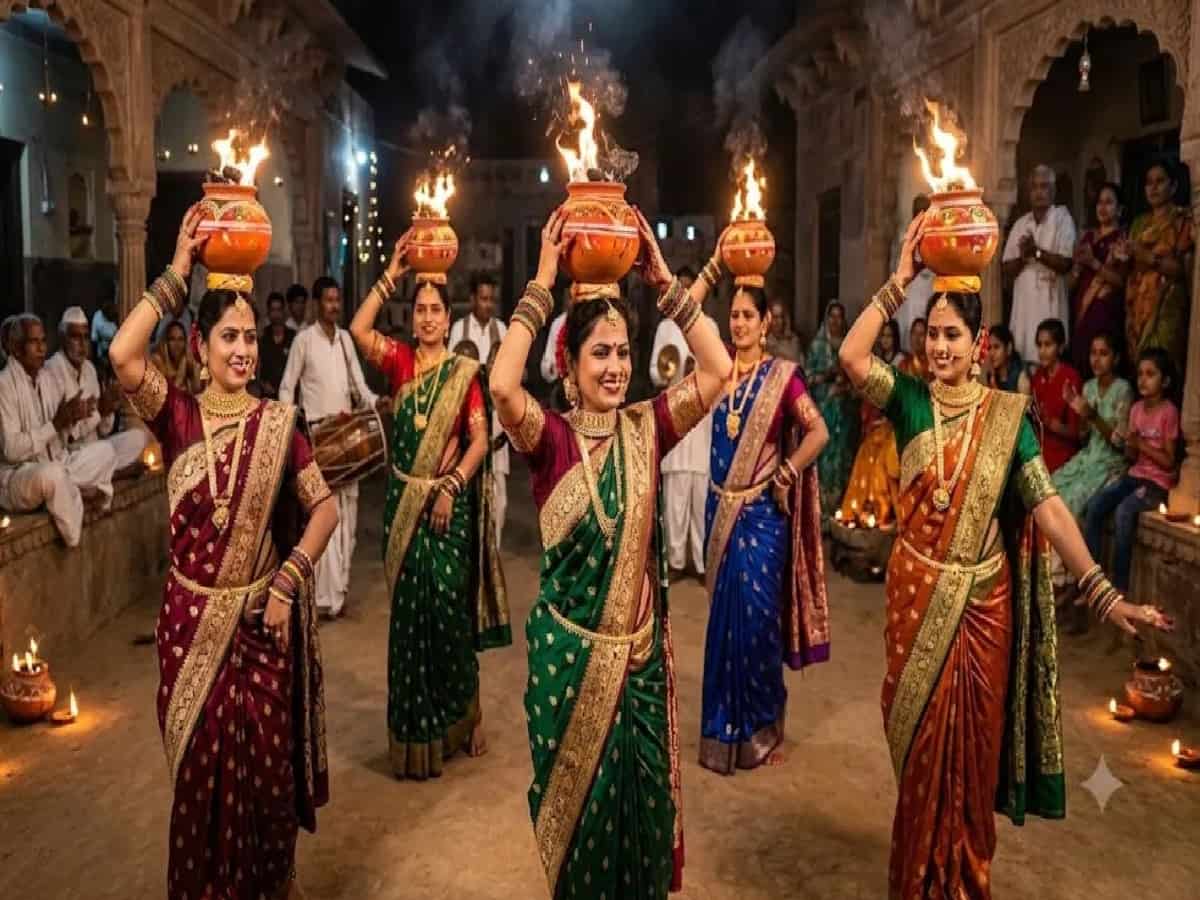
Women Invoke Guardian Deity 'Brahma Baba' During the Mystical Jhijhiya Dance
Across the rural heartlands of Bihar and eastern Uttar Pradesh, spiritual devotion often transcends the mainstream classical pantheon, finding its most potent everyday anchor in the veneration of hyper-local guardian deities (Gram Devatas). Chief among these regional protectors is 'Brahma Baba'—colloquially revered in the local Bhojpuri dialect as 'Barmah Baba'—whose sacred outdoor shrine, the Brahma Sthan, is consecrated in virtually every village settlement. Revered as the sovereign custodian of village boundaries, Brahma Baba is believed by rural communities to create an energetic perimeter that completely wards off malicious spirits, misfortune, and demonic disturbances. Before initiating weddings, harvests, or auspicious life milestones, villagers assemble at the Brahma Sthan to seek his mandatory blessings, making offerings of traditional earthen pots, clean dhotis, sacred threads (janeu), fresh betel leaves (paan), sweets, and seasonal flowers to ensure unbroken domestic peace.
The Mystical Jhijhiya Ritual: Perforated Pots, Witchcraft Lore, and Divine Protection
The protective mantle of Brahma Baba takes center stage during the extraordinary folk performance of the Jhijhiya dance, an ancient ritual staged by rural women during times of crisis, severe drought, and the sacred nights of Navratri. Designed primarily as a metaphysical shield to protect their children and preserve household prosperity from the malevolent glance (buri nazar), the dance requires women to perform intricate choreographies while balancing perforated earthen pitchers on their heads, each housing an active, flickering oil lamp (diya). According to centuries-old folklore, these countless perforations serve a supernatural purpose: local legend warns that practicing witches (daayans) and dark spirits seek to cast fatal spells on performers by counting every opening in the pot. By maintaining dynamic, rhythmic motion, the dancers prevent any bystander from successfully calculating the number of holes before the performance concludes, while their continuous devotional hymns implore Brahma Baba to extend his divine sanctuary and neutralize occult threats targeting their households.
The Sacred Folk Pantheon: Millions Revere Gram Devatas from Vaishali to the Nepal Terai
While Brahma Baba remains the premier patriarchal protector of the Bhojpuri and Maithili belts, he forms part of a sprawling, highly sophisticated tapestry of folk deities whose influence spans western Bihar, eastern Uttar Pradesh, Jharkhand, West Bengal, and the Terai plains of southern Nepal. Worshipped by millions of agrarian families who view them as immediate spiritual guardians, these deities include fierce protective feminine powers such as Sarkatti Mai, Baudhi Mai, and Banni Mai, alongside the widely revered Gadhi Devi, whose ancient shrines dot western Bihar and cross-border Nepalese territories. Similarly, across central districts stretching from Gopalganj to historical Vaishali, sacred shrines dedicated to Goraiya Baba, Dehwar Baba, and Malang Baba serve as community spiritual anchors. Often misunderstood by urban observers unfamiliar with grassroots agrarian culture, these ancestral folk shrines represent a living tradition of indigenous reverence, preserving centuries of oral history, community resilience, and protective faith that define the spiritual fabric of northern India's rural life.




