







Why Yamaraj Needed an Assistant: Origin of Lord Chitragupta
Across millions of Hindu households, the festive crescendo of Diwali and Bhai Dooj brings a sacred, contemplative ritual that honors the divine keeper of universal justice: Chitragupta Puja. Observed annually on the auspicious Tithi of Shukla Paksha Dwitiya in the holy month of Kartika—commonly celebrated alongside Yama Dwitiya or Bhai Dooj—the occasion is dedicated to Lord Chitragupta, the celestial scribe entrusted with logging the virtues and vices of every living being. While traditional folklore often depicts Yamaraj as the stern dispenser of cosmic justice, ancient Puranic scriptures reveal that the maintenance of universal dharma once pushed the lord of death to his absolute operational limits, necessitating the divine intervention of Lord Brahma to restore cosmic balance.
According to sacred accounts preserved in the Padma Purana, Brahmavaivarta Purana, and Garuda Purana, the story began during the primeval dawn of creation. Having engineered the vast physical cosmos, celestial realms, and countless varieties of earthly life forms, Lord Brahma appointed Yamaraj, the son of the Sun god Surya, to supervise the departed souls and maintain ethical equilibrium. Yamaraj was charged with delivering impartial retribution and rewards strictly in accordance with dharma, directing elevated souls toward the heavenly gardens of Swarga and dispatching unrepentant transgressors to Naraka. However, as the epochs unfolded, the mortal population exploded across multiple continents, creating a web of karmic deeds that challenged even the divine focus of the lord of death.
The Manifestation of Chitragupta: Born from Brahma's Deep Meditation
As human society expanded, the sheer volume of daily thoughts, spoken words, hidden intentions, and overt actions generated by mortal beings overwhelmed the lone sovereign of the underworld. Yamaraj found himself grappling with intricate karmic calculations: determining how genuine remorse softened past sins, how hidden charity counteracted overt transgressions, and how moral compromises shaped individual destinies. Recognizing that administrative oversights could jeopardize the moral fabric of the universe, Yamaraj approached Lord Brahma in Brahmaloka, laying bare the exhausting reality of his solitary burden and humbly requesting a capable, infallible divine partner to record every soul's karmic ledger.
Hearing the earnest petition of Yamaraj, Lord Brahma recognized the urgency of the cosmic request. Closing his eyes, the creator plunged into profound meditation (samadhi) and rigorous ascetic penance (tapasya) that lasted for eleven thousand divine years. As Brahma remained immersed in absolute stillness, holding the vision of an omniscient, impartial celestial chronicler in his consciousness, a radiant effulgence began to emanate directly from his divine body (kaya). From this luminous aura manifested a majestic, four-armed celestial being holding a quill, an inkpot, and an ancient manuscript parchment. Because he emerged completely and silently from the body of Brahma while remaining concealed within his consciousness, he was bestowed with the divine name Chitragupta—the one who records what is hidden in the mind—and was acknowledged as the divine progenitor of the Kayastha community.
The Iconography of Justice: Pen, Inkpot, and the Ledger of Deeds
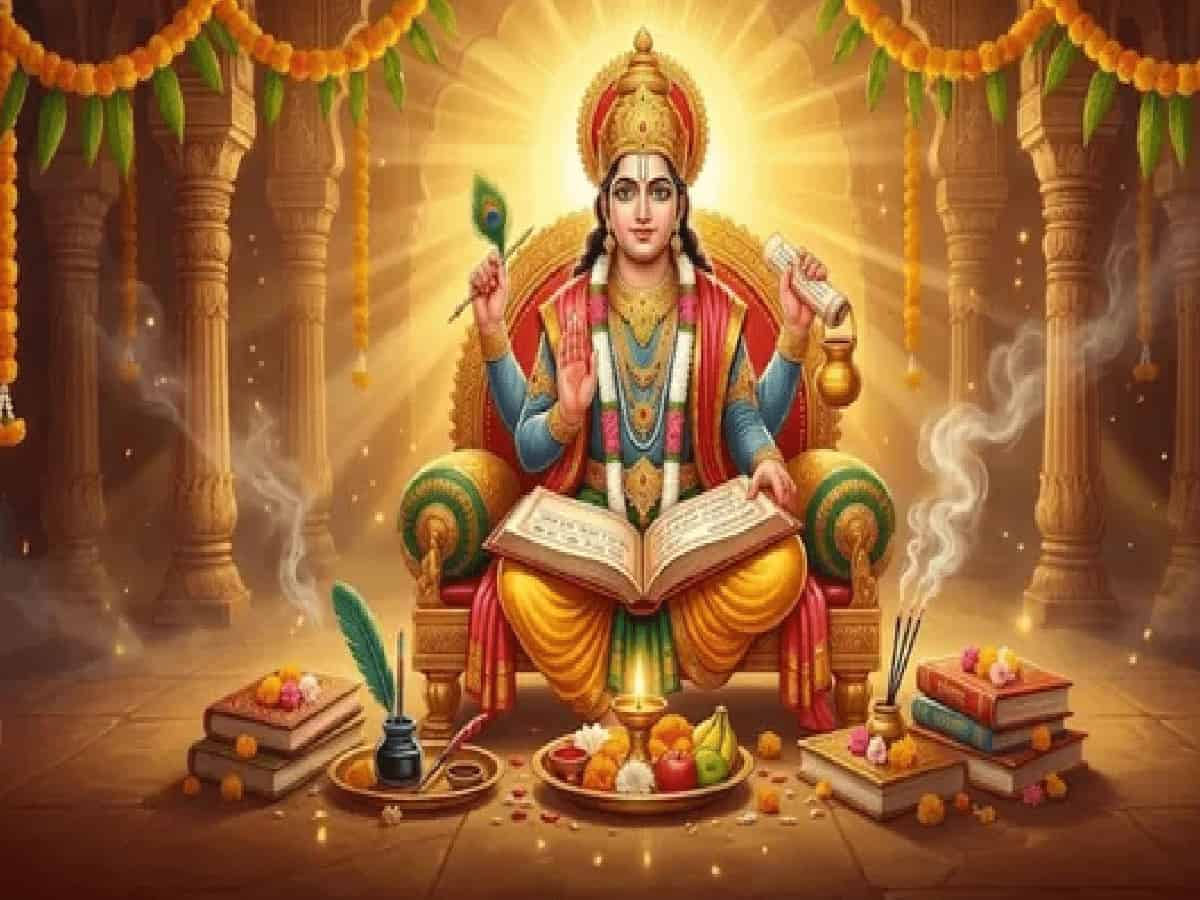
The divine appearance of Lord Chitragupta is characterized by an aura of calm, unyielding justice and intellectual majesty. Unlike fierce martial deities adorned with battlefield weaponry, Chitragupta’s iconography reflects righteous scholarship and administrative precision. He is traditionally depicted with a serene, focused countenance, clad in royal silk vestments that symbolize dignity, truth, and judicial impartiality. He wears an ornate crown of burnished gold studded with divine jewels, while shining earrings and a garland of sacred gems adorn his neck.
In his sacred four-armed form, Lord Chitragupta carries the instruments that govern human destiny. In his primary hands, he holds the writing quill (kalam) crafted from celestial reed and the sacred inkpot (dawat), representing the power of documentation and the permanence of truth. In his other hands, he carries the holy book of records, known scripturally as the Agrasandhani—the comprehensive celestial ledger wherein every individual's thoughts, speech, and overt actions are systematically recorded from birth until their final breath. The golden parchment leaves no action unexamined: every selfless charity performed in secret, every vow broken behind closed doors, every gentle word offered to the distressed, and every act of deliberate cruelty is etched into its leaves with unalterable accuracy.
The Ritual of Chitragupta Puja: Why Devotees Worship the Pen and Ledger
The celebration of Chitragupta Puja on Bhai Dooj carries a deep practical and moral philosophy for professionals, writers, accountants, teachers, and business owners. On this sacred day, families gather in the morning to decorate domestic prayer spaces with fresh yellow marigolds, sandalwood paste, and vermilion. At the heart of the ceremony lies the sanctification of the tools of trade: brand new accounting ledgers (bahi-khata), business notebooks, pens, and ink bottles are placed reverently at the feet of Lord Chitragupta’s idol or portrait.
Devotees invoke the blessings of the deity by writing sacred invocations on fresh white paper using red ink or saffron water, beginning with the auspicious mantra: "Shri Ganeshaya Namah" followed by "Om Shri Chitraguptaya Namah." Practitioners traditionally write their names, family lineages, and a solemn pledge committing themselves to ethical conduct, honest business dealings, and transparent financial stewardship throughout the coming year. The ritual concludes with the ceremonial distribution of sweets, fruits, and panchamrit, alongside prayers asking for intellectual clarity, professional prosperity, and the absolution of unintentional errors committed in the course of daily work.
An Eternal Moral Reminder: The Irreversible Reality of Karmic Accounting
Beyond religious liturgy and festive customs, the legend of Lord Chitragupta’s manifestation delivers an enduring philosophical message that resonates across all generations. In Hindu philosophy, the concept of Chitragupta is not merely an external scribe perched in the clouds, but a reflection of human conscience—the inner moral witness that constantly observes our true motives when no one else is watching. The ancient scriptures emphasize that while earthly legal systems can be deceived through clever rhetoric or concealed evidence, the cosmic record kept by Chitragupta remains completely transparent to divine truth.
By remembering the origins of Yamaraj’s trusted assistant on this sacred day, devotees are reminded that every human action carries an inevitable consequence. The story reassures the righteous that their hidden sacrifices and quiet goodness never go unnoticed, while serving as a warning to the corrupt that no transgression can remain permanently hidden from the cosmic ledger. As the ink dries on fresh account books and prayer chants echo through courtyards across the nation, Chitragupta Puja stands as a timeless festival of truth, ethics, and universal accountability.




