







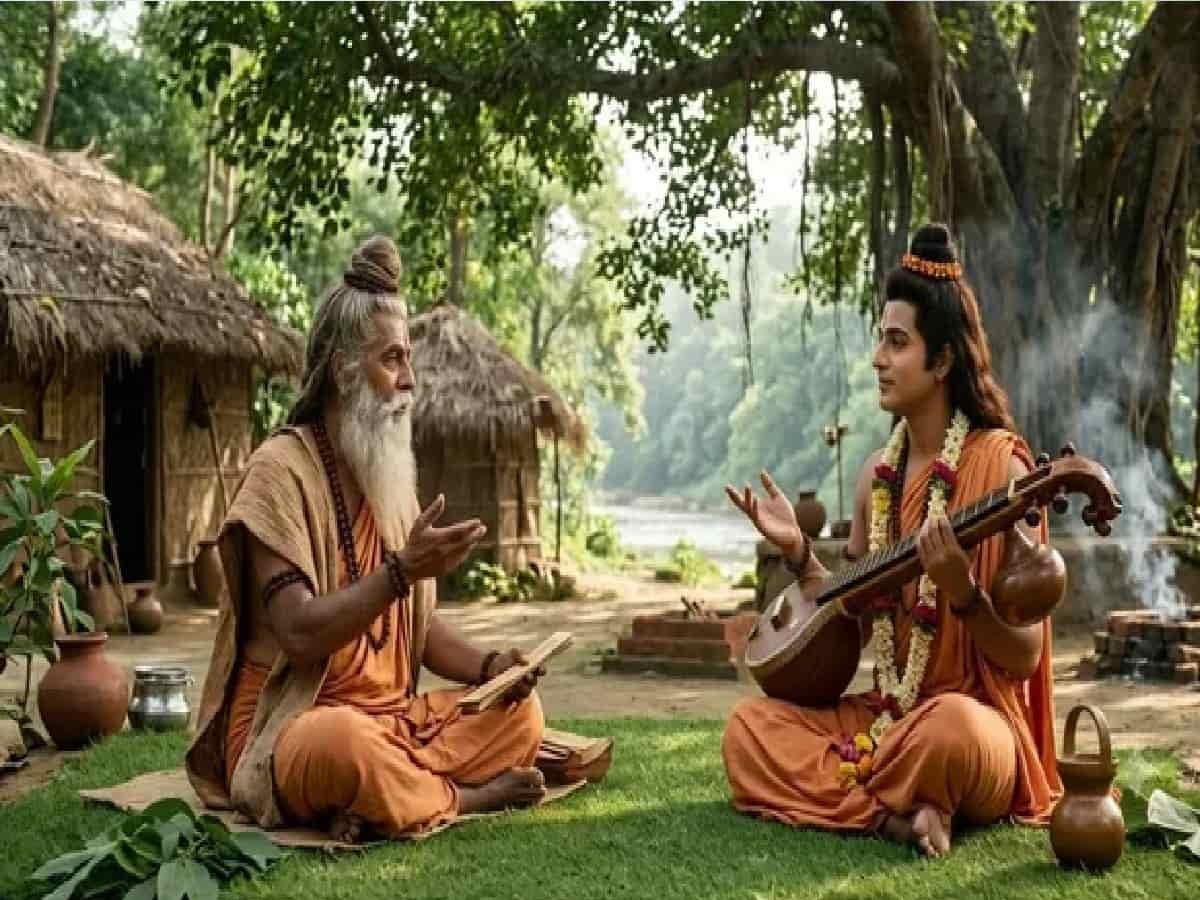
Why Maharishi Valmiki Consulted Narada Before Writing the Ramayana
The Valmiki Ramayana stands as one of the foundational pillars of Indian literature and Sanatana Dharma, revered as the Adikavya (the first epic poem) and celebrated for teaching generations how to navigate duty, relationships, and righteousness. Yet before composing a single verse of the 24,000-shloka epic, Maharishi Valmiki turned to Devarshi Narada with a profound philosophical question. Rather than asking about celestial gods or mythic battles, Valmiki wanted to know whether a living human being walked the earth who embodied sixteen supreme virtues—a pivotal dialogue preserved in the opening chapter of the Balakanda.
The Opening Dialogue in Balakanda: Searching for the Ideal Human
At the very beginning of the Balakanda (Sarga 1), Maharishi Valmiki, deeply devoted to austerity and scriptural study, welcomes the wandering celestial sage Narada to his ashram along the banks of the Tamasa River. Sensing an opportunity to anchor his life's literary mission in living truth rather than abstract imagination, Valmiki poses a direct inquiry to his guest.
The second shloka of the Balakanda captures the opening of Valmiki's famous question:
"Ko nvasmin sampratam loke gunavan kascha viryavan।
Dharmajnascha kritajnascha satyavakyo dridhavratah॥"
In English, Valmiki asks: "Who in this present world is truly virtuous (Gunavan), heroic and full of valor (Viryavan), deeply knowledgeable of righteousness (Dharmajna), grateful for every good deed (Kritajna), unwaveringly truthful (Satyavakya), and firm in his sacred vows (Dridhavrata)?"
Over the next three verses, Valmiki expands this inquiry into a complete portrait of human excellence—asking who possesses noble conduct (Charitrena cha ko yuktah), compassion for all living beings (Sarvabhuteshu ko hitah), supreme wisdom (Vidvan), capability (Samarthah), a singularly pleasing presence (Priyadarshanah), self-mastery (Atmavan), conquest over anger (Jitakrodhah), radiant dignity (Dyutiman), freedom from envy (Anasuyakah), and a valor so awe-inspiring that even the gods stand in respect when he enters battle (Kasya bibhyati devascha).
Why Only Devarshi Narada Could Answer Valmiki's Question
Spiritual scholars and literary historians across Ayodhya, Prayagraj, Varanasi, Lucknow, and Chitrakoot emphasize that Valmiki's decision to consult Narada Muni was deliberate and deeply meaningful:
-
Universal observer of the three worlds: Devarshi Narada is revered in Vedic tradition as Triloka-sanchari—a divine sage who travels effortlessly across heaven, earth, and the netherworlds, witnessing human actions without bias or attachment.
-
Encyclopedic command of past, present, and future: Scriptural texts describe Narada as Trikalagya (knower of past, present, and future) and a master of sacred lore, making him uniquely qualified to evaluate every living ruler and sage on earth against Valmiki's sixteen demanding benchmarks.
-
Grounding the epic in living history: Valmiki did not wish to invent an unreachable fictional superhero; he sought a real mortal example proving that ordinary human beings can uphold Dharma even amid exile, betrayal, and personal grief.
Key Virtues Valmiki Sought in the Ideal Human Being
| Sanskrit Virtue (Balakanda) | English Meaning | Why It Mattered to Valmiki |
| Gunavan & Viryavan | Endowed with noble qualities & courage | Balances inner moral gentleness with outer strength |
| Dharmajna & Kritajna | Knower of duty & deeply grateful | Honors cosmic law and remembers even small acts of kindness |
| Satyavakya & Dridhavrata | Truthful in speech & firm in vows | Never compromises integrity regardless of personal cost |
| Atmavan & Jitakrodhah | Self-controlled & conqueror of anger | Rules emotions rather than being ruled by impulse |
| Sarvabhuteshu Hitah | Devoted to the welfare of all beings | Practices inclusive compassion beyond self-interest |
How Narada's Answer Revealed Lord Rama's Life Story
Delighted by the depth of Valmiki's inquiry, Devarshi Narada smiled and replied that while such rare virtues seldom unite in a single person, one ruler born in the illustrious Ikshvaku dynasty possessed every single quality Valmiki had named—Lord Rama of Ayodhya. Narada then narrated the concise Samkshepa Ramayana (the hundred-verse summary of Rama's life) right there in the hermitage, tracing Rama's exile to the forests, the abduction of Mata Sita, the alliance with Hanuman and Sugriva, the defeat of Ravana, and the establishment of Rama Rajya.
Inspired by Narada's account and subsequently blessed by Lord Brahma after witnessing the poignant episode of the Krauncha birds on the banks of the Tamasa River, Maharishi Valmiki transformed that timeless oral narrative into the monumental Sanskrit epic that continues to guide humanity today.




