







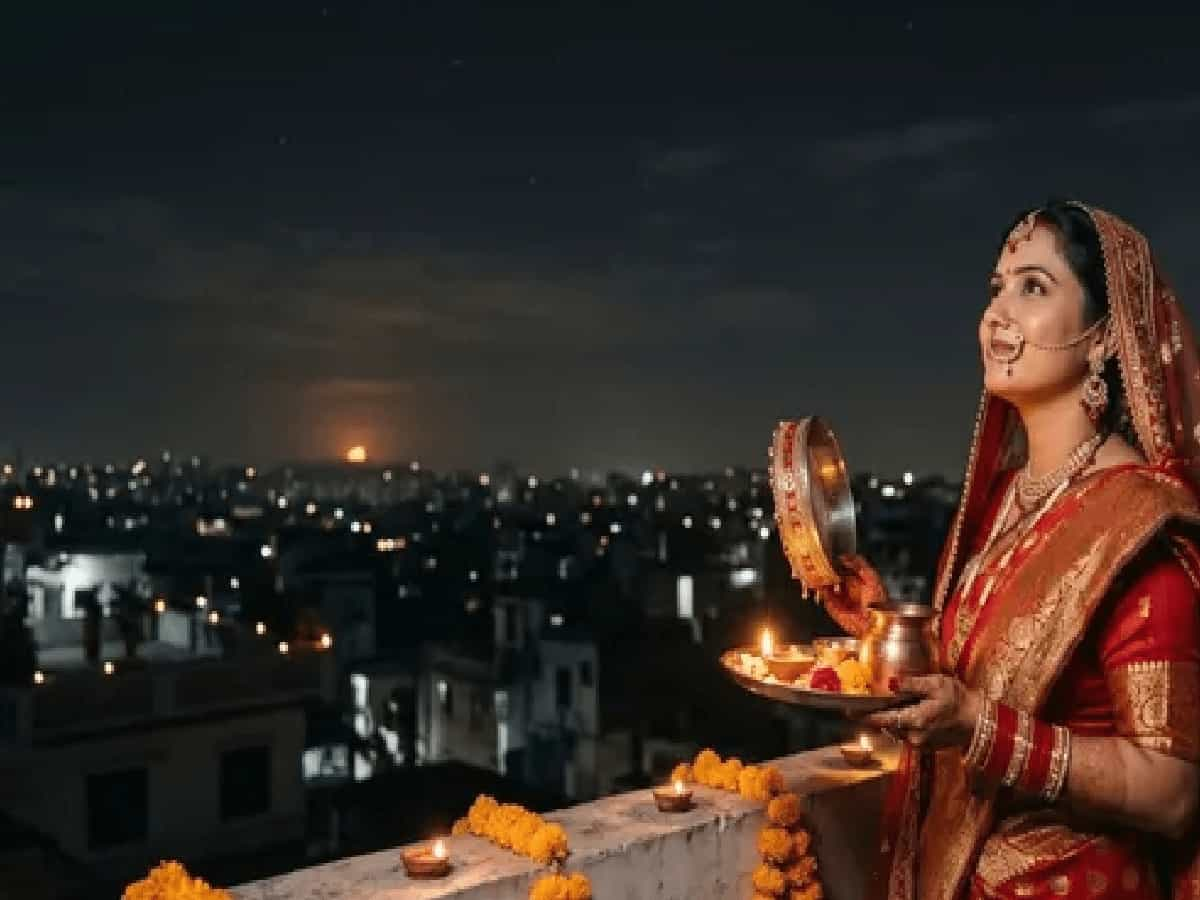
Why Does the Moon Always Rise Late on Karwa Chauth? The Exact Mathematics
Every year on the sacred festival of Karwa Chauth, millions of married women and unmarried brides-to-be across India observe a stringent, waterless fast (nirjala vrat) from dawn until the night moon emerges, praying for the longevity, good health, and prosperity of their husbands. Because the fast can strictly be concluded only after sighting the lunar orb through a decorated sieve and offering sacred water (arghya), the prolonged wait for the night sky to illuminate frequently sparks curiosity: why does the moon invariably appear so late on Karwa Chauth compared to other festive evenings? Providing astronomical clarity, astrologer Chandrashekhar Sharma of Astropatri reveals that this perceived delay is neither a cosmic anomaly nor sheer coincidence, but the direct mathematical consequence of orbital mechanics, the 50-to-53-minute daily lunar orbital lag, and the specific timing of the fourth lunar day (Chaturthi) of the waning fortnight (Krishna Paksha) in the Hindu month of Kartik.
The 200-Minute Calculation: Celestial Mechanics Behind the Krishna Chaturthi Moon
The astronomical explanation for the timing of the moonrise on Karwa Chauth rests entirely on the Moon's eastward orbital velocity around Earth:
-
The Daily Orbital Shift: As the Earth completes one full rotation on its axis every 24 hours, the Moon travels roughly 12 to 13 degrees eastward in its orbit. To compensate for this eastward shift, the Earth must rotate for approximately 50 to 53 additional minutes each night for an observer to see the Moon rise again on the eastern horizon.
-
The Purnima Baseline: On the full moon night of Sharad Purnima, the Moon rises almost simultaneously with sunset, appearing between 5:00 PM and 5:30 PM.
-
The Post-Purnima Timeline:
-
Pratipada (Day 1): The moonrise shifts to approximately 6:00 PM.
-
Dwitiya (Day 2): Moonrise pushes back to roughly 6:50 PM.
-
Tritiya (Day 3): The lunar crest ascends around 7:40 PM.
-
Chaturthi (Day 4 - Karwa Chauth): The cumulative lag reaches nearly 200 minutes (over three hours) past sunset, pushing the celestial appearance between 8:00 PM and 8:30 PM across most Indian latitudes.
-
Autumn Haze, Smog, and Urban Horizons: The Ground-Level Delay
Even after the Moon physically crosses the astronomical horizon, ground-level observational hurdles frequently extend the visual wait by an additional 15 to 30 minutes:
-
Seasonal Mist and Temperature Inversion: Karwa Chauth typically falls during late October or early November, coinciding with the onset of North India’s winter transition, where nighttime cooling traps moisture, smog, and low-lying particulate fog near the Earth's surface.
-
Horizon Obstruction: A moon positioned just above the horizon must project its light through a much thicker layer of atmospheric particulate matter, dulling its initial luminosity.
-
Urban Vertical Sprawl: For fasting devotees living in metropolitan centers, high-rise residential towers and dense city skylines block the low-angle eastern horizon, ensuring the moon is only visible once it climbs significantly higher into the night sky.
Faith and Tapasya: The Spiritual Symbolism of the Extended Vigil
Beyond the mathematical calculations of planetary motion, Hindu scriptural tradition imbues this prolonged nocturnal vigil with deep spiritual meaning:
-
A Test of Devotional Patience: In Sanatan Dharma, the delayed moonrise on Karwa Chauth is revered as a symbolic test of a married woman’s patience, devotion, and resilience (tapasya) on behalf of her partner.
-
Sanctifying the Marital Bond: Enduring the physical challenges of a waterless fast until the late-night hour is believed to burn away negative domestic energies, fortifying marital harmony and channeling divine protection over the household.
-
The Sacred Arghya: The culmination—offering consecrated water from a clay or metal karwa while chanting mantras—completes the ritual cycle, uniting ancient astronomical cycles with sacred matrimonial heritage.




