






Who Was Surasa: Unveiling the Mythological History of the Mother of Serpents and Hanuman's Trial
In Hindu mythology, characters of deep antiquity and layered symbolism often span multiple epochs and texts. Among them, Surasa stands out as a fascinating and mysterious figure whose narrative weaves through the epics, Puranas, and cosmological tales. Known primarily as the divine mother of serpents and the fierce obstacle who tested Lord Hanuman during his ocean crossing, Surasa's mythological lineage and incarnations carry profound spiritual and historical significance.
Lineage and Birth: Unraveling the Puranic Accounts of Surasa
Different scriptures narrate divergent origins for Surasa, reflecting the rich, multi-layered nature of ancient Indian literature:
-
Valmiki Ramayana (Aranya Kanda): Surasa is described as one of the ten daughters of Krodhavasha, who herself was a daughter of Daksha Prajapati. Following her marriage to the great sage Maharishi Kashyap, she became the progenitor of the serpentine race (Nagavansh). The Mahabharata further notes that she gave birth to three daughters named Anala, Ruha, and Virudha.
-
Skanda Purana (Asura Kanda): This text presents a contrasting narrative. During the cosmic Deva-Asura wars, an Asura fled to the underworld to escape death, and Surasa was born as his daughter. After marrying Maharishi Kashyap in this lineage, she became the mother of prominent mythological figures, including the demon siblings Tarakasura, Surapadma, Simhavaktra, and Gomukha, alongside daughters Angaraka and Ajamukhi. The text also records that the demon preceptor Shukracharya imparted a devastatingly powerful mantra to her.
The Iconic Test of Lord Hanuman in the Sundarkand
The most widely celebrated episode featuring Surasa occurs in the Sundarkand of the Valmiki Ramayana. As Lord Hanuman soared across the vast ocean in search of Mother Sita, the deities and Gandharvas decided to test his boundless strength, agility, and wit.
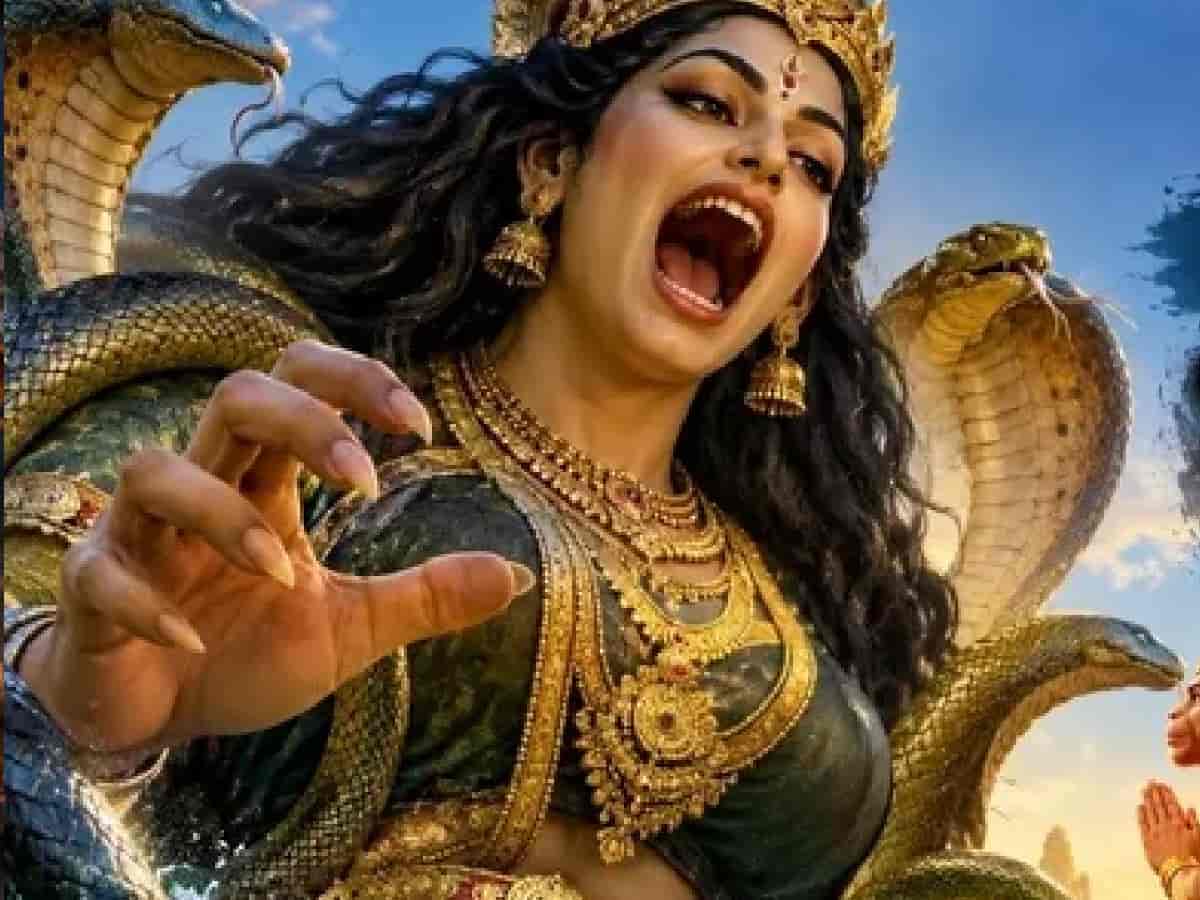
Taking on a colossal, terrifying mountain-like form, Surasa blocked Hanuman's path and declared him her meal. Demonstrating remarkable presence of mind, Hanuman engaged in a tactical dialogue. When Surasa expanded her mouth to a staggering width of one hundred yojanas, Hanuman shrewdly shrank his body down to the size of a thumb, swiftly darted into her gigantic mouth, and emerged from her ear. Impressed by his extraordinary intelligence and humility, Surasa blessed the devoted monkey warrior with success in his sacred mission.
Incarnation as Rohini and Mother of Balarama in Devi Bhagavatam
Surasa's journey extends far into the cosmic order as detailed in the Devi Bhagavatam (Canto 4) and the Srimad Bhagavatam (Canto 10). According to sacred accounts, Sage Kashyapa once took Varuna Deva’s celestial cow for a ritual, and Surasa alongside Aditi hid it in their hermitage.
Consequently, due to the curse of Brahma and Varuna, Sage Kashyapa took birth as Vasudeva in the 28th Dwapara Yuga, while Aditi incarnated as Devaki and Surasa incarnated as Rohini in Gokul. In this divine incarnation, Surasa as Rohini nurtured and raised Lord Balarama (Balabhadra), serving as his mother. Additionally, the Mahabharata notes that Surasa holds an exalted position in the celestial assembly of Lord Brahma, where she continuously offers worship.