







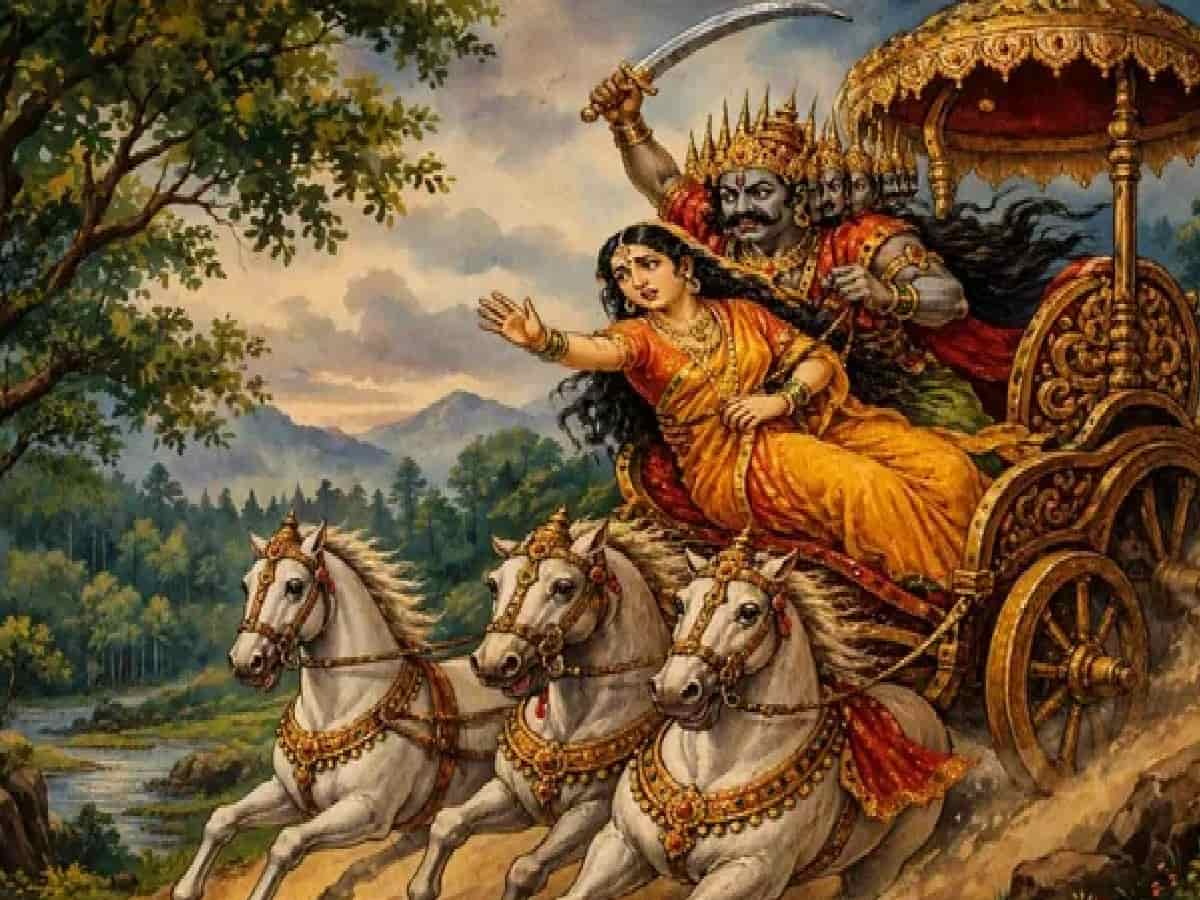
How Ravana Abducted Sita Without Touching Her: Kamba Ramayana Secret
Across centuries of Indian storytelling, the abduction of Mata Sita by Lanka's demon king Ravana stands as the pivotal turning point of the Ramayana—setting in motion the epic journey of Lord Rama and Lakshmana across the subcontinent and culminating in the great war of Lanka. Yet alongside this famous episode lies a question that has intrigued devotees, scholars, and curious readers for generations: knowing that Ravana was bound by a fatal curse forbidding him from forcibly touching any woman against her will, how exactly did he carry Sita from Panchavati to Lanka without laying a finger on her? While Sage Valmiki's Sanskrit Ramayana narrates the abduction in one classical manner, a vivid and lesser-known explanation is preserved in the 12th-century Tamil masterpiece Kamba Ramayana (Ramavataram), composed by the celebrated poet Kamban. According to Kamban's dramatic rendering, Ravana bypassed the deadly curse of Nalakubara through an extraordinary display of brute physical strength and cunning: rather than touching Sita's person, he carved deep into the soil beneath her forest hermitage, uprooted the entire earthen mound along with her parnakuti (thatched hut), and lifted the whole plot of land directly onto his celestial chariot, the Pushpaka Vimana. For readers, mythology enthusiasts, and spiritual seekers across Ayodhya, Lucknow, Varanasi, Prayagraj, Kanpur, Patna, Chennai, Madurai, Thanjavur, New Delhi, Mumbai, and Bengaluru, exploring this remarkable narrative from the Kamba Ramayana illuminates both the rich literary diversity of India's epic traditions and the profound moral truth that even Ravana's immense might remained shackled by the consequences of his past deeds.
The Secret of Sita's Abduction in Tamil Poet Kamban's 'Kamba Ramayana'
India's sacred literature encompasses numerous regional and classical tellings of the Ramayana—each offering distinct poetic textures and philosophical insights while honoring the core victory of dharma over adharma. In the Kamba Ramayana, revered as one of the supreme pillars of classical Tamil literature, poet Kamban presents a striking visual solution to the dilemma Ravana faced at Panchavati when Sita stepped outside the protective boundary drawn by Lakshmana to offer alms to a disguised ascetic.
As soon as Ravana shed his mendicant disguise and revealed his towering ten-headed form, he realized that seizing Sita physically would trigger immediate self-destruction. Instead, he plunged his mighty arms deep into the forest earth surrounding her hermitage, tore free the entire section of ground upon which Sita stood, and hoisted both the soil and her dwelling intact onto the Pushpaka Vimana—carrying her across the skies to Lanka without ever making physical contact.
How Much Earth Did Ravana Uproot According to the Kamba Ramayana
Kamban's verses emphasize the sheer cosmic scale of Ravana's physical might to underscore how formidable an adversary Lord Rama would later defeat. According to the poetic descriptions in the Kamba Ramayana, Ravana excavated a massive trench stretching one yojana wide—an ancient unit of distance traditionally equated to roughly 8 miles (around 8 to 13 kilometers)—and dug deep beneath the roots of the Panchavati grove so that not a single clod of earth beneath Sita's feet would crumble during the aerial journey to Lanka.
| Narrative & Scriptural Aspect | Valmiki Ramayana (Aranya Kanda) | Kamba Ramayana (12th-Century Tamil Epic) |
| Author & Language | Sage Valmiki in classical Sanskrit | Poet Kamban in classical Tamil (Ramavataram) |
| Method of Abduction at Panchavati | Ravana seizes Sita directly by her hair and thighs while lifting her onto his chariot | Ravana never touches Sita; he uproots the entire patch of earth and her hut and places the land onto the Pushpaka Vimana |
| Scale of Land Excavated | Focuses on the aerial flight and Sita dropping her ornaments to the Vanaras | Describes Ravana digging roughly one yojana (~8 km / miles) deep and wide beneath Sita's ashram |
| Role of Nalakubara's Curse | Explained later in the Yuddha Kanda as the reason Ravana cannot force Sita in Ashoka Vatika | Directly governs the abduction itself, preventing Ravana from laying hands on Sita even at Panchavati |
Why Was Ravana Terrified of Nalakubara's Curse
The invisible shield that protected Mata Sita throughout her captivity in Lanka—and dictated Ravana's tactics in the Kamba Ramayana—originated from a solemn curse pronounced by Nalakubara, the son of Kubera (the Lord of Wealth and Ravana's own stepbrother). Years earlier, when an arrogant Ravana misbehaved with the celestial nymph Rambha—who was betrothed to Nalakubara—a furious Nalakubara invoked a binding curse upon the demon king: if Ravana ever forcibly touched or violated any woman without her consent again, his head would shatter into seven pieces (or be reduced to ashes) at that very instant.
Moral Lesson: Even Supreme Strength Bows to the Consequences of Karma
Comparing the Aranya Kanda of the Valmiki Ramayana with Kamban's Tamil Ramayana reveals how different traditions highlight distinct facets of the epic—yet both converge on a timeless spiritual message. Despite possessing ten heads, unmatched penance, mastery over the heavens, and strength capable of lifting mountains and earth alike, Ravana could not overcome the boundary imposed by his own past adharma. His fear of Nalakubara's curse stands as an eternal reminder in Indian philosophy that raw power divorced from righteousness ultimately becomes its own prison.




