







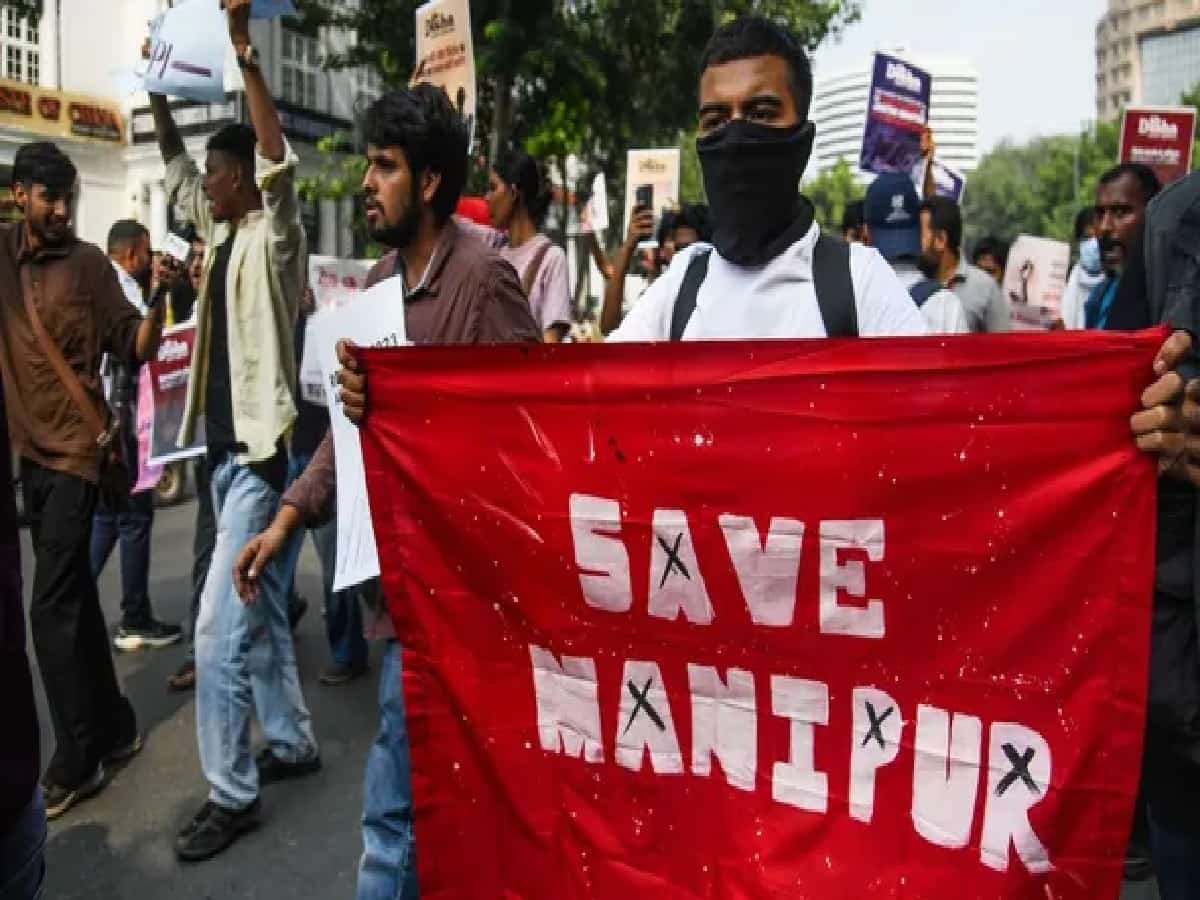
Woman Killed, 2 Missing in Kamjong Ambush Amid Escalating Ethnic Clashes
Fresh ethnic violence erupted across Manipur's volatile hill tracts on Thursday, October 15, 2026, after suspected Naga militants ambushed a group of civilians traveling along the Faikoh-Aishu roadway in Kamjong district. The targeted assault claimed the life of a Kuki woman, identified as Hatneikim from Haokip Molnoi village, and left her husband fighting for his life with severe traumatic injuries, while two accompanying community members remain untraceable. The victims were en route toward Faikoh to purchase essential household goods when their vehicle was intercepted and fired upon in an isolated forested stretch. Local administrative authorities and security formations rushed armed reinforcements to the remote international frontier belt, launching intensive cordon-and-search operations to track down the missing civilians and prevent retaliatory confrontations from spilling over into adjacent mixed-community villages.
Rising Casualties and Retaliatory Cycles: The Deadly Toll of Kuki-Naga Clashes
Thursday’s fatal ambush marks the tenth killing of a Kuki woman—including two expectant mothers—since deadly skirmishes between Kuki and Naga factions reignited in February 2026, following the prolonged Kuki-Meitei crisis that spanned from 2023 to 2025. The escalating friction has claimed at least 32 Kuki and 22 Naga lives over recent months, occurring barely five days after coordinated gunfights across three districts resulted in nine fatalities, including six Naga men, two Kukis, and one Gorkha civilian. The fragile ground situation deteriorated further late Wednesday night when joint security forces recovered the missing severed head of Ajinbou Ringkamai from an abandoned clearing in Kangpokpi district. Ringkamai was among four Naga villagers killed during an alleged militant strike on Makui Ashang on October 10, during which his assailants decapitated his body. Following a 48-hour ultimatum served by the Joint Tribes Council Manipur demanding the recovery of his remains for traditional rites, the recovered head was transferred to the Jawaharlal Nehru Institute of Medical Sciences (JNIMS) in Imphal to join his remains for an official autopsy.
Government Calls for Dialogue as Spear Corps Reviews India-Myanmar Border Fencing
Addressing the deteriorating law-and-order scenario from the state capital, Manipur Home Minister Govindas Konthoujam emphasized that statutory enforcement and military deployments alone cannot extinguish generational ethnic hostility, urging civil society groups to embrace structured dialogue and exercise emotional restraint. Speaking in Imphal while checking on 84 Border Security Force (BSF) personnel admitted to the Regional Institute of Medical Sciences (RIMS) due to suspected food poisoning, the Home Minister asserted that resolving territorial and ethnic disputes requires mutual human empathy rather than armed bloodshed. Simultaneously, defense authorities conducted high-level operational appraisals along sensitive frontier outposts, with Lieutenant General Girish Kalia, General Officer Commanding of the Spear Corps, visiting Assam Rifles forward bases to inspect tactical readiness along the 1,643-kilometer India-Myanmar boundary, of which 398 kilometers fall inside Manipur. Central engineering agencies have completed approximately 55 kilometers of fortified border fencing under a project targeted for total completion by 2028, though officials acknowledged that challenging mountainous terrain, dense jungle canopies, and persistent opposition from cross-border insurgent syndicates continue to test the pace of construction.




