







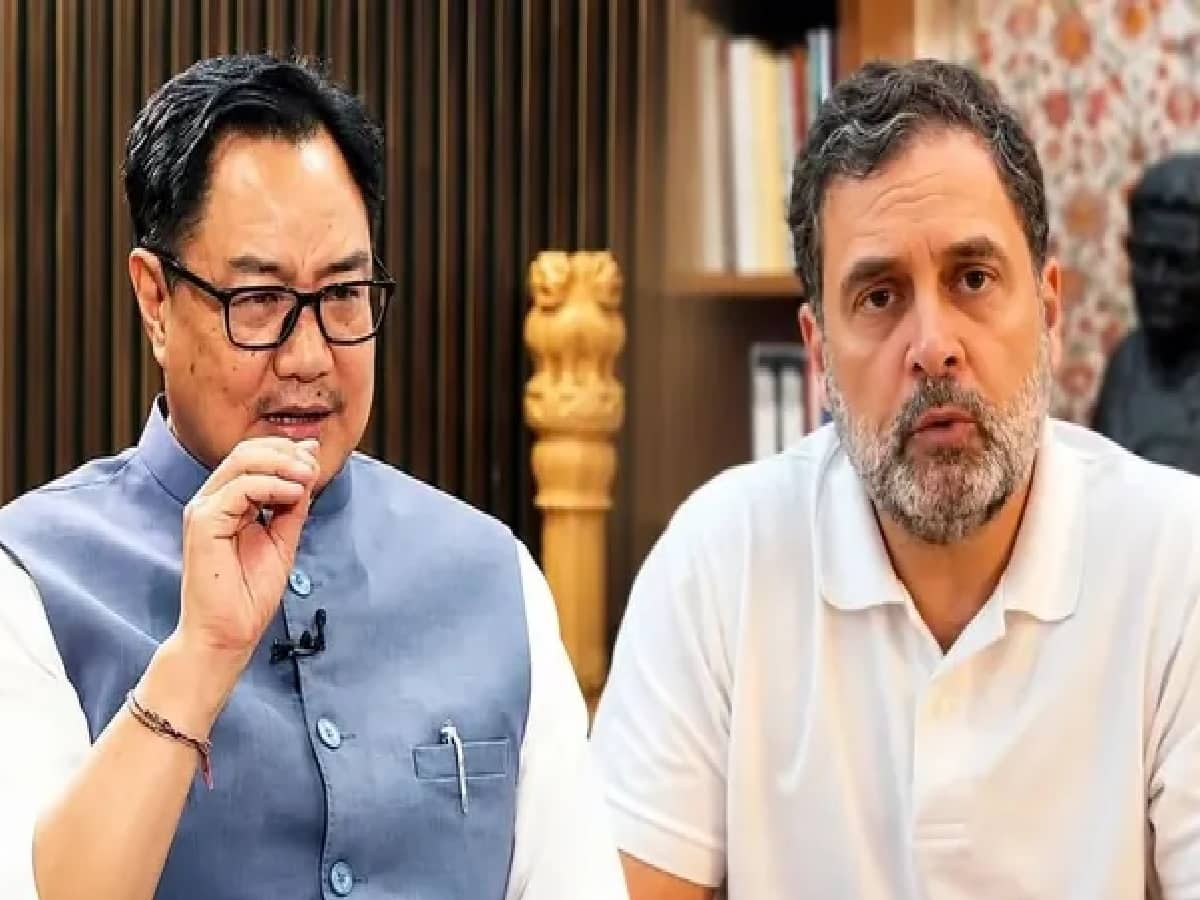
Rijiju Fires Four Questions at Rahul Gandhi Over 'Compromised PM' Post
A sharp war of words has erupted between the ruling Bharatiya Janata Party (BJP) and the Congress over India's foreign policy and historical governance record after Union Parliamentary Affairs Minister Kiren Rijiju issued a four-point challenge to Leader of the Opposition in the Lok Sabha Rahul Gandhi. In a social media post on X late Friday and in remarks to reporters through Saturday morning, November 21, 2026, Rijiju—who hails from Arunachal Pradesh—demanded that the Congress party apologize for what he termed the "humiliation" of the 1962 Sino-Indian War, recounting that his own village was occupied by Chinese forces during that conflict. Rijiju's intervention came in direct response to Rahul Gandhi's Friday social media post sharing a photograph of US President Donald Trump, Chinese President Xi Jinping, and Russian President Vladimir Putin seated together during their trilateral meeting on the sidelines of the Asia-Pacific Economic Cooperation (APEC) summit in Shenzhen, China. Sharing the image, Gandhi had written that if the Congress were in power, India's Prime Minister would have been seated at that table, adding that a "compromised PM can never sit at this table"—following up on his remarks earlier in the week at the University of Chicago, where he argued that India had been reduced to a "side player" in global diplomacy while Pakistan engaged in negotiations involving the United States and Iran. BJP leaders—including Rajya Sabha MP Sudhanshu Trivedi and national spokesperson Ashish Usha Agarwal—rejected Gandhi's critique by noting that India is not a member of APEC, which groups Pacific Rim economies, and highlighting India's active role in forums such as BRICS, the Quad, and the Shanghai Cooperation Organisation (SCO). For voters, political observers, and readers across Unnao, Lucknow, Kanpur, Varanasi, Itanagar, Mumbai, Bengaluru, and New Delhi, the exchange highlights the widening clash between the government and opposition over how India projects its diplomatic standing abroad.
Rijiju vs. Rahul Gandhi (Nov 20–21, 2026): Core Statements & Geopolitical Context
To bring together the exact questions posed by Union Minister Kiren Rijiju, the remarks made by Rahul Gandhi in the United States and on social media, and the counter-arguments raised by BJP leaders regarding APEC and multilateral diplomacy, the table below summarizes the verified facts:
| Political Actor / Side | Attributed Statements & Key Arguments | Geopolitical & Historical Context |
| Union Minister Kiren Rijiju's Four Questions | Challenged the Congress on X to answer four questions: 1. Whether Congress will apologize for the 1962 humiliation, noting Chinese forces occupied his village in 1962; 2. Why Congress kept India a poor nation; 3. Why India was labeled a "land of snake charmers"; and 4. Why India's economy was dismissed as the "Hindu rate of growth". | Urged Rahul Gandhi not to make statements against India whether inside or outside the country, questioning whether his criticism of PM Narendra Modi had crossed into undermining the nation itself. |
| Rahul Gandhi's 'Compromised PM' & 'Side Player' Remarks | On Friday, shared a photo of Donald Trump, Xi Jinping, and Vladimir Putin at the Shenzhen APEC sidelines, writing: "If Congress were in power, India's Prime Minister would be sitting at this table. A compromised PM can never sit at this table". Earlier at the University of Chicago (Nov 18), stated India had become a "side player" in global affairs while Pakistan negotiated with Iran and the US. | Called for India to reclaim a stronger independent global voice comparable to the stature of the Non-Aligned Movement and base foreign policy strictly on national interest. |
| BJP's Diplomatic Rebuttal | BJP MP Sudhanshu Trivedi and spokesperson Ashish Usha Agarwal pointed out that APEC (founded in 1989) is a forum for Pacific Rim economies, which India does not border, and noted that even nuclear-armed UNSC permanent members like the UK and France were absent from the US–China–Russia arms-control talks. | Cited India's membership in BRICS, the Quad, SCO, MTCR, Wassenaar Arrangement, and Australia Group as evidence of strategic autonomy. |
Inside Kiren Rijiju's Four-Point Challenge to the Congress Party
Responding to Rahul Gandhi's critique of Prime Minister Narendra Modi's foreign policy, Parliamentary Affairs Minister Kiren Rijiju framed the debate around India's post-independence economic and security record. Drawing on his personal roots in Arunachal Pradesh, Rijiju stated on X that Chinese troops had occupied his village during the 1962 war and asked whether the Congress party would apologize for what he called the 1962 humiliation. He further pressed the opposition party to explain why India remained economically constrained for decades, why the country was stereotyped abroad as a "land of snake charmers," and why its sluggish GDP expansion during the pre-liberalization era came to be derided globally as the "Hindu rate of growth". Speaking to reporters in New Delhi, Rijiju added that political opposition to the Prime Minister should never turn into remarks that diminish India's standing on foreign soil.
APEC Sidelines Photo, University of Chicago Speech, and the Foreign Policy Debate
The controversy stems from two back-to-back interventions by Rahul Gandhi during his trip to the United States. During an interaction at the University of Chicago on November 18, Gandhi argued that despite India's population of 1.5 billion and historical scale, New Delhi had become a "side player" in major international negotiations, contrasting India's posture with Pakistan's diplomatic engagement with Washington and Tehran. When Donald Trump, Xi Jinping, and Vladimir Putin subsequently held rare trilateral talks on UN reforms, energy supplies, and nuclear risk reduction on the sidelines of the APEC summit in Shenzhen, Gandhi posted their photograph to assert that a Congress Prime Minister would have been seated at that table. In response, BJP leaders argued that judging Indian diplomacy by absence from an APEC gathering overlooks basic diplomatic geography—since India borders the Indian Ocean rather than the Pacific—while emphasizing New Delhi's active presence in the Quad, BRICS, and SCO.




