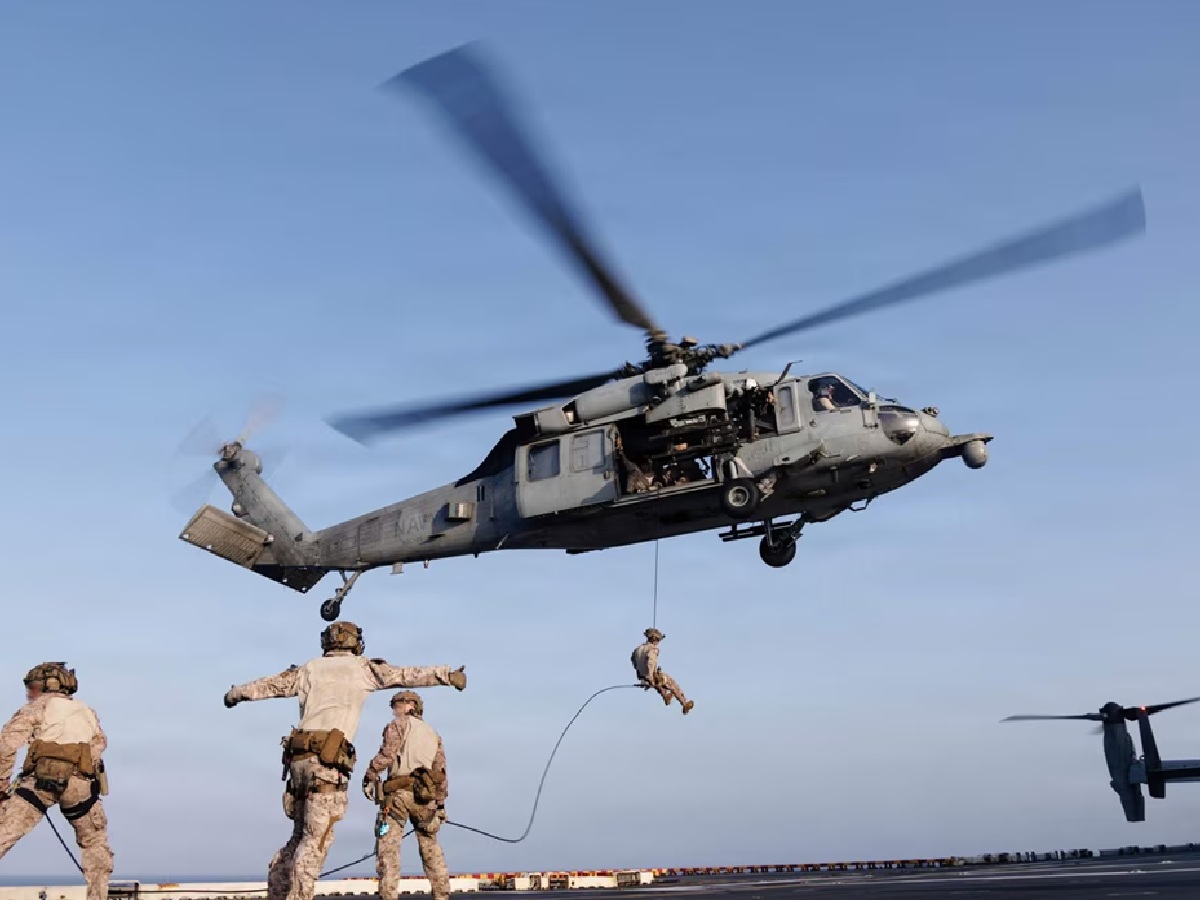
US Navy Helicopter Makes Emergency Landing in Arabian Sea: Search Underway for Missing Pilot
A critical maritime incident unfolded in the Arabian Sea early Wednesday, as a US Navy MH-60S Sea Hawk helicopter was forced into an emergency landing. While three of the four crew members on board were swiftly rescued and are currently in stable condition aboard the USS George H.W. Bush, a massive search-and-rescue operation is now underway for the one remaining pilot still missing.
Incident Details and Rescue Efforts
The emergency occurred at approximately 3:30 a.m. on July 1. According to the US Naval Forces Central Command, the helicopter was deployed from the USS George H.W. Bush when it encountered unexpected complications, forcing the crew to ditch the aircraft. The Navy has confirmed that there is currently no evidence to suggest the incident was the result of enemy fire or hostile action. All assets in the region have been redirected to coordinate the search for the missing crew member as the investigation into the mechanical cause of the emergency landing begins.
The Dangers of Maritime Emergency Landings
Aviation experts note that emergency water landings for helicopters are notoriously perilous. Because of the heavy design of the aircraft's upper hull, there is an immediate and significant risk of the vehicle capsizing and sinking rapidly upon impact. This inherent danger makes the successful evacuation of the three crew members a significant achievement for the rescue teams involved. Given the high-tension environment in the Arabian Sea, where military activity remains constant despite a tenuous ceasefire between US and Iranian forces, all naval units in the area have been placed on heightened alert.
Context of Regional Tensions
The crash occurs at a sensitive moment for US-Iran relations. As the search operation continues, both nations are concurrently engaged in a new round of indirect talks in Doha, Qatar. Mediated by Qatari and Pakistani officials, these negotiations are aimed at operationalizing a recent agreement focusing on the release of frozen Iranian assets and the stabilization of the Strait of Hormuz. While the military incident is being treated as an isolated operational emergency, it serves as a stark reminder of the complexities and risks inherent in maintaining a naval presence in one of the world's most volatile maritime corridors.