Why Is Lord Ganesha Worshipped First? Shiva’s Sacred Boon Revealed
Across Sanatan Dharma, every sacred undertaking—whether an elaborate Vedic wedding, a Griha Pravesh housewarming, or the launch of a new commercial enterprise—commences with an invocation to Lord Ganesha. Celebrated with unmatched spiritual joy on Ganesh Chaturthi, which marks his manifestation on Bhadrapada Shukla Chaturthi, the elephant-headed deity holds the uncontested title of Pratham Pujya (the First Worshipped Deity). While the tradition is woven into the daily rituals of millions of devotees, the theological and metaphysical basis for why Lord Ganesha takes precedence over all other celestial divinities rests on profound scriptural narratives preserved within ancient Puranic literature.
The Cosmic Race: Wisdom Triumphs Over Physical Speed in the Sibling Contest
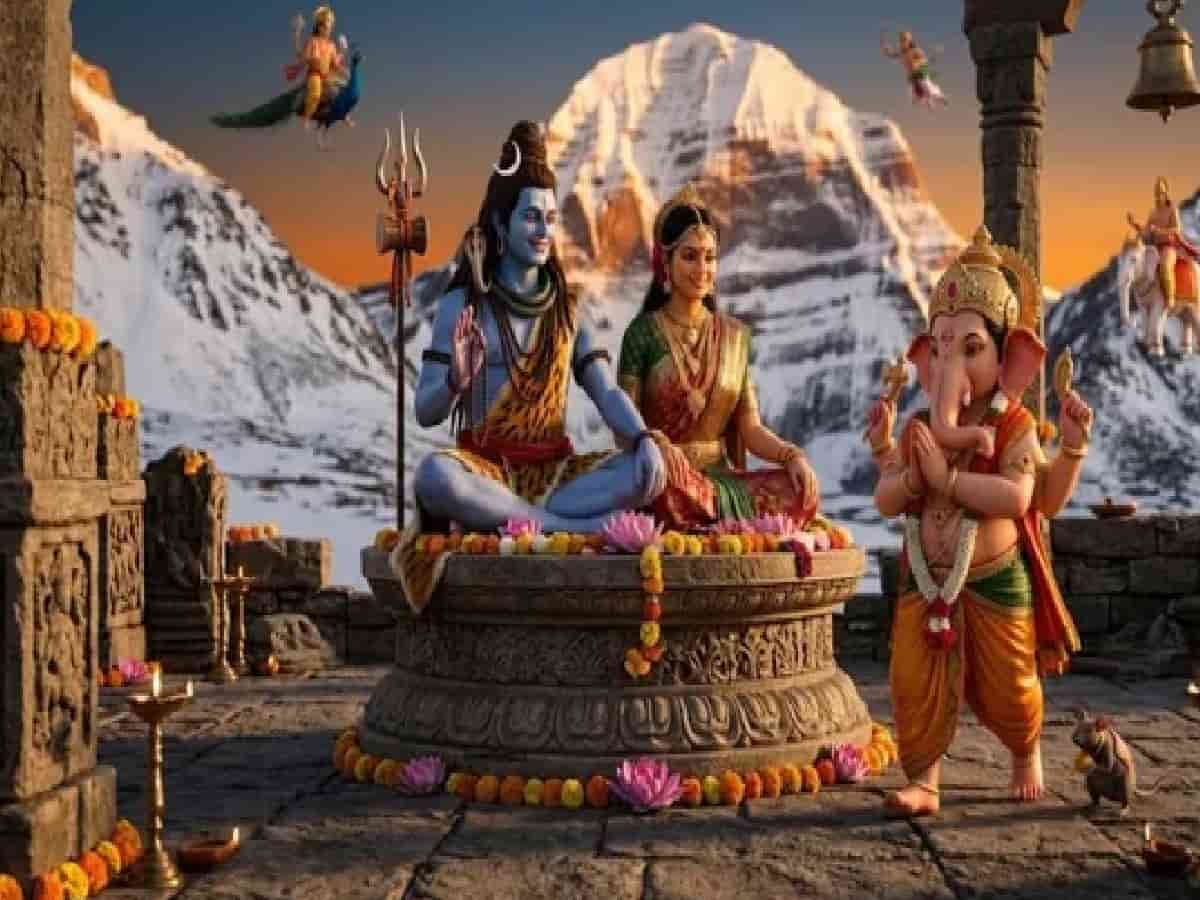
According to detailed chronicles in the Shiva Purana and associated mythological texts, the gods once faced a philosophical dilemma over who deserved absolute precedence in Vedic rituals. To determine primacy, Lord Shiva and Mother Parvati devised a definitive test for their two sons, Ganesha and Kartikeya (Murugan). The divine parents declared that whoever completed a full circumambulation (Pradakshina) of the entire cosmic universe and returned first to Mount Kailash would be honored as the supreme, foremost deity among all celestials.
Upon hearing the decree, Lord Kartikeya swiftly mounted his celestial peacock, Mayura, and sped off across cosmic boundaries to physically orbit creation. Lord Ganesha, with his heavy physique and riding a humble mouse (Mushak), recognized that sheer physical speed could not bridge the infinite cosmos. Instead of embarking on an outward journey, Ganesha employed his supreme intellect (Buddhi). Folding his hands with reverence, he performed three deliberate circumambulations around Lord Shiva and Mother Parvati.
‘My Universe Lies at My Parents’ Feet’: Shiva’s Eternal Boon of Pratham Puja
When an astonished Lord Shiva questioned his actions, Ganesha humbly replied that the entire cosmos, along with all sacred tirthas and divine realms, resides eternally within one’s parents, making circumambulating them equivalent to orbiting the entire manifest universe. Deeply touched by his profound wisdom, filial devotion, and philosophical clarity, Lord Shiva crowned him the foremost divinity and granted him an irrevocable boon, as codified in the Shiva Purana:
Tatvapujaam prathamam krutva tato pujaam karoti yah,
Tasya sarvaani karyaani sidhyanti naatra samshayah.
Through this divine decree, Mahadev ordained that whoever offers prayers to Lord Ganesha prior to invoking any other deity in any ceremony will see all their righteous endeavors accomplished without impediment, guaranteeing uninterrupted success and protection from adversity.
Sacred Ritual Essentials: Appeasing the Pratham Pujya with Modak and Durva Grass
To properly invoke the blessings of the foremost deity during Ganesh Utsav and daily worship, traditional rituals prescribe two indispensable offerings:
-
Naivedya of Modaks: Representing supreme bliss (Mahasukh) and spiritual enlightenment, fresh steamed or fried modaks are dear to Ganesha, symbolizing the sweet reward of inner wisdom.
-
Clusters of Fresh Durva Grass: Embodying cool metaphysical energy, sacred Durva grass blades offered in bunches of 21 soothe burning worldly ailments and complete the ceremonial worship.
Without these foundational elements and initial invocations to Ganpati Bappa, traditional rituals remain incomplete, reinforcing Lord Ganesha’s timeless role as the indispensable guardian of auspicious beginnings.