






Who is Anupama Singh, the envoy who called Pakistan a Bhasmasur at a jam-packed UN session
Indian diplomat Anupama Singh hit out strongly against Pakistan at the UN and described the neighboring country as a crumbling Frankenstein state that is being crippled by the very terror machinery that it spawned.
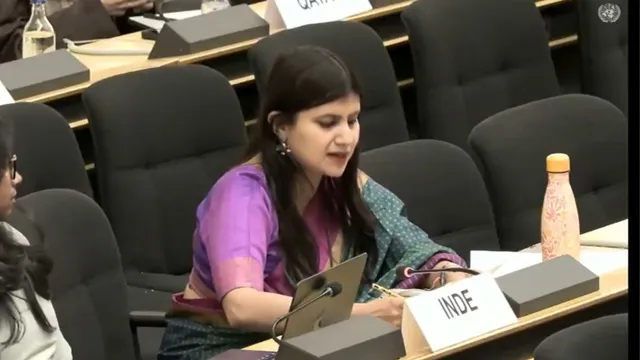
Singh, First Secretary at the Permanent Mission of India to the UN, slammed Pakistan on Friday during the 62nd session of the UN Human Rights Council (UNHRC) in Geneva.
During India’s right of reply at the interactive dialogue on the annual report of the UN High Commissioner for Human Rights, the young diplomat vehemently dismissed a litany of accusations that were levied by Pakistan and the Organization of Islamic Cooperation on Jammu and Kashmir.
Who is Anupama Singh?
Anupama Singh is a young diplomat in the Indian Foreign Service (IFS) and is currently holding the position of First Secretary at the Permanent Mission of India to the UN. She plays a significant role in presenting Indian policy and debating complex issues relating to global human rights on various multilateral forums, including the UN Human Rights Council. Known for her logical and clear arguments, she is at the forefront of new-age diplomats who aim to put a strong defense against anti-India global narratives.
What is Frankenstein state?
A Frankenstein state is a country that nourished, and empower, a particular extremist or terrorist element or group, only for that element/group to become dangerously out of control and be threatening its existence. Similar to the demon Bhasmasur in Hindu mythology, who was consumed by his own boon.
Hypocrisy in seeking world's sympathy
The much-talked about part of Singh's speech began with the First Secretary hitting out at the country's record of proxy terrorist actions. He labelled Pakistan's efforts to gain global sympathy as hypocrisy.
"This is a country where the sitting Defense Minister claims to nurture, train, and provide weapons to terrorists on official policy, and yet Pakistan itself is claiming to be the victim of terrorism. The paradox is only Pakistan can possibly perpetrate," he said.
He continued: "This is the living example of a Frankenstein state which finds itself shocked when the monster it has brought into being comes knocking on its door with knives ready to attack."
Drawing attention to the brutality in PoJK
Singh also hold the country accountable on the issue of human rights and highlighted the civil unrest and what he termed as state-backed violence in Pakistan-occupied Jammu and Kashmir. Singh further cited the ongoing civilian protest and crackdown in Rawalakot.
"The present situation in Rawalakot, the killings of hundreds of civilians, and the current crackdown in PoJK is the predicted outcome of a system that has survived through forceful occupation and continued repression," he pointed out. "People only have their lives left to defend from bullets and brutality, even for their fundamental rights of food, water, electricity and human dignity."
Indus Water Treaty rendered obsolete
The envoy squarely linked cross-border terror activity with sharing of resources between the two countries, and stated that it is no longer feasible for India to share its resources with such an administration, especially in view of the "security challenges", such as the recent Pahalgam terror attack. India reiterated its stance on the 1960 Indus Water Treaty no longer fitting in with the new realities of a 66-year-old conflict.
Concluding with strong words, Singh reminded the world that the region of Jammu and Kashmir was, is and will always remain an integral and inalienable part of India, and in no uncertain terms declared Pakistan's border transgressions as nothing more than a 'seasonal gimmick'. Singh urged Pakistan to stop its "blind lust" for Indian territory and "mend its broken house."