I Am Jantar Mantar: Witnessing the Unstoppable Rise and Raw Power of Gen-Z
Written from the poetic and historical perspective of New Delhi's iconic monument, the legendary Jantar Mantar has stood as a silent witness to centuries of political upheaval, social transformation, and the relentless march of time. Built in 1724 by King Sawai Jai Singh II of Jaipur primarily to map the cosmos, measure planetary movements, and track celestial bodies, these red-brick astronomical instruments have long since evolved into the ultimate epicenter of Indian democracy. From the historic anti-corruption movements of 2011 led by Anna Hazare to farmers' rights agitations and protests by elite female wrestlers, these historic grounds have echoed with the collective voice of a nation. Yet, despite witnessing countless protests, lathicharges, and political demonstrations, the ancient observatory recently encountered an entirely unprecedented wave of mobilization: the raw, determined power of Generation Z.
The Unprecedented Gen-Z Uprising Against Paper Leaks
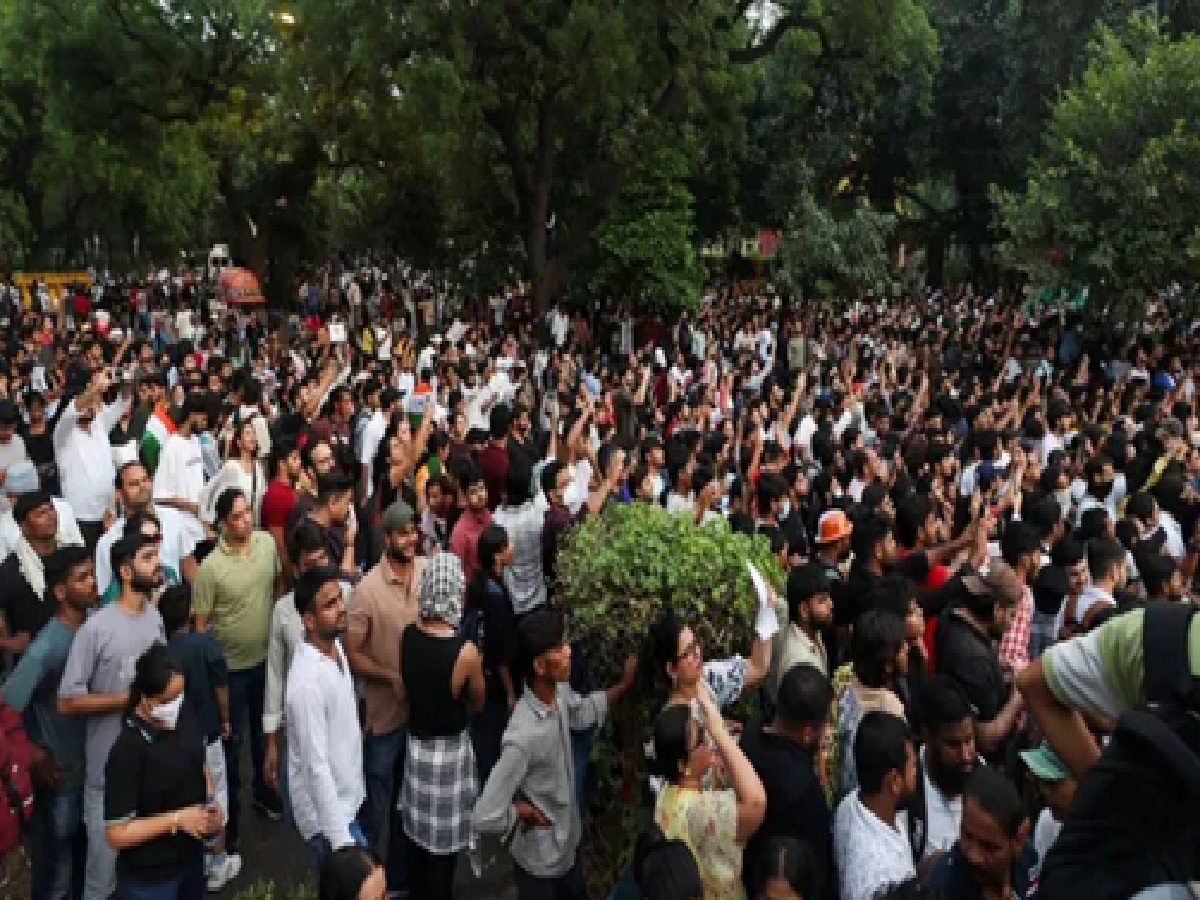
The historic courtyard in the heart of Lutyens' Delhi recently witnessed a massive, paradigm-shifting demonstration driven entirely by Gen-Z—youngsters born between 1997 and 2012 who traveled from all corners of the country. Gathering to peacefully protest systemic flaws in the education system and recurring competitive exam paper leaks, these youth brought a completely new energy to the capital's streets. Undeterred by heavy police barricades, water cannons, and batons, the participants stood their ground, proving that India's newest generation possesses an unyielding resolve to secure its collective future. Unlike traditional political rallies dominated by party flags and rigid organizational structures, this movement was organic, tech-driven, and focused strictly on systemic reform and academic justice.
A Modern Protest Culture: Books, Plakats, and Pizza Boxes
The recent youth-led agitation at Jantar Mantar also marked a fascinating cultural shift in how demonstrations unfold in modern India. Eschewing the traditional reliance on local confectioners preparing massive batches of puris and vegetables, the contemporary protest site saw an endless stream of digital food delivery executives navigating police cordons. Students carrying books and justice-oriented placards were seen sharing fast food like pizzas and burgers, reflecting a distinct urban youth lifestyle. While the massive influx of outside food occasionally resulted in street litter and attracted rogue miscreants trying to hijack the narrative, the sheer passion, ideological clarity, and digital-age enthusiasm of the students overshadowed the administrative chaos, reaffirming the monument's timeless role as a crucible of social change.
A Quick Glance at the History and Architecture of Jantar Mantar
Originally constructed as an advanced astronomical observatory by Maharaja Sawai Jai Singh II of Jaipur to rectify errors in ancient astronomical tables, Jantar Mantar remains an architectural marvel protected by the Archaeological Survey of India across its 18.5-acre sprawling grounds. Aside from New Delhi, these architectural complexes were built in Jaipur, Ujjain, Varanasi, and Mathura, with the Delhi and Jaipur locations gaining global renown. The site features legendary instruments such as the world's largest stone sundial, the Samrat Yantra, which accurately calculates local time, alongside bowl-shaped instruments designed to track stellar positions, the cylindrical Ram Yantra for measuring solar altitude, and the Mishra Yantra, a composite device capable of determining times across various international cities. Though its astronomical instruments are now defunct relics of a bygone era, Jantar Mantar continues to tick forward, standing tall as the eternal heartbeat of India's democratic aspirations.