







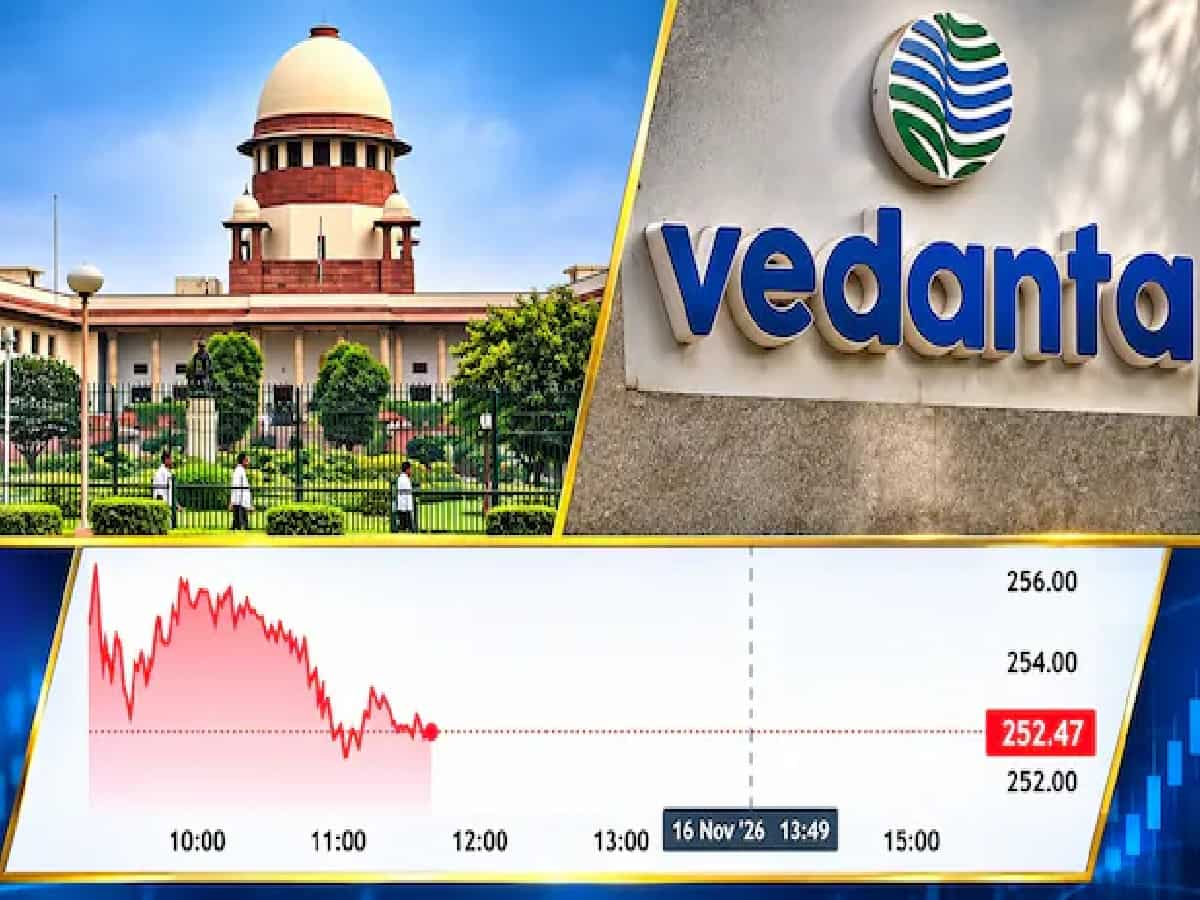
Vedanta Shares Slip After Supreme Court Upholds Twin Star Plan Rejection
Shares of mining and metals major Vedanta Limited came under selling pressure in Monday morning trade on November 16, 2026, after the Supreme Court of India upheld a landmark National Company Law Appellate Tribunal (NCLAT) ruling that set aside the resolution plan submitted by Vedanta Group-backed Twin Star Technologies Limited for 13 consolidated Videocon Group companies. Opening at ₹257.31 against its previous close of ₹259.68 on the exchanges, Vedanta's stock slipped intraday to a low of ₹251.50 as investors digested the legal setback surrounding the long-running insolvency proceeding. By dismissing appeals challenging the appellate tribunal's decision, the apex court has cleared the way for the matter to return to Videocon's Committee of Creditors (CoC), opening the door for lenders to reconsider the resolution process and potentially invite fresh bids. The dispute centers on Twin Star Technologies' 2020 resolution offer of approximately ₹2,962 crore against admitted creditor claims of roughly ₹64,637.6 crore—a deal that drew intense judicial and financial scrutiny because it entailed a steep 95 to 96 percent haircut for banks and financial institutions. For retail shareholders, institutional investors, banking analysts, and market participants across Mumbai, New Delhi, Bengaluru, Chennai, Hyderabad, Ahmedabad, Pune, Kolkata, Lucknow, and Jaipur, the Supreme Court verdict removes years of legal ambiguity over the Videocon insolvency while prompting near-term reassessment of Vedanta's corporate acquisition roadmap.
What Did the Supreme Court Decide in the Twin Star–Videocon Case
In Monday's ruling, the Supreme Court dismissed appeals filed against the NCLAT's January 5, 2022 judgment, thereby affirming the appellate tribunal's authority to overturn the National Company Law Tribunal's (NCLT) earlier approval of Twin Star Technologies' takeover bid and remit the matter back to the Committee of Creditors for fresh consideration. In a related order, the top court also rejected a separate plea by former Videocon Group chairman Venugopal N. Dhoot seeking to fold overseas oil and gas assets of group entities into the insolvency process of Videocon Industries Limited.
| Legal & Market Parameter | Verified Case & Market Figures | Key Impact on Vedanta & Creditors |
| Vedanta Share Price Action (Nov 16) | Opened at ₹257.31 (prev. close ₹259.68); fell intraday to ₹251.50 | Immediate knee-jerk selling as markets priced in the Supreme Court dismissal |
| Twin Star Resolution Offer vs. Claims | ~₹2,962.02 crore offer against ~₹64,637.6 crore in admitted claims | Implied a ~95.85% (nearly 96%) haircut for financial creditors |
| Supreme Court & NCLAT Mandate | Upheld NCLAT order setting aside NCLT approval and returning plan to the CoC | Committee of Creditors can reconsider terms and potentially invite fresh resolution bids |
| Procedural & Statutory Flaws Cited | Challenged by dissenting lenders (Bank of Maharashtra, IFCI, SIDBI) | NCLAT flagged Section 30(2)(b) IBC non-compliance (paying dissenting lenders via equity/NCDs) and missing prior CCI approval |
| Institutional Ownership Trend | FII holding in Vedanta rose from 11.08% (Sept 2025) to 15.78% (Sept 2026) | Reflects a 4.70 percentage point increase in foreign institutional backing over the past year |
Under India's Insolvency and Bankruptcy Code (IBC), the NCLAT hears appeals against NCLT orders, while the Committee of Creditors—comprising financial lenders owed money by the distressed company—evaluates and votes on revival proposals. By upholding the NCLAT's remand order, the Supreme Court confirmed that appellate tribunals can send a resolution plan back to lenders when statutory compliance is found lacking.
Why Was the Nearly 96% Haircut Questioned by Lenders and Tribunals
When a debt-laden corporation cannot repay its full liabilities, lenders may accept a "haircut"—waiving a portion of their admitted claims to facilitate a viable corporate revival. However, in the consolidated insolvency of 13 Videocon Group firms led by the State Bank of India, Twin Star Technologies' ₹2,962 crore proposal meant creditors would recover barely 4 to 5 percent of their ₹64,637.6 crore dues, absorbing an extraordinary ~95.85 percent write-off.
Dissenting financial creditors—including Bank of Maharashtra, IFCI, and SIDBI—challenged the June 2021 NCLT approval before the NCLAT. The appellate tribunal found that paying dissenting creditors through non-convertible debentures (NCDs) and equity violated Section 30(2)(b) of the IBC, noted discrepancies in liquidation value disclosures, and pointed out that mandatory Competition Commission of India (CCI) clearance had not been obtained prior to the CoC vote.
What Happens Next for Vedanta Shareholders and the Resolution Process
With the Supreme Court putting its final seal on the NCLAT order, the Videocon insolvency file now returns to the Committee of Creditors, which may deliberate on inviting fresh resolution plans from prospective bidders. Market experts note that it remains premature to predict the timeline, valuation, or recovery rate of any revised bidding round, or whether Vedanta Group will submit a modified proposal. For Vedanta investors, core operational fundamentals—supported by rising Foreign Institutional Investor (FII) ownership, which climbed 4.70 percentage points from 11.08 percent in September 2025 to 15.78 percent in September 2026—remain the primary long-term anchor once Monday's legal headline volatility subsides.




