






HSBC Upgrades India to Overweight, Downgrades China to Neutral
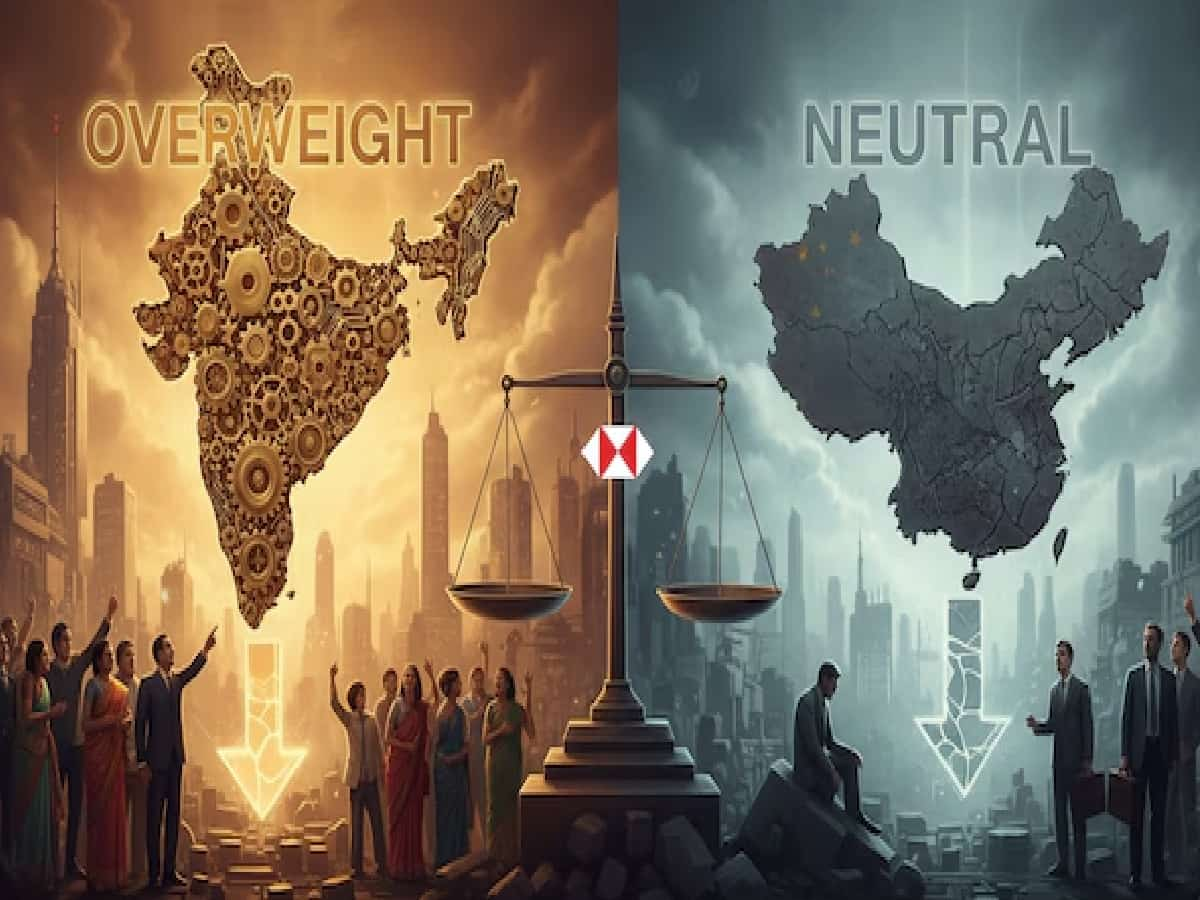
Global institutional asset allocators are preparing for a notable realignment in emerging market capital flows as banking giant HSBC announced a major strategic pivot across its Asian equity coverage. In a comprehensive strategy note released to global institutional investors, the London-headquartered investment bank upgraded India’s equity market rating from "Neutral" to "Overweight," while simultaneously downgrading China from "Overweight" to "Neutral." The strategic repositioning signals a tactical and structural vote of confidence in India's macroeconomic resilience, led by sustained corporate profitability, expanding private credit demand, and insulation from external trade shocks. Conversely, while Beijing’s recent stimulus interventions and depressed valuations have offered tactical floor support for Chinese equities, HSBC's strategists emphasized that broader catalysts capable of driving a sustained, multi-year bull market in China remain constrained, opening the doors for institutional reallocation toward Dalal Street.
The Great Asian Reallocation: Why HSBC Flipped on China and India
The tactical reassessment, led by Harald van der Linde, Head of Equity Strategy for Asia-Pacific at HSBC, marks a critical inflection point in the ongoing debate between emerging market investors. For much of the preceding quarters, global fund managers had attempted to rotate capital back into mainland Chinese indices, drawn by beaten-down multiples and aggressive government liquidity injections. However, structural headwinds—including prolonged real estate balance sheet deleveraging, subdued consumer sentiment, and geopolitical tariff overhangs—have continued to cap sustainable upside.
In contrast, the Indian market has absorbed global volatility and high international interest rates with remarkable domestic absorption. Foreign institutional investors (FIIs), who had maintained a cautious posture due to elevated price-to-earnings multiples in mid-cap segments, are now confronting an Indian macro environment characterized by robust capital expenditure cycles, stable foreign exchange reserves, and steady domestic institutional inflows. HSBC's strategic upgrade serves as an authoritative endorsement that India’s economic growth is not merely a transient post-pandemic rebound, but a durable multi-year expansion cycle driven by structural domestic demand.
Five Core Catalysts Behind HSBC’s Overweight Call on India
HSBC's conviction in lifting India to an Overweight benchmark rests upon five foundational economic and financial pillars:
First, corporate earnings visibility remains resilient. Unlike export-reliant economies across East Asia that are vulnerable to slowing global trade, corporate India’s top-line and operating profit trajectories continue to show robust durability. While seasonal input price increases and energy costs may lead to localized revisions in selected sectors, HSBC underscored that aggregate corporate earnings momentum across frontline Nifty and Sensex constituents remains broad-based, providing fundamental earnings support to equity benchmarks.
Second, equity valuations have returned to more reasonable and sustainable bands. Following intermittent market corrections and time-wise consolidation throughout recent quarters, the valuation gap between Indian equities and their long-term historical averages has moderated. HSBC's comparative models indicate that risk-adjusted valuations in India now offer attractive entry windows for long-term allocators when measured against sovereign return profiles and structural return on equity (ROE) across emerging markets.
Third, a generational credit boom is empowering the domestic financial system. Indian commercial banks and non-banking financial companies (NBFCs) are operating with multi-year low non-performing asset (NPA) ratios, well-capitalized balance sheets, and robust capital adequacy buffers. Healthy double-digit loan growth across retail mortgages, auto loans, MSME working capital, and private infrastructure loans is generating strong net interest income, making the financial sector a primary engine of market profitability.
Fourth, domestic consumption acts as an autonomous growth engine. India’s growth is fundamentally anchored by internal consumer demand rather than vulnerable overseas export corridors. Sustained consumer spending across urban retail, automotive, private healthcare, and residential real estate has created a protective moat around corporate revenues. Furthermore, prudent monetary interventions by the Reserve Bank of India have stabilized the Indian Rupee against broader currency market swings, reinforcing macroeconomic predictability.
Fifth, India serves as an indispensable portfolio diversifier against AI-concentrated North Asian markets. Many prominent East Asian bourses—such as Taiwan and South Korea—have become heavily concentrated around semiconductor fabrication and hardware supply chains tethered to the artificial intelligence thematic trade. While lucrative during tech rallies, this hyper-concentration exposes portfolios to severe technology-cycle volatility. HSBC positions India as an essential, non-correlated balancing asset, offering investors exposure to diversified secular themes including demographic dividends, domestic consumption, and physical infrastructure buildouts.
The China Reality Check: Why Policy Stimulus Isn't Fueling a Rally
Explaining the rationale behind cutting China’s rating to "Neutral," HSBC acknowledged that recent fiscal announcements, monetary easing measures, and state-backed equity purchases by Beijing have helped arrest steep market declines. Historically cheap equity valuations across the CSI 300 and Hang Seng indices continue to attract short-term opportunistic traders looking for technical rebounds.
However, HSBC's strategy team cautioned that a distinction must be drawn between short-term policy stabilization and a structural economic expansion. Despite successive policy rate cuts and liquidity injections into state-owned commercial banks, Chinese private sector credit demand remains subdued, while household savings rates remain unusually high due to lingering anxieties over property sector debt and municipal fiscal distress. Without aggressive structural reforms aimed at reviving consumer confidence, real estate liquidation, and sustainable domestic demand, the catalysts required to drive Chinese equities to new highs remain distinctly limited.
Sector Playbook: Where HSBC Sees Alpha in India
Within the upgraded Indian market, HSBC has articulated a clear sector rotation framework, advising institutional clients to concentrate exposure in high-quality, domestic-demand-facing growth companies:
The bank's most preferred sectors include Financials, Consumer Discretionary, Automobiles, Real Estate, Industrials, and Hospitals. Financial institutions stand to benefit directly from resilient credit demand and clean corporate loan books. The automotive and consumer discretionary spaces are riding premiumization trends among middle-class households. Real estate developers continue to report strong pre-sales momentum and inventory liquidation, while capital goods and industrials are supported by public and private capex allocations. The private hospital sector is experiencing structural tailwinds driven by rising health insurance penetration and expanding medical tourism.
Conversely, HSBC has adopted an underweight or least-preferred stance toward Information Technology (IT), Consumer Staples, Oil and Gas, Utilities, and Pharmaceuticals. Export-oriented IT services firms continue to face headwinds from delayed discretionary spending decisions among American and European corporate clients. Consumer staples companies are grappling with margin pressures and sluggish rural recovery, while the oil and gas sector remains vulnerable to international crude volatility and administered pricing interventions.
Macro Headwinds: Navigating Crude Volatility and Climate Uncertainties
Despite the upgrade, HSBC's research note does not dismiss the macroeconomic risks facing the Indian economy. The foremost vulnerability remains elevated global crude oil prices. Because India imports over 85 percent of its domestic crude requirements, sustained price spikes in international Brent crude could widen the current account deficit, introduce imported inflation, and squeeze operating margins for energy-intensive manufacturing industries.
The second variable monitored by analysts is climate-related volatility, specifically the periodic disruption caused by El Niño weather patterns. Unpredictable spatial distribution of monsoon rains can disrupt kharif and rabi agricultural yields, stoking food inflation and temporarily dampening rural discretionary purchasing power. Nevertheless, HSBC concluded that while these factors could generate quarterly earnings fluctuations, they do not possess the structural momentum required to derail the broader institutional conviction underpinning India’s equity trajectory.