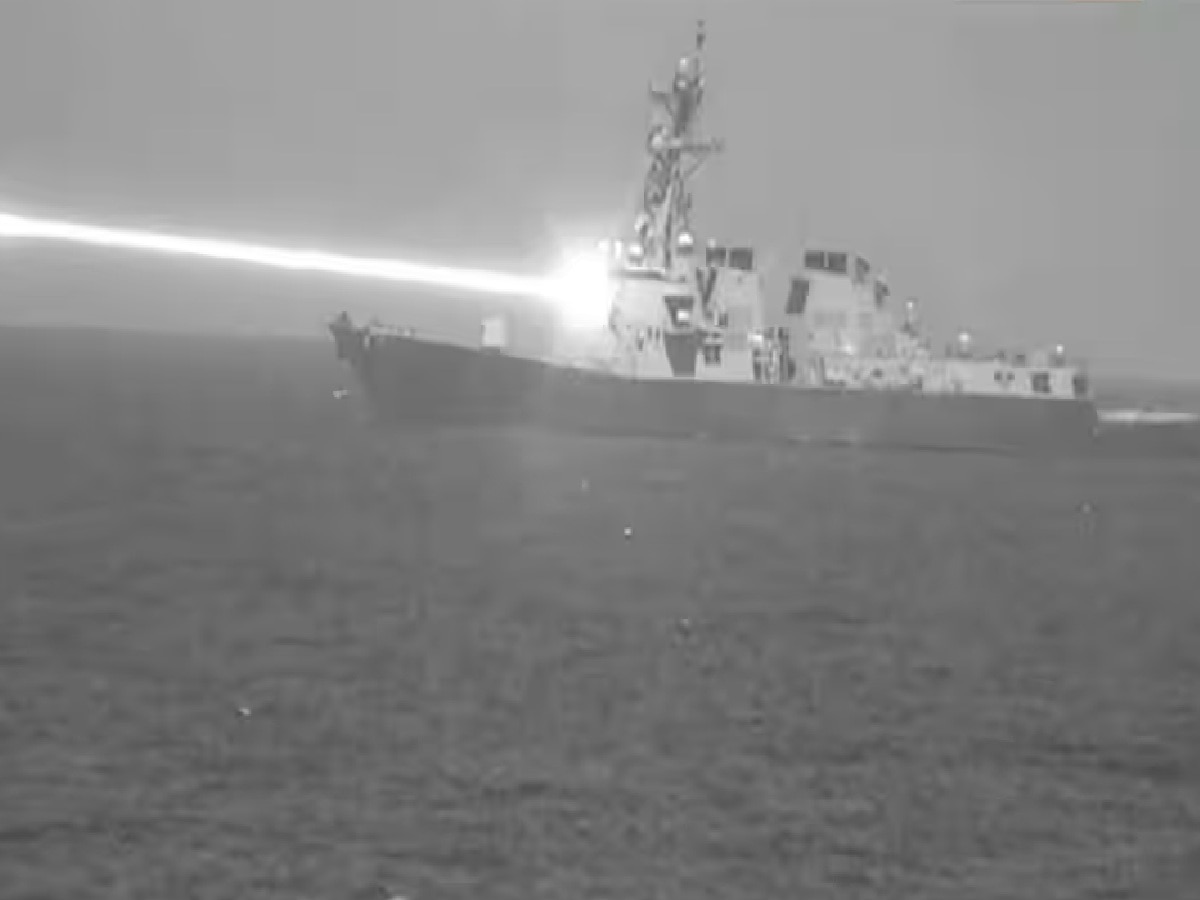
No Missiles, No Drones: US Navy Arms Warships With 60-kW HELIOS Laser Weapon
Faced with an escalating barrage of low-cost loitering munitions, anti-ship ballistic missiles, and autonomous surveillance drones across volatile Middle Eastern waters, the United States Navy is accelerating the deployment of directed-energy weaponry. Rather than launching multi-million-dollar interceptor missiles to down inexpensive targets, American naval planners are pivoting toward high-energy laser systems capable of striking threats at the speed of light. At the cutting edge of this tactical transformation is the High Energy Laser with Integrated Optical-dazzler and Surveillance (HELIOS) system, a game-changing 60-kilowatt class directed-energy weapon engineered to defeat modern asymmetric aerial swarms.
Deployed on Warships: Inside the 60-Kilowatt HELIOS Arsenal
Engineered as an organic defense system for modern naval combatants, HELIOS fundamentally alters the economics of surface warfare by projecting high-intensity beams of concentrated photonic energy instead of kinetic ordnance. The weapon system is purpose-built to execute three simultaneous missions: physically burning through uncrewed aerial vehicles (UAVs), neutralizing fast attack small craft, and using an integrated low-power optical dazzler to blind hostile intelligence, surveillance, and reconnaissance (ISR) sensors. The US Navy integrated and field-deployed the combat-ready HELIOS system aboard the Arleigh Burke-class guided-missile destroyer USS Preble, with comprehensive Pentagon defense evaluations in 2025 and 2026 demonstrating successful live-fire intercepts against dynamic drone threats.
Precision Targeting: How Mirrors Lock Onto Drone Vulnerabilities
Engaging an airborne threat with HELIOS relies on a tightly synchronized loop of electronic sensors and high-speed optics. Modern shipboard radar tracks the incoming target before transferring coordinates to advanced electro-optical and infrared targeting systems. Once locked, the weapon's operator inspects the live visual telemetry to pinpoint the target's most vulnerable structural or functional point—known in naval ballistics as the 'M-spot'—such as an engine manifold, battery pack, fuel bladder, or flight-control winglet. High-speed, micro-calibrated mirrors instantly focus the 60-kilowatt laser beam onto that singular point, heating the material to catastrophic failure within seconds. While operating the system eliminates the need for expensive physical rounds, sustained firing requires reliable shipboard electrical power and liquid-cooling thermal regulation.
Video-Game Controllers at the Helm of Futuristic Combat
A defining operational innovation of modern shipboard directed-energy weapons is the adoption of familiar, commercial-grade human-machine interfaces. Tracing back to initial Laser Weapon System (LaWS) trials conducted aboard the USS Ponce in the Persian Gulf as early as 2014, naval engineers have integrated intuitive, Xbox-style video game controllers to command turret slew and beam positioning. The ergonomic design drastically reduces the training curve for junior enlisted operators, enabling fluid, millisecond adjustments during high-stress aerial engagements. However, the accessible hand controls represent merely the frontline interface; behind the joystick operates an immensely sophisticated web of autonomous fire-control algorithms, thermal telemetry nodes, and target-motion predictors.
The Deep Magazine Advantage Over Million-Dollar Missiles
The primary strategic impulse driving directed-energy adoption is the steep cost-exchange asymmetry of modern combat. Houthi rebels and regional militias frequently deploy one-way attack drones costing a few thousand dollars, while traditional shipboard interceptors like the SM-2, SM-6, or ESSM cost anywhere from 1 million to over 4 million dollars per launch. Laser weapons solve this financial drain by offering a near-limitless "deep magazine"—a vessel can fire continuously as long as its onboard gas turbines generate electrical wattage, reducing the per-shot operational cost to pennies. Despite these advantages, lasers face tactical constraints, as dense sea fog, blowing desert dust, sandstorms, and atmospheric turbulence can scatter photon beams, making directed energy a critical complement to traditional surface-to-air missiles rather than a total replacement.
Naval Forward Deployments Across Persian Gulf and Red Sea Corridors
With naval combat fleets operating continuously under US Central Command and the Bahrain-based US 5th Fleet, operational testing has shifted directly toward frontline maritime choke points. Strategic waters including the Bab el-Mandeb and the Strait of Hormuz have seen heightened naval escorts to protect global merchant shipping and freedom of navigation. Official US Navy logs confirm continuous deployments of advanced surface combatants into the 5th Fleet's area of operations—including missions by destroyers like the USS Mason—positioning directed-energy systems and integrated layered defenses directly where commercial sealanes face persistent drone harassment.