







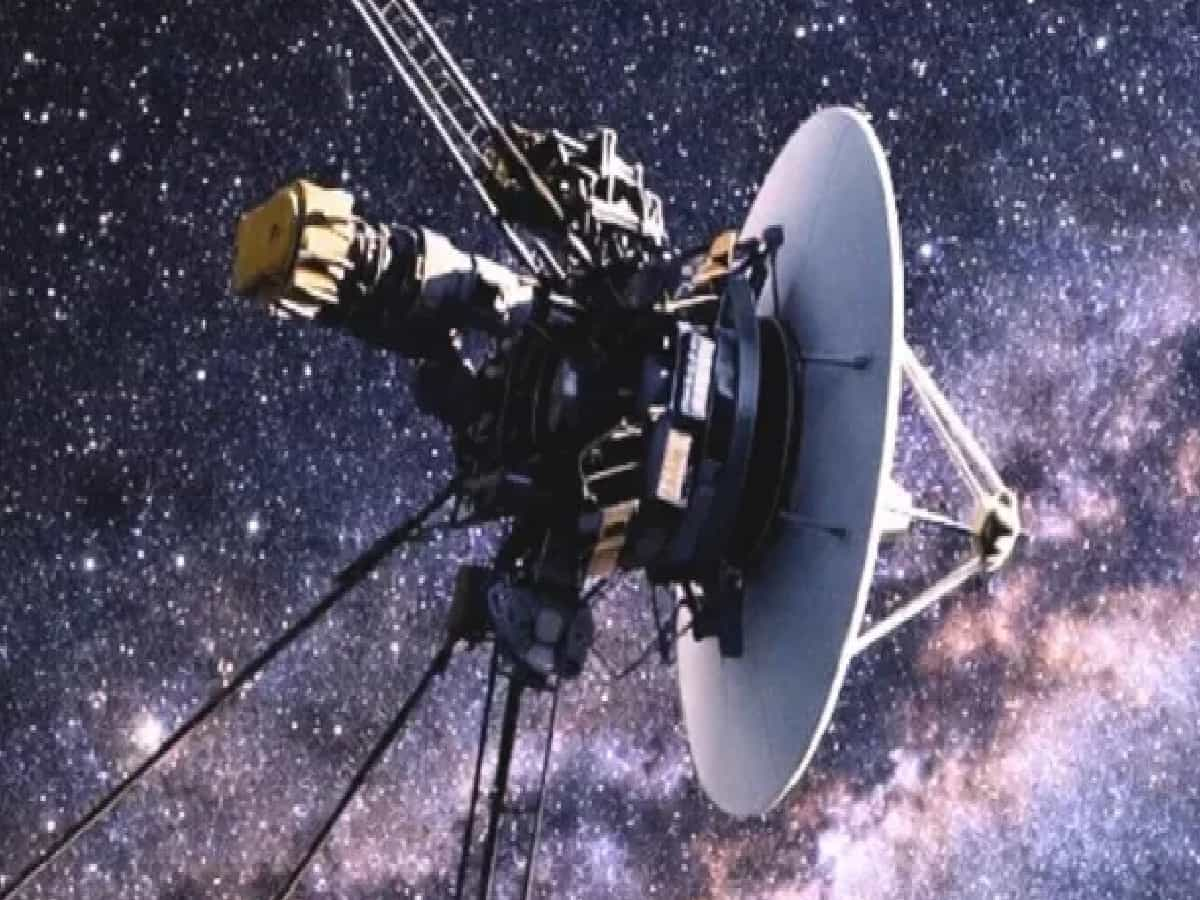
NASA's Voyager 1 Set to Reach One Light-Day From Earth After 49 Years
Nearly half a century after departing Earth on an epic voyage into the cosmos, NASA's Voyager 1 spacecraft is poised to cross a breathtaking frontier in human space exploration. According to NASA mission officials, on Wednesday, November 18, 2026, at 5:16 a.m. EST (3:46 p.m. IST), the 49-year-old robotic probe will become the first human-made object in history to reach a distance of one light-day from Earth—roughly 16.094 billion miles (about 25.9 to 26 billion kilometers) away. A light-day measures the staggering distance that light—traveling at nearly 300,000 kilometers (186,000 miles) per second—covers in a full 24-hour period. Once Voyager 1 crosses this threshold, any radio command transmitted from NASA's Deep Space Network on Earth will require 24 hours just to reach the spacecraft, and another 24 hours for Voyager 1's response to return—turning every single engineering exchange into a 48-hour round-trip conversation across interstellar space. For astronomy enthusiasts, science students, educators, and space watchers across New Delhi, Lucknow, Bengaluru, Mumbai, Hyderabad, Chennai, Kolkata, Pune, and Ahmedabad, this historic milestone celebrates human curiosity, enduring engineering, and India's own contribution to Voyager's iconic Golden Record.
What One Light-Day Means—And Why Signals Take 24 Hours Each Way
Despite its name, a light-day is a unit of distance rather than time, representing how far electromagnetic radiation travels in 24 hours. To put Voyager 1's separation into cosmic perspective, sunlight takes just 8 minutes and 20 seconds to reach Earth (1 Astronomical Unit, or about 150 million kilometers), and roughly 5.5 hours to reach Pluto. Voyager 1, cruising through interstellar space beyond the heliopause at approximately 61,155 km/h (nearly 38,000 mph), has now traveled more than four times farther than Pluto.
| Cosmic Benchmark / Mission Milestone | Approximate Distance From Earth / Sun | One-Way Light / Radio Travel Time |
| Earth to the Moon | ~384,400 km | 1.3 seconds |
| Sun to Earth (1 AU) | ~149.6 million km | 8 minutes 19 seconds |
| Sun to Pluto (Average) | ~5.9 billion km (~3.67 billion miles) | ~5.5 hours |
| Voyager 1 Crosses Heliopause (Aug 2012) | ~121 AU (~18 billion km) | ~17 hours |
| Voyager 1 One Light-Day Milestone (Nov 18, 2026) | ~25.9–26 billion km (16.094 billion miles / 173.14 AU) | 24 hours one way (48 hours round-trip) |
Because radio waves travel at the speed of light, mission engineers at NASA's Jet Propulsion Laboratory (JPL) in Southern California must verify every command sequence meticulously on the ground before transmission, knowing they must wait two full days to confirm whether the spacecraft executed the instruction.
Keeping a 49-Year-Old Space Explorer Alive in Interstellar Space
Launched on September 5, 1977—16 days after its twin, Voyager 2—Voyager 1 originally set out to study Jupiter and Saturn before continuing outward past the solar bubble into interstellar space in August 2012. Nearly five decades later, its plutonium-powered radioisotope thermoelectric generators lose roughly 4 watts of electrical power each year, forcing JPL engineers to manage power budgets with extraordinary precision. Even with older cameras and several instruments powered down to conserve energy, Voyager 1 continues relaying vital measurements from its plasma wave subsystem and magnetometer on interstellar magnetic fields, plasma density, and cosmic rays.
The Golden Record and NASA's Global 'Shine Bright' Celebration
Voyager project manager Suzanne Dodd has affectionately described the twin probes as "national treasures" and enduring ambassadors of humanity. Bolted to Voyager 1's exterior is the famous 12-inch gold-plated copper Golden Record, curated by a committee chaired by Carl Sagan—carrying spoken greetings in 55 languages (including Hindi, Bengali, Gujarati, Kannada, Marathi, Odia, Punjabi, Rajasthani, Tamil, Telugu, and Urdu), the classic Indian raga "Jaat Kahan Ho" sung by Surshri Kesarbai Kerkar, natural Earth sounds, 115 encoded images, and a child's voice saying, "Hello from the children of planet Earth."
To mark the historic milestone, NASA has invited skywatchers worldwide to participate in "Shine Bright for Voyager's Light-Day" after sunset on Tuesday, November 17, by flashing Voyager's Morse code call sign V-G-R toward the sky, followed by a live public briefing from JPL's von Kármán Auditorium on Thursday, November 19.




