







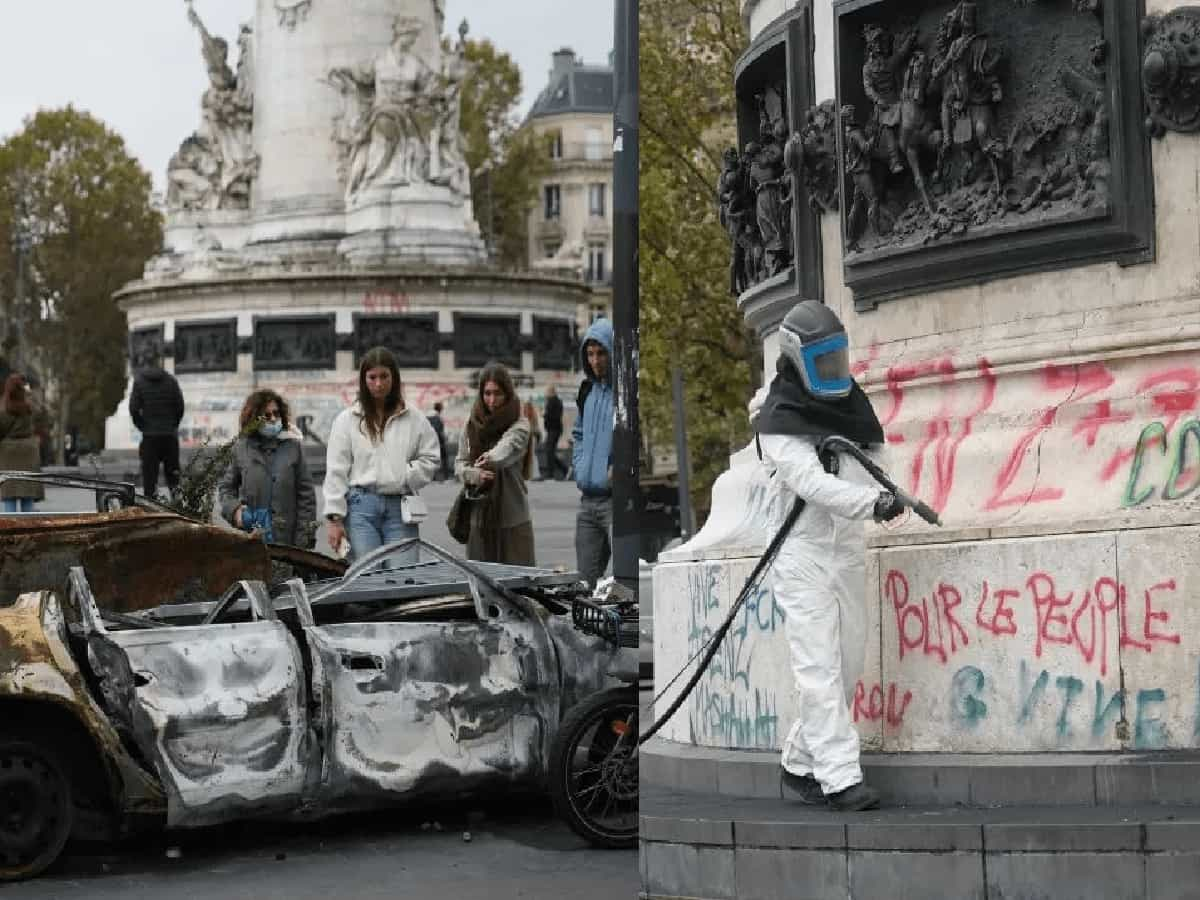
France Under Siege: Nearly 1,000 Arrested and 70,000 Police Deployed as Fierce Riots
France witnessed a dramatic resurgence of nationwide civil unrest on Saturday, October 24, 2026, as hundreds of thousands of demonstrators flooded urban boulevards to protest soaring living expenses, chronic underfunding in public education, and escalating economic inequality. The mobilization deteriorated into severe street confrontations across Paris, Lyon, Nantes, and multiple regional hubs, forcing anti-riot police to deploy tear gas salvos and high-pressure water cannons. French Interior Minister Laurent Nuñez announced that law enforcement detained nearly 1,000 individuals nationwide amid what authorities described as extreme violence from ultra-left extremist factions. With over 70,000 security personnel deployed across the republic, the violent flare-up has dramatically intensified pressure on President Emmanuel Macron, who faces mounting administrative friction just six months ahead of the pivotal French presidential elections.
Massive Nationwide Mobilization: Divergent Turnout Figures and Urban Flashpoints
The scale of the Saturday mobilization highlighted deepening domestic discontent across socioeconomic divides:
-
Contrasting Crowd Estimates: The French Interior Ministry estimated that roughly 410,000 citizens mobilized nationwide, whereas the General Confederation of Labour (CGT) trade union calculated total street participation at approximately 800,000 demonstrators.
-
Parisian Standoffs: In Paris alone, turnout estimates ranged between 110,000 and 250,000 marchers. While the core demonstration proceeded peacefully along pre-designated corridors, heavy skirmishes erupted during dispersal, with riot squads deploying batons and tear gas rounds.
-
Severe Physical Injuries: Interior Minister Nuñez confirmed that two individuals suffered severe trauma during the clashes, including a protester in Toulouse who had several fingers severed and another demonstrator severely injured in Clermont-Ferrand.
-
Widespread Regional Chaos: Beyond the capital, street battles swept through Marseille, Lyon, Bordeaux, Lille, Toulouse, Montpellier, and Nantes, with sporadic looting reported along commercial corridors in Marseille and Grenoble.
70,000 Security Forces Deployed: Armored Units, Water Cannons, and Route Lockdowns
Attempting to prevent a catastrophic breakdown of public order following destruction witnessed the previous weekend, the state enacted strict security protocols:
-
Massive Security Umbrella: The government deployed 70,000 police officers, gendarmerie units, armored tactical carriers, aerial surveillance helicopters, and tactical water cannon trucks to defend civic infrastructure.
-
Urban Route Restrictions: In Paris, municipal authorities diverted the primary protest march away from historic luxury retail centers toward southeastern peripheral corridors, while premier cultural landmarks including the Louvre and the Musée d'Orsay closed their doors as shopkeepers boarded up display windows.
-
Breached Perimeters in Nantes and Lyon: Despite local gathering prohibitions, demonstrators in Lyon attempted highway blockades before being pushed back by tear gas, while thousands in Nantes breached defensive police barricades using smoke projectiles to access central commercial districts.
-
Civil Liberties Debate: Demonstrators, labor syndicates, and civil liberties watchdogs sharply criticized the administrative route curbs, contending that arbitrary gathering bans infringe upon the constitutional right to peaceful public assembly.
Political Flashpoint in Orléans: Counter-Protests Target National Rally Congress
Simmering ideological polarities collided in Orléans, where France's prominent far-right party was staging a pivotal political summit:
-
National Rally Campaign Launch: Marine Le Pen’s National Rally (RN) party hosted a two-day national congress in Orléans to inaugurate its formal campaign strategies for the upcoming presidential race, during which Jordan Bardella was re-elected as party president.
-
Mass Counter-Demonstrations: Thousands of anti-fascist campaigners, trade unionists, and progressive student alliances staged massive counter-marches outside the venue, carrying banners and chanting slogans against the far-right platform.
-
Heightened Partisan Polarization: The simultaneous convergence of anti-RN rallies and economic inequality demonstrations underscored the volatile political atmosphere heading into the post-Macron electoral transition.
From Classrooms to Fuel Pumps: The Structural Roots of the Crisis
The spreading demonstrations originated from localized educational grievances before expanding into a nationwide cost-of-living rebellion:
-
The Educational Catalyst: The unrest initially sparked when high school and university students demonstrated against acute teaching staff shortages, deteriorating classroom infrastructure, and declining educational allocations.
-
Compounding Inflationary Squeeze: Public frustration rapidly coalesced around escalating household expenses, surging utility tariffs, and crippling fuel costs that continue to squeeze middle-class budgets.
-
Return of the Yellow Vests: Echoing the nationwide economic disruption that challenged Macron's executive agenda in 2018, organizers aligned with the Yellow Vests (Gilets Jaunes) movement have called for fresh coordinated strikes and street blockades on October 31, 2026.
-
The Administration's Tightrope: While the Interior Ministry credited pre-emptive perimeter searches for preventing wider structural fires, the sustained wave of demonstrations underlines the immense challenge facing the Élysée Palace in balancing public order against systemic economic distress.




