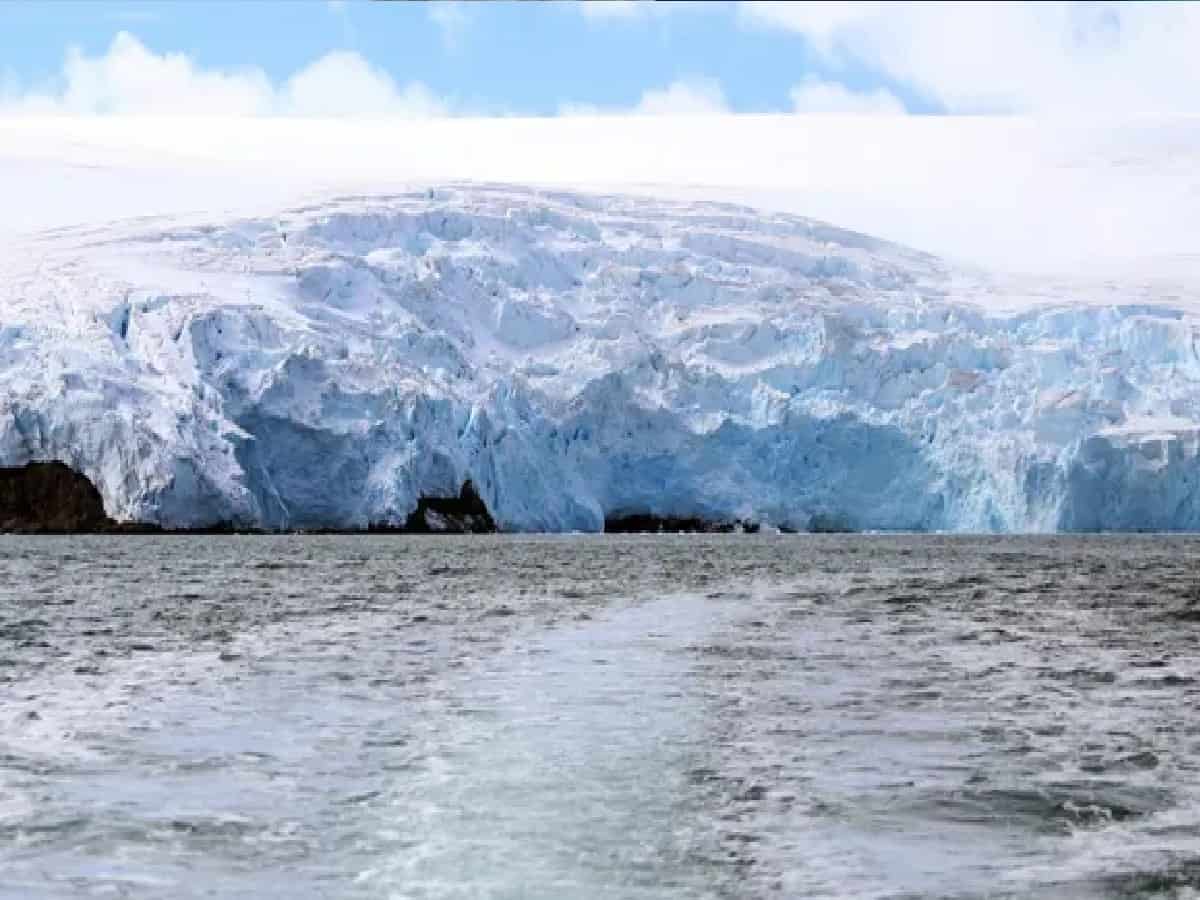
12.5 Trillion Tons Vanish From Greenland & Antarctica Since 1979 as Warm Oceans Drive Collapse
In what stands as one of the most comprehensive and alarming multi-decade glaciological assessments ever conducted, a breakthrough study published in the peer-reviewed journal Scientific Data has confirmed that the planet's polar cryosphere is unraveling at an unprecedented rate. Drawing on nearly five decades of recalibrated NASA and European Space Agency (ESA) satellite datasets, international researchers revealed that Greenland and Antarctica have collectively shed a staggering 12.5 trillion tons—roughly 1.13 trillion metric tons—of glacial ice mass between 1979 and 2026. To put the volume of this frozen displacement into physical perspective, if this vanished volume were spread evenly across the entire North and South American continents, it would coat the entire landmass in a solid, uniform sheet of ice over 5 feet deep.
Three Quadrillion Gallons Melted: How a Mere 1-Inch Sea Level Rise Threatens Millions
The liquidation of these colossal continental glaciers has introduced an estimated 3 quadrillion gallons (approximately 11.3 quadrillion liters) of freshwater directly into the global ocean system. This staggering influx has driven a cumulative global sea level rise of roughly 1.2 inches (3.1 centimeters) since 1979. While an elevation of just over an inch may appear minor on a macroscopic scale, lead author and Northumbria University glaciologist Ines Otosaka warned that the real-world humanitarian repercussions are profound. For every single-third of an inch of vertical oceanic rise, an estimated 2 to 3 million people inhabiting low-lying coastal plains worldwide face annual baseline flood risks, permanent saltwater intrusion into vital freshwater tables, and heightened vulnerability to storm surges.
The Real Threat Beneath: Subsurface Thermal Currents, Not Just Air Temperatures, Carving Glacial Bases
Defying the conventional assumption that soaring polar air temperatures serve as the primary driver of polar melting, the investigation highlighted a far more insidious and structurally dangerous mechanism: warming ocean currents. The findings indicate that between one-fifth and one-sixth of total ice loss is driven from below, as heated marine water intrudes into deep sub-ice cavities, melting the grounding lines and destabilizing the submerged flanks of massive marine-terminating glaciers. Deprived of bottom support, colossal ice blocks are calved directly into the ocean. The study noted that Greenland’s famed Jakobshavn Glacier is now retreating at an astonishing rate of up to 164 feet (50 meters) per day, turning deep marine fjords into continuous conveyor belts for melting icebergs.
Five Decades of Satellite Tracking: Stability Shattered as Dynamic Collapse Looms
Historical data synthesized from 1970s satellite records reveals that both ice caps remained largely in a state of dynamic mass equilibrium through the 1970s, 1980s, and 1990s, before experiencing an exponential runaway destabilization starting in the 2010s. While a brief plateau in melting velocity occurred between 2020 and 2023 due to temporary climatic variations—and record-breaking snowfall across East Antarctica temporarily counterbalanced catastrophic losses in West Antarctica—the post-2023 era has seen melting accelerate back to peak historical rates. University of California glaciologist Eric Rignot and New York University ice scientist David Holland emphasized that because the vast majority of this structural failure is driven by dynamic mechanical retreat rather than slow surface melting, large-scale ice-shelf collapses can unfold without warning. Given the multi-decadal lag of thermal inertia, scientists caution that even if global greenhouse gas emissions were halted tomorrow, the deep-sea heat already locked beneath the poles will continue destabilizing the polar ice caps for generations to come.