







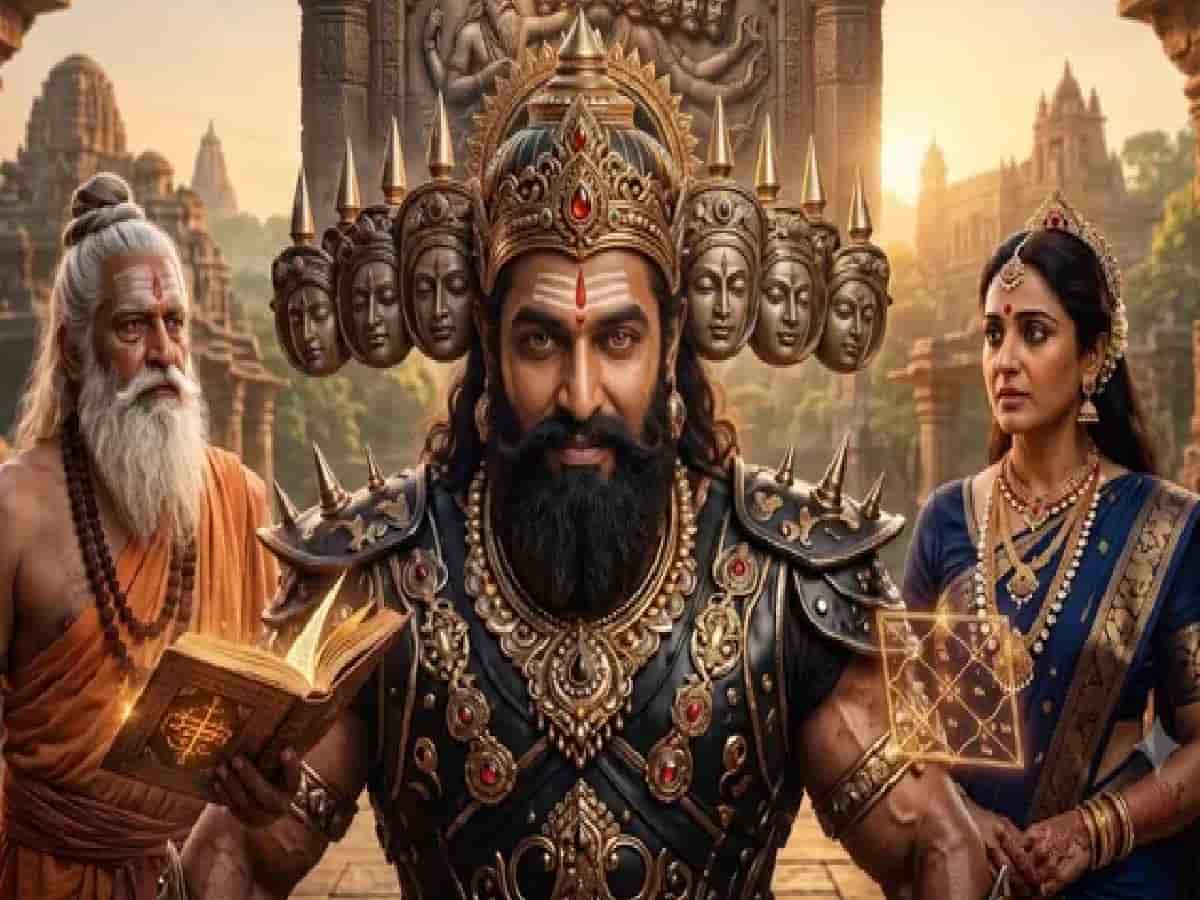
The Mystery of Ravana's Birth: The Lineage, Vedic Wisdom & Boons Behind the King of Lanka
The epic Ramayana chronicles the boundless valor of Lord Rama alongside the immense power of his greatest adversary, the formidable King of Lanka, Ravana. While celebrated as an invincible warrior whose life culminated in spiritual salvation at the hands of the divine, few know the esoteric origins surrounding his parentage, lineage, and birth. Scriptural chronicles in the Valmiki Ramayana, Padma Purana, and Srimad Bhagavata Purana reveal that Ravana was born from an extraordinary dual heritage—half Brahmin and half Rakshasa. As the grandson of Maharishi Pulastya, one of the venerated Saptarishis and mind-born sons of Lord Brahma, Ravana carried the highest Vedic pedigree through his paternal line, while inheriting fierce primal strength and dark sorcery through his maternal demonic ancestry.
The Union of Sage Vishrava and Demoness Kaikasi: Lineage Behind the Demon King
The foundation of Ravana's lineage traces to Sage Vishrava, a revered ascetic born to Maharishi Pulastya. Vishrava had first married Devangana, the daughter of Sage Bharadwaja, giving birth to Kubera, the divine treasurer of the gods. Seeking to reclaim demonic supremacy over celestial realms, the demon king Sumali sent his daughter, Kaikasi, to entice the great ascetic. Kaikasi approached Sage Vishrava and sought a divine boon for off-spring who would surpass the devas in raw might and remain unvanquished across all realms. From this union were born Ravana, Kumbhakarna, Vibhishana, and their sister Surpanakha. According to the Srimad Bhagavata Purana, this lineage also fulfilled the cosmic cycle of Jaya and Vijaya—Lord Vishnu's cursed gatekeepers—who had earlier incarnated as Hiranyaksha and Hiranyakashipu and took their second mortal rebirth as Ravana and Kumbhakarna.
Vedic Polymath to Ten-Headed Emperor: How Rigorous Tapasya Shaped Dashanana
Contrary to widespread popular belief, Ravana was not physically born with ten heads. Raised under the rigorous intellectual discipline of his father, he mastered all four Vedas—Rigveda, Samaveda, Yajurveda, and Atharvaveda—during his formative years, alongside profound treatises on Ayurveda, astrology, astronomy, and advanced occult Tantra. Seeking unmatched cosmic dominance as he matured, Ravana retreated deep into forest solitude to execute severe penance (tapasya). While Lord Brahma withheld absolute immortality, he endowed him with invulnerability against devas, danavas, and celestial beasts. Continuing his relentless penance in dedicated worship of Lord Shiva, Ravana offered his severed heads in unyielding devotion, eventually earning Lord Shiva’s supreme grace and the restoration of his form with ten heads (Dashanana). This unique confluence gave Ravana an unmatched combination of towering Vedic intellect inherited from his Brahmin father and invincible raw might gifted by his demonic maternal bloodline.