







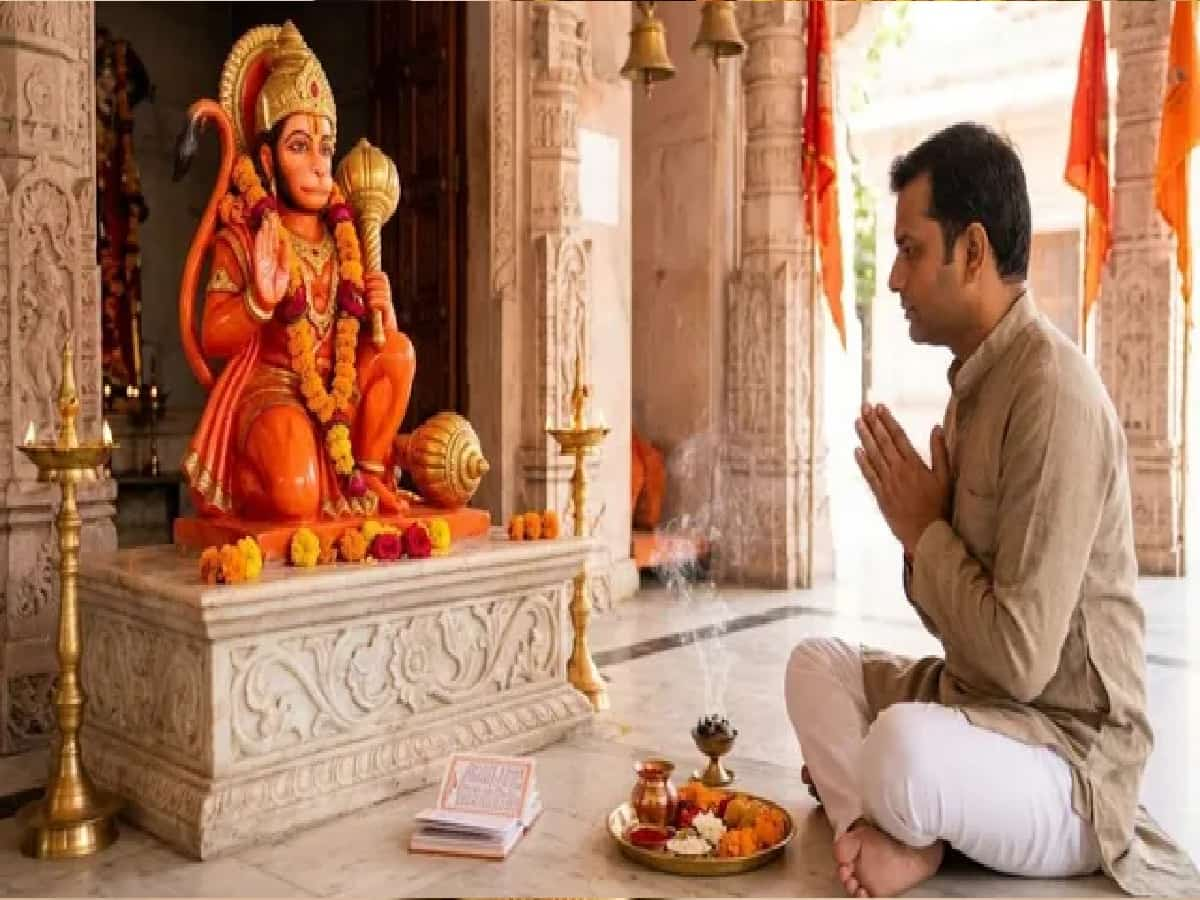
'Tej Pratap Maha Jag Vandan':This Hanuman Chalisa Verse Dispels Life's Deepest Troubles
Across millions of Hindu households and sacred shrines worldwide, the disciplined recitation of Goswami Tulsidas's Hanuman Chalisa has endured for centuries as the ultimate devotional shield against life’s deepest adversities, fears, and psychic distress. Composed of forty spiritually charged Awadhi quatrains, every couplet within this devotional hymn carries a distinct metaphysical resonance engineered to awaken mental resilience and channel the protective grace of Bajrangbali. Among these sacred verses, Vedic scholars, astrologers, and spiritual seekers consistently spotlight one specific quatrain for its transformative psychological and spiritual potency: "Shankar Suvan Kesari Nandan, Tej Pratap Maha Jag Vandan." Regarded as the spiritual core of the hymn, meditating on this single couplet is believed to dissolve longstanding emotional turbulence, cleanse lingering negative energies, and infuse the seeker’s life with untamed vitality and self-assurance.
Decoding the Sacred Etymology: The Cosmic Lineage of Lord Shiva’s Living Incarnation
The profound transformative power of this verse originates in the deliberate etymological precision employed by Saint Tulsidas to define Bajrangbali’s true cosmic status. Through the opening declaration "Shankar Suvan," the verse establishes that Lord Hanuman is not merely an exalted monkey warrior, but the eleventh Rudra avatar—a direct, living manifestation and spiritual extension (suvan) of Lord Shiva Himself, walking creation to uphold righteousness and eradicate malevolence. By immediately pairing this celestial truth with the phrase "Kesari Nandan," Tulsidas honors Hanuman's earthly identity as the devoted son of the valiant vanara king Kesari, perfectly bridging absolute cosmic transcendence with grounded, humble devotion. Scriptural commentators emphasize that chanting this divine lineage invokes both the serene contemplation of Shiva and the fearless strength of the Rudra force, helping devotees shatter internal stagnation and external hardships.
'Tej Pratap Maha Jag Vandan': Channeling Solar Effulgence to Conquer Fear and Obstacles
The concluding half of the couplet, "Tej Pratap Maha Jag Vandan," shifts the focus from divine identity to invincible aura and universal authority. In Vedic symbology, "Tej" signifies supreme spiritual effulgence, radiant aura, and inner luminescence, while "Pratap" represents unyielding valor, cosmic prowess, and eternal renown that knows no defeat. The descriptor "Maha" underscores that this majesty is boundless, earning Hanuman the spontaneous reverence and worship ("Jag Vandan") of the entire universe, including gods, sages, and ordinary mortals alike. Spiritual counselors highlight that when individuals chant this chaupai during moments of severe despair, professional setbacks, or crippling anxiety, its vibrational cadence acts as a mental recalibration, driving out weakness and cloaking the devotee under the immortal, benevolent armor of the ultimate protector.




