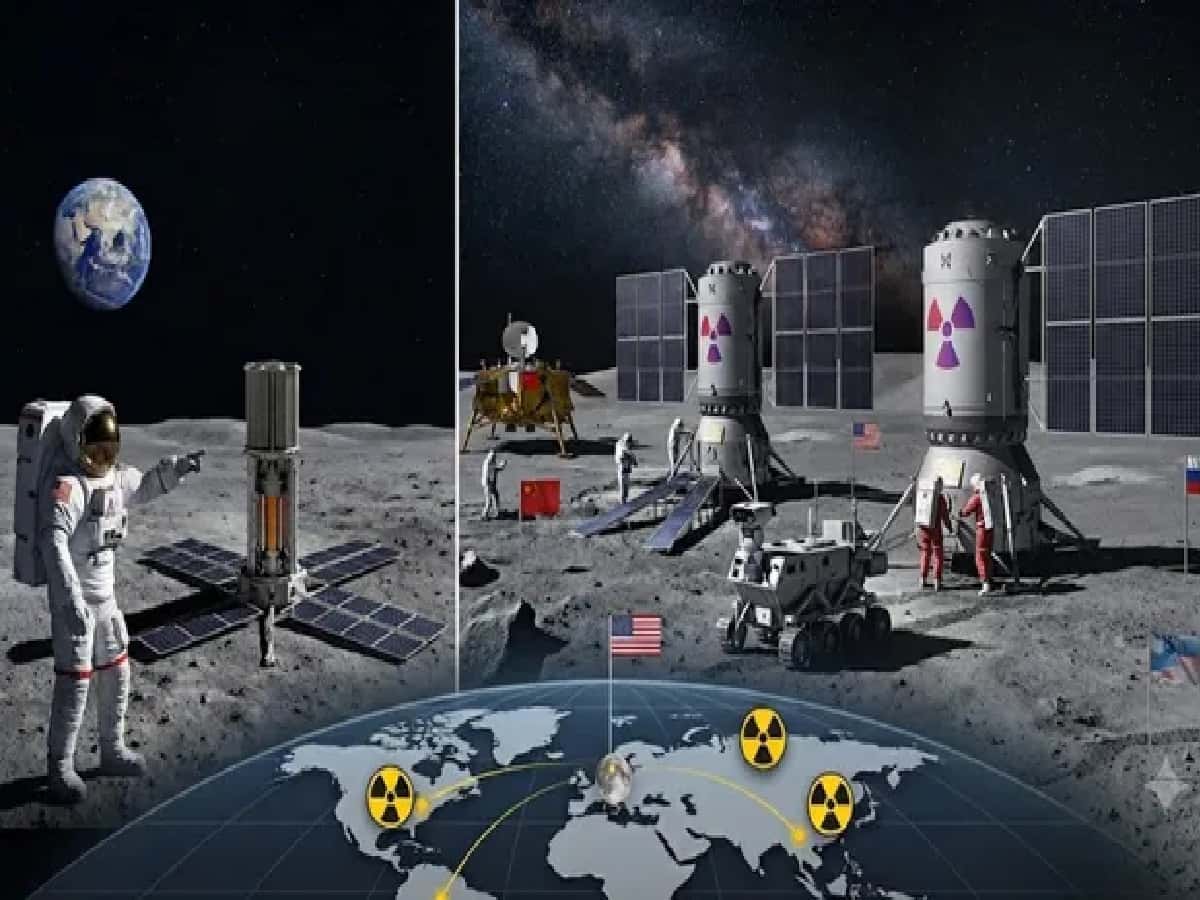
Nuclear Race on Moon: US, China & Russia Plan Lunar Reactors
A geopolitical and technological race is intensifying among the world's leading space powers as the United States, Russia, and China accelerate programs to deploy nuclear reactors directly onto the Moon's surface. According to reporting highlighted by The New York Times, space agencies have concluded that conventional renewable sources cannot reliably support permanent crewed habitats, automated mining stations, and deep-space staging infrastructure. With ambitions shifting from brief orbital visits to sustained surface settlements, nuclear fission has emerged as the sole reliable energy solution capable of sustaining complex bases in deep space.
NASA’s 2030 Fission Push vs Russia-China 'Selena' Station Timeline
To safeguard its strategic lead in cislunar space, the United States space agency NASA has solicited commercial defense and aerospace contractors to engineer a resilient, flight-ready nuclear reactor. Designed to survive rigorous launch loads and operate without manual maintenance on the Moon’s rugged south pole, NASA’s proposed Lunar Reactor 1 is targeted for full flight readiness by December 2030. The unit is designed to produce 20 kilowatts of continuous electricity autonomously for at least five years. Concurrently, Russia and China are collaborating on a joint lunar energy architecture. Under this partnership, Roscosmos plans to build the automated "Selena" lunar reactor by 2036, a 10-kilowatt power unit engineered to supply a Chinese-led International Lunar Research Station (ILRS) for an operational lifespan of ten years.
The 14-Day Lunar Night: Why Solar Panels Fall Short for Permanent Habitats
The push toward lunar nuclear reactors is driven by the Moon's environmental extremes. While photovoltaic arrays provide adequate power during the lunar daytime, a single lunar night lasts roughly 14 Earth days, plunging the surface into unbroken darkness with temperatures plummeting below minus 130 degrees Celsius. Storing sufficient solar-generated energy in conventional battery systems to survive these extended, freezing fortnights presents severe mass and payload constraints for heavy-lift rockets. Nuclear fission reactors bypass these environmental limitations entirely, ensuring a stable, uninterrupted, multi-kilowatt power supply regardless of sunlight conditions or heavy polar shadows.
Geopolitical Friction and Space Law: Security Exclusion Zones Under the 1967 Treaty
The rapid development of lunar nuclear infrastructure has triggered technical and legal debates within the international community. Aerospace safety specialists note that high-speed launch failures could disperse radioactive material across Earth's upper atmosphere or contaminate prospective landing zones. To mitigate these risks, engineers plan to transport the reactor cores in a completely dormant, unactivated state, triggering fission only after secure touchdown on the lunar surface. Beyond radiation safety, significant diplomatic questions surround the 1967 Outer Space Treaty, which explicitly prohibits sovereign land claims on celestial bodies. Western space officials express concern that China and Russia could establish wide restricted safety perimeters around operating nuclear facilities, potentially restricting the movement of international rovers and astronauts, thereby testing global accords governing open access to space.