






Melting Himalayas Threaten 20% of India's GDP: Glaciers Disappearing 65% Faster
The majestic Himalayan mountain range has reached an alarming environmental tipping point as accelerated global warming causes its glaciers to melt 65 percent faster than in the preceding decade. According to a landmark interdisciplinary assessment published jointly by global sustainability consultancy Systemiq, the Integrated Mountain Initiative (IMI), the International Centre for Integrated Mountain Development (ICIMOD), and the GB Pant National Institute of Himalayan Environment, the rapid deterioration of these high-altitude cryogenic ecosystems is no longer merely an ecological concern confined to remote mountain passes. Instead, the study reveals that this cryospheric collapse is directly targeting India’s core macroeconomic stability, threatening the perennial water basins that anchor essential industrial sectors, massive clean hydroelectric infrastructure, primary food security networks, and widespread cultural tourism across northern, central, and eastern India.
Economic Lifeline at Risk: How the Himalayan Cryosphere Fuels One-Fifth of National Output
The statistical link between the Himalayan hydrology and India's economic output is staggering: the Himalayan river basins directly sustain and power approximately 20 percent of India’s overall Gross Domestic Product (GDP). These glacial runoffs feed the fertile Indo-Gangetic plains, providing indispensable baseline irrigation for key national staples like wheat and rice, while sustaining high-value cash crops such as Assam and Darjeeling tea. Furthermore, these river channels generate thousands of megawatts of baseload hydroelectricity and power vibrant spiritual and pilgrimage economies that welcome millions of devotees annually. Economists warn that if runaway warming continues unchecked and these frozen freshwater reservoirs disappear, India faces the catastrophic erosion of this 20 percent GDP contribution. In a glaring socio-economic paradox highlighted by the report, while downstream plains generate colossal commercial value from these waterways, barely 5 percent of the total economic benefit ever returns to the indigenous mountain states that preserve these delicate ecosystems.
56 Glacial Lakes Classified as Highly Sensitive Amid Looming GLOF Hazards
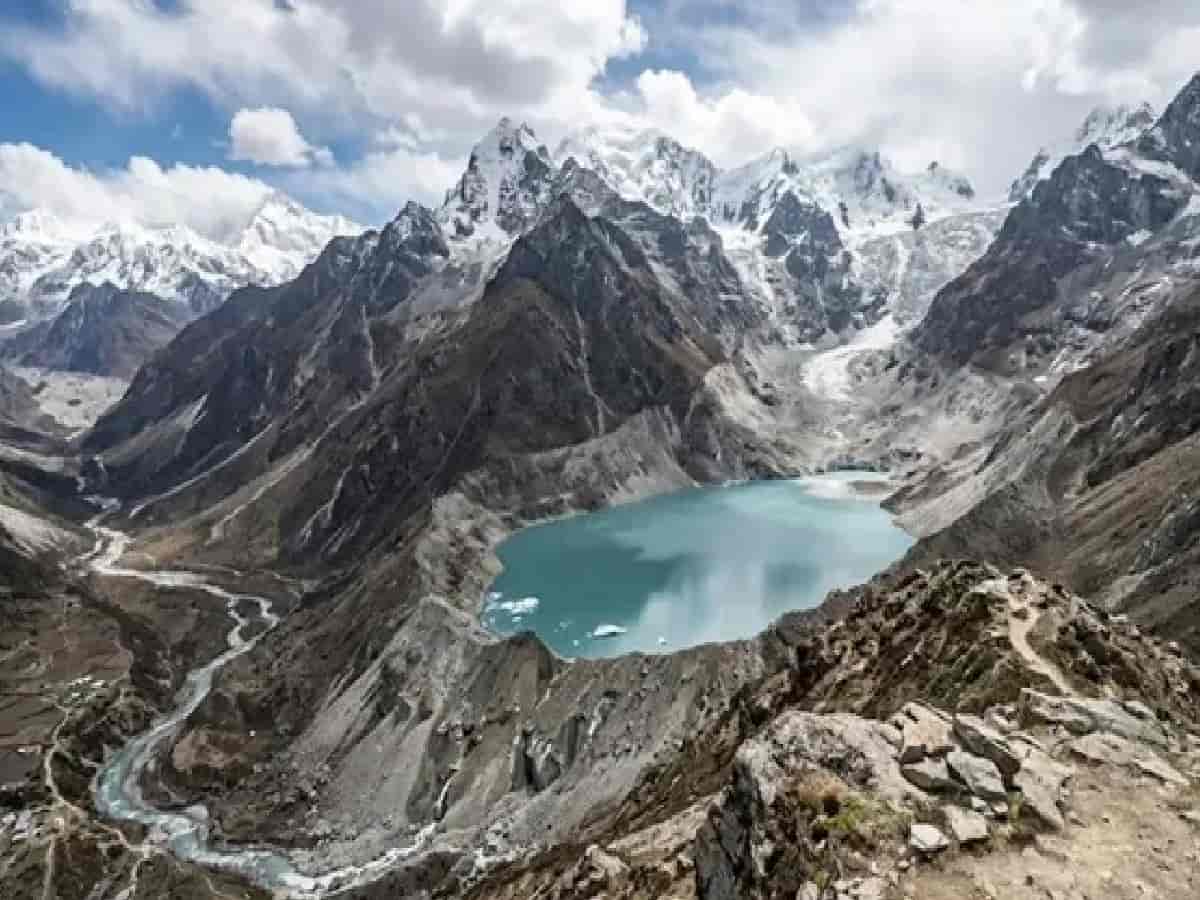
The geographic footprint of the Indian Himalayan region encompasses around 18 percent of the country’s total land area, yet it disproportionately suffers 35 percent of all national disaster impacts. Official data tabled in Parliament reveals that scientific teams have rigorously evaluated 189 high-risk glacial water bodies across the Indian mountain corridor, identifying 56 glacial lakes as "very high-risk" zones primed for catastrophic Glacial Lake Outburst Floods (GLOFs). To mitigate sudden deluge scenarios, the Central Water Commission (CWC) currently conducts continuous telemetry and satellite monitoring over 2,485 high-altitude water bodies measuring larger than 10 hectares across upstream Himalayan river basins. Recent memory still carries the scars of historical GLOF catastrophes, including the devastation in Sikkim in 2023, the catastrophic Rishiganga and Dhauliganga flash floods in Uttarakhand in 2021, and recent cross-border flood tragedies in Nepal and Tibet that claimed over 1,300 lives.
The Black Carbon Menace: Brick Kilns in the Plains Accelerate Glacier Retreat
A critical driver accelerating this glacial retreat stems from the heavy deposit of airborne "black carbon" originating far below in the industrial and agrarian plains. The report notes that roughly one-third of the accelerated ice melt in the Himalayas is directly attributable to black carbon particulate soot, primarily belched out by thousands of traditional brick kilns, thermal installations, and diesel exhaust systems across the northern plains. This airborne soot travels along atmospheric wind channels to settle directly on pristine white snow caps, sharply reducing the albedo effect and absorbing intense solar radiation to trigger rapid surface liquefaction. Compounding this challenge, Lord Nicholas Stern of the London School of Economics warned that unlike the uninhabited polar extremes of the Arctic and Antarctic, this populous "Third Pole" sustains hundreds of millions of human lives who depend directly on its hydrological cycles, while out of an estimated 40,000 glaciers spanning the wider Himalayan-Karakoram belt, barely 21 glaciers are subjected to continuous scientific monitoring.
Rethinking Mountain Tourism and Cross-Border Coalitions Before the Tipping Point
To prevent regional ecosystems from passing irreversible thresholds, ICIMOD Director General Pema Gyamtsho emphasized that environmental disasters recognize no sovereign geopolitical boundaries, mandating unified transboundary cooperation. The report outlines 10 urgent priority interventions, led by stringent emission caps on industrial black carbon, major expansions in satellite-based glacier surveillance, and enhanced international early-warning communication arrays. Crucially, the researchers call for a complete overhaul of mass tourism models in the fragile mountain corridors, which currently host nearly 400 million domestic and global travelers every year. Transitioning from unchecked tourism volumes toward sustainable, high-value, and ecologically conscious community travel is essential to preserve the living mountain barrier that ensures water, energy, and food security for more than a billion people.