







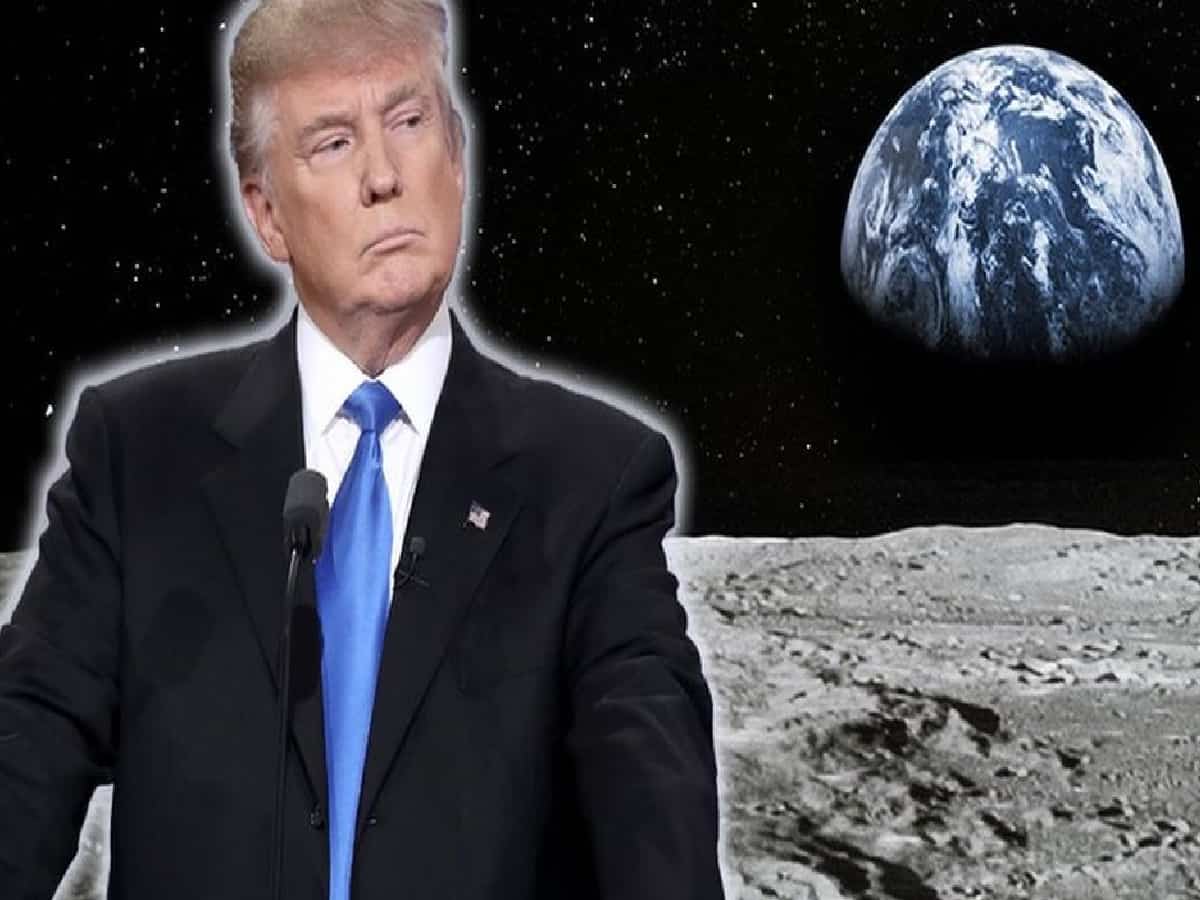
Trump claims the Moon is US property – legal reality and mining prospects
On 6 September former US President Donald Trump posted on his social platform that the Moon belongs to America, attaching an image of the lunar surface marked with an American flag. While the United States has long been a leading player in lunar exploration, the assertion runs contrary to the international framework that has governed outer space for more than half a century.
The Outer Space Treaty and sovereign claims
The cornerstone of space law is the 1967 Outer Space Treaty, adopted during the Cold War with strong US support. Article II makes it clear that no nation may claim sovereignty, occupation or any other form of ownership over outer space, including the Moon and other celestial bodies. Planting a flag, establishing a base or using a particular region does not confer legal title.
Exploration for the benefit of all
Article I of the treaty sets out a broader principle: the exploration and use of outer space must be carried out for the benefit of all countries, and every state has an equal right to conduct such activities. The treaty also holds governments responsible for the actions of private entities that operate under their jurisdiction.
What about extracting resources
The treaty does not explicitly address commercial extraction of lunar material. While it forbids national appropriation of territory, it is silent on whether the minerals themselves can be owned once they have been removed. This gap has led to divergent national approaches.
US legislation on space resources
In 2015 the United States enacted the Commercial Space Launch Competitiveness Act. The law grants US citizens the right to commercially exploit space resources and to retain ownership of extracted material, while expressly stating that such activities do not confer sovereignty over the celestial body from which they are taken. In effect, the US separates the ownership of the resource from the ownership of the land.
NASA’s Artemis programme and commercial involvement
NASA has incorporated resource utilisation into its Artemis programme. In 2020 the agency selected private companies to collect lunar material under commercial contracts, arguing that such resources could support future lunar habitats and even missions to Mars. The idea is that water ice at the poles could be turned into drinking water, oxygen and rocket propellant, while minerals could aid construction.
The Artemis Accords
Also in 2020, the United States launched the Artemis Accords – a set of non‑binding guidelines intended to promote peaceful, transparent and cooperative lunar activities. Signatory states affirm the Outer Space Treaty’s principles and agree that extracting and using resources is permissible provided no claim of territorial ownership is made. The accords introduce the concept of “safety zones” around operational sites to prevent interference, but these zones are not meant to establish exclusive rights.
The Moon Agreement
A separate United Nations treaty, the 1979 Moon Agreement, treats the Moon and its resources as the common heritage of mankind. It requires that any commercial exploitation be overseen by an international body and that benefits be shared equitably. However, the agreement has been signed by only a handful of states, none of the major space powers, and the United States has not ratified it. Consequently, its practical impact on lunar mining remains limited.
Who owns the extracted material
International law distinguishes between the celestial body and the resources taken from it. Under the Outer Space Treaty, no state can claim ownership of a portion of the Moon, but the treaty does not specify who owns the minerals once they are removed. Some legal scholars argue that ownership of extracted material does not violate the treaty, while others warn that unrestricted commercial rights could erode the treaty’s spirit of shared benefit.
Why the debate matters
Lunar water ice, especially in permanently shadowed craters near the poles, could be transformed into life‑support consumables and propellant, dramatically reducing the cost of deep‑space missions. Likewise, certain minerals could be vital for building habitats and infrastructure. Yet the technology for large‑scale mining and the economic models required are still in early development.
Emerging challenges for space law
The legal regime was drafted when space exploration was the domain of nation‑states, primarily the United States and the Soviet Union. Today, a crowded marketplace of private launch providers, spacecraft manufacturers and prospective mining firms is reshaping the landscape. Questions that were not anticipated in the original treaties include the size of mining operations, coordination of overlapping resource zones, dispute resolution mechanisms, and whether safety zones might evolve into de‑facto claims of control.
Conclusion
Trump’s claim that the Moon belongs to the United States is not supported by the Outer Space Treaty, which remains the governing document for outer‑space activities. While US law permits private entities to own extracted lunar resources, it does not grant sovereignty over the Moon itself. International agreements such as the Artemis Accords seek to balance commercial ambition with the treaty’s non‑appropriation principle, but the lack of a comprehensive framework for resource ownership leaves significant legal uncertainty. As technology advances and commercial interest grows, the space community will need clearer rules to ensure that lunar exploitation benefits all humanity without igniting new territorial disputes.