







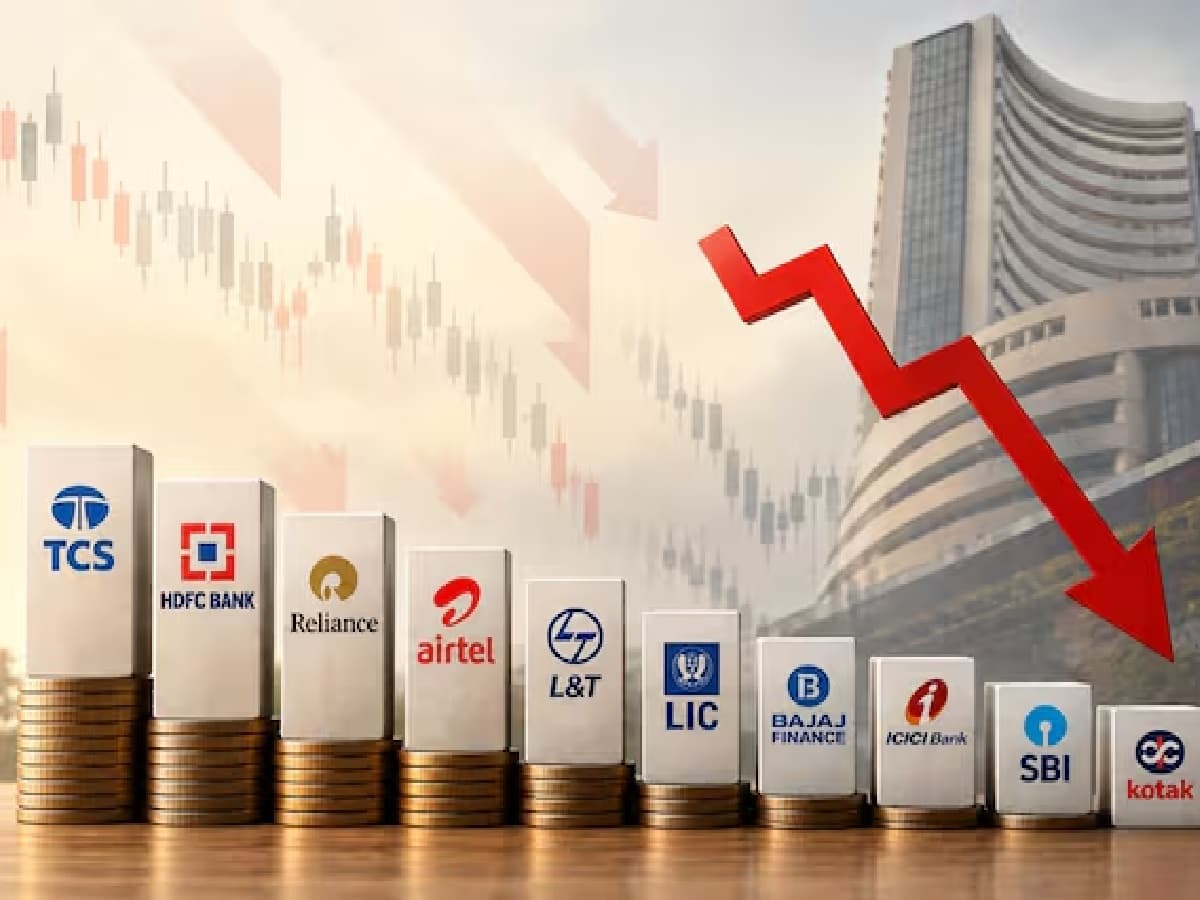
Top 10 Indian Stocks' Market Share Sinks to 9-Year Low as FPIs Dump Mega-Caps
In an unprecedented structural realignment on Dalal Street, the dominance of India’s corporate titans has weakened significantly as the combined market capitalization share of the country's top 10 listed blue-chip companies tumbled to roughly 17.64 percent in October 2026. This contraction marks the lowest concentration of wealth at the top tier in nearly nine years, matching the historic trough of 17.60 percent recorded in January 2017. The collective valuation of these ten marquee heavyweights has shriveled to ₹84.84 lakh crore, while the broader Indian stock market's total listed capitalization expanded to ₹480.82 lakh crore. The steep divergence underscores a visible erosion in the pricing power of India's bellwethers, signaling that domestic benchmark resilience is increasingly relying on broader market participation rather than the conventional pull of traditional corporate giants.
Mega-Cap Meltdown: TCS, HDFC Bank, and Reliance Bear Brunt of ₹3 Lakh Crore FPI Exodus
The dramatic slide in blue-chip dominance has been orchestrated by relentless foreign institutional liquidation, with Foreign Portfolio Investors (FPIs) withdrawing more than ₹3 lakh crore from domestic equities so far in 2026. Institutional custodial data reveals that nearly 60 to 70 percent of this intense foreign outflow was extracted directly from the top 10 mega-cap counters, compounded by a softening Indian rupee that eroded foreign currency yields and prompted international desks to trim their heaviest allocations. The persistent selling has taken a brutal toll on premier corporate balance sheets: information technology titan Tata Consultancy Services (TCS) suffered the steepest battering with an approximate 32 percent decline, followed by banking heavyweight HDFC Bank tumbling 27 percent and oil-to-telecom conglomerate Reliance Industries shedding 26 percent. Other bellwethers were similarly caught in the downdraft, with Bharti Airtel down 15 percent, Larsen & Toubro dropping 11 percent, state-run Life Insurance Corporation (LIC) slipping 7 percent, and Bajaj Finance easing 3 percent, while banking majors ICICI Bank and State Bank of India traded flat, leaving private lender Kotak Mahindra Bank as the lone gainer with a marginal 1 percent advance.
The Rise of Broader Equities: Midcaps and Smallcaps Reshape Dalal Street’s Valuation Mix
As the traditional heavyweights lost their grip on index weighting, mid-tier and emerging enterprises stepped in to capture substantial valuation ground, permanently transforming the risk and return dynamics across Mumbai's bourses. Institutional tracking confirms that smallcap companies have expanded their collective footprint to command 20.6 percent of total listed market capitalization, while midcap firms have surged to secure a 23.1 percent share—a striking leap from early 2024 levels when both segments hovered near 18 percent each. This decisive redistribution illustrates that market capital and liquidity are democratizing across a wider cross-section of manufacturing, infrastructure, and domestic consumption themes rather than pooling inside an exclusive club of corporate giants. While the shift signals broader economic depth across India Inc, portfolio managers caution that elevated capital allocation toward mid- and small-cap segments introduces heightened volatility risks for retail and institutional investors alike, especially as global macro crosscurrents and currency pressures continue to dictate foreign capital flows.




