







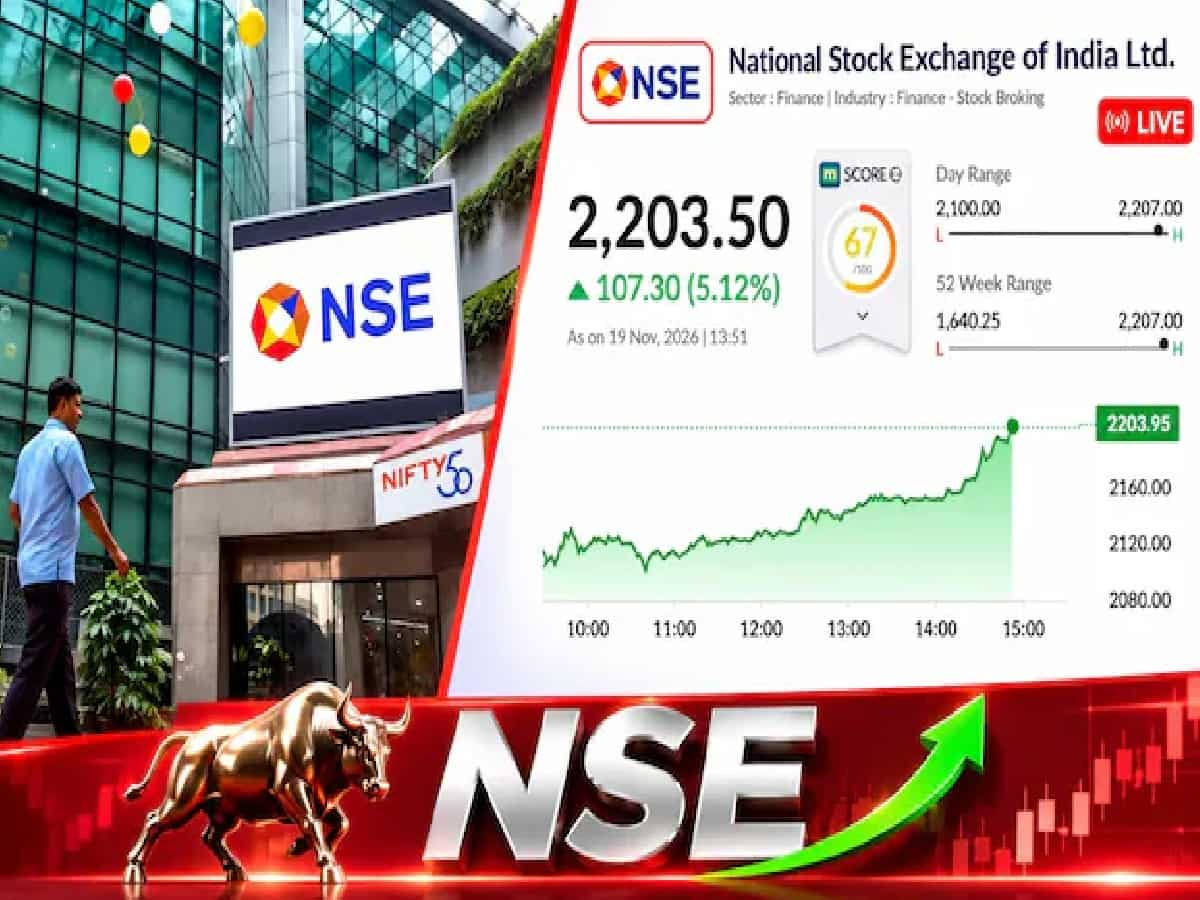
NSE Shares Jump 5% to ₹2,207; Experts Eye ₹2,310 Target
Shares of the National Stock Exchange of India Limited (NSE) staged an impressive rally on Thursday, November 19, 2026, climbing roughly 5% to breach the ₹2,200 mark and touch a fresh peak of ₹2,207 in afternoon trading. After opening higher at ₹2,113.00 compared to its previous close of ₹2,096.20, the exchange counter gathered steady buying momentum through the session, lifting near-term market estimates toward ₹2,310 among brokerage and market observers. Investors and analysts attribute the surge to deepening domestic retail and institutional participation in Indian equities, strong underlying cash and derivatives market liquidity, and multiple ancillary revenue streams—including Nifty index licensing, co-location data-center services, its stake in NSDL, and emerging verticals such as server racks, commodity trading, and electronic gold receipts (EGR) highlighted by SBI Securities. At the same time, Motilal Oswal has underscored NSE's structural durability over a three- to five-year horizon due to unmatched market depth and institutional liquidity, even as rival exchange BSE continues to post faster percentage growth in revenue and net profit. For retail investors, market participants, and readers across Unnao, Lucknow, Kanpur, New Delhi, Mumbai, Bengaluru, Ahmedabad, and Kolkata, the sharp move in NSE underscores how exchange operators sit directly at the center of India's expanding capital-markets ecosystem.
NSE Share Price Surge & Q2 FY27 Performance: Key Numbers
To put Thursday's jump to ₹2,207 into financial perspective, the table below compares NSE's price action and Q2 FY27 earnings profile alongside exchange rival BSE and prevailing valuation multiples:
| Metric / Comparison Parameter | NSE (National Stock Exchange) | BSE Limited | Market & Valuation Takeaway |
| Intraday Price Action (Nov 19, 2026) | Opened at ₹2,113.00 vs. prior close ₹2,096.20; jumped ~5% past ₹2,200 to hit ₹2,207; near-term target cited at ₹2,310. | Actively traded alongside NSE on Indian bourses. | Strong momentum reflects rising market participation and institutional confidence in exchange earnings. |
| Q2 FY27 Operating Revenue & YoY Growth | ~₹4,067 crore (~11% YoY growth). | ~₹1,433 crore (₹1,432.70 crore, ~34.1% YoY growth). | NSE commands nearly 2.8x BSE's quarterly operating revenue, while BSE posts faster percentage top-line growth. |
| Q2 FY27 Net Profit & YoY Growth | ~₹2,578 crore (~23% YoY growth; operating EBITDA up 107% YoY to ₹3,079 crore). | ~₹809 crore (₹809.20 crore, ~44.9% YoY growth). | NSE's profit is more than 3x BSE's Q2 profit, backed by high operating leverage and a lower expense base after prior-year provisions. |
| Valuation (P/E Ratio) | ~50x P/E. | ~51.61x P/E. | Both exchanges command premium valuation multiples, requiring sustained volume and earnings delivery to justify rich pricing. |
NSE's Core Strengths and New Growth Drivers: Motilal Oswal & SBI Securities Views
According to Motilal Oswal, NSE stands out as a relatively stable multi-year play over a three- to five-year timeframe owing to its dominant market share, deep order books, and superior liquidity. High liquidity allows large institutional funds and active traders to execute big orders smoothly with minimal price impact. Beyond core trading and clearing fees, NSE benefits from recurring income streams tied to Nifty index-linked funds and derivatives, co-location services—which enable algorithmic and high-frequency trading firms to house servers close to the exchange's data infrastructure for ultra-low latency—and its NSDL stake. Research from SBI Securities further points to fresh expansion avenues across server racks, commodity trading, and electronic gold receipts (EGR), noting that while these initiatives can add incremental growth over time, their actual earnings contribution will unfold gradually.
Why BSE Is Also in Focus—and What Valuations Mean for Investors
While NSE leads comfortably in absolute scale, liquidity, and profit size, BSE has drawn close attention for its rapid pace of expansion in Q2 FY27, delivering ~34.1% year-on-year revenue growth to ₹1,432.70 crore and ~44.9% profit growth to ₹809.20 crore. As Saurabh Jain, Head of Research at SMC Global Securities, notes, Sensex options trading has been a major growth engine for BSE alongside BSE StAR MF, a roster of over 5,500 listed companies, SME IPOs, and its stake in CDSL. With NSE trading around a 50x P/E and BSE near 51.61x P/E, analysts remind investors that elevated multiples leave little room for prolonged volume slowdowns or adverse regulatory shifts—making earnings growth, market-share trends, and entry price discipline essential factors to weigh together.




