







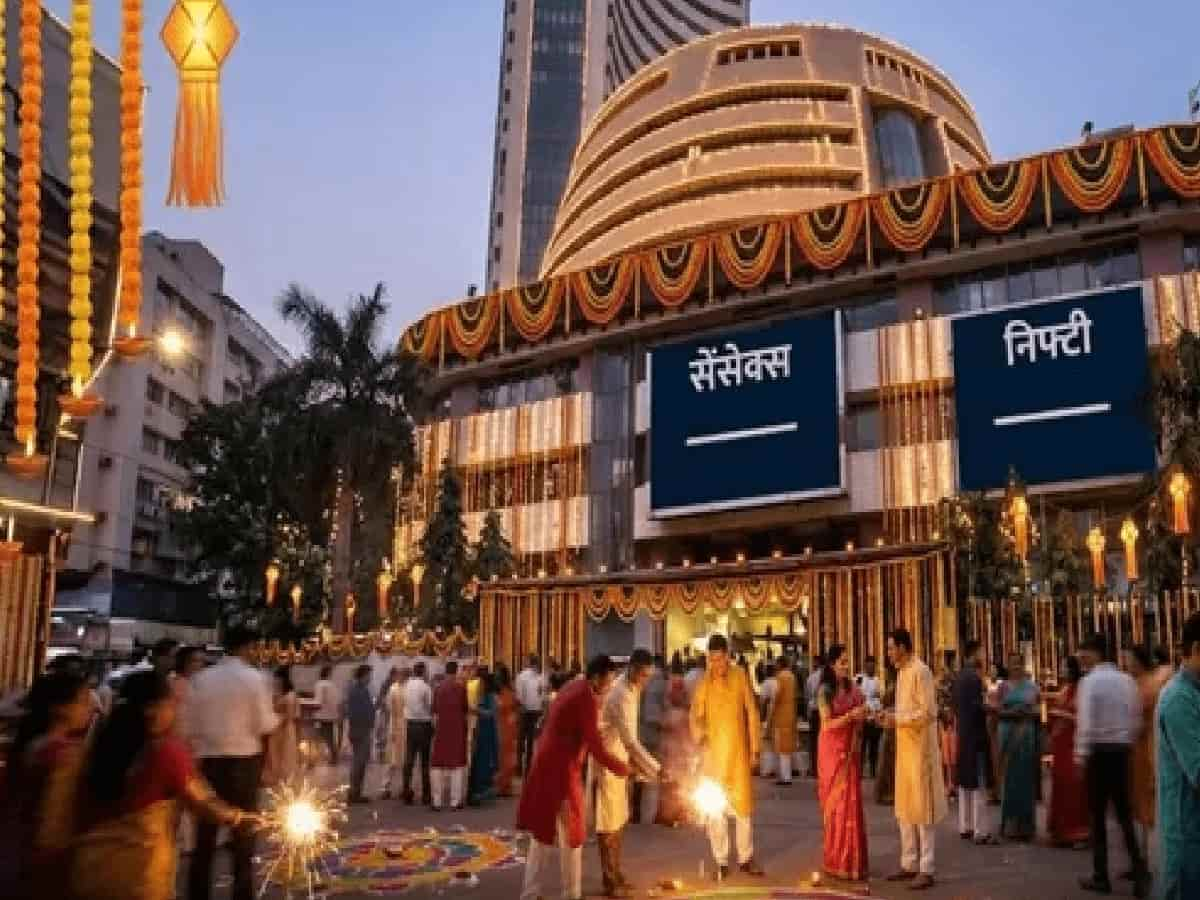
Muhurat Trading: Sensex, Nifty Slip Marginally; Media, Pharma Lead
In a closely watched Diwali Muhurat trading session inaugurating the new accounting year of Samvat 2083 on Sunday, November 8, 2026, Indian equity benchmarks concluded with marginal declines following late post-closing auction adjustments. The special 70-minute trading window—revered by domestic investors as an auspicious occasion to welcome financial prosperity and wealth—opened with spirited enthusiasm before late-session volatility pared early gains. The 30-share BSE Sensex slipped 28.62 points, or 0.04 percent, to settle at 80,999.40, while the broader 50-share NSE Nifty index dropped 43.95 points, or 0.18 percent, to finish at 24,986.40. Despite the slight mathematical pullback in frontline indices that broke a nine-year winning streak for the Diwali session, broader market breadth painted a decidedly optimistic picture. Advancing shares heavily outpaced decliners across the wider exchange floor, propelled by robust momentum in pharmaceutical, media, and metal stocks, even as heavyweight banking, information technology, and real estate counters faced localized profit-booking.
Market Breadth Outshines Benchmarks: 3,248 Stocks Surge on the BSE
While the headline gauges ended marginally in the red, the internal health of Dalal Street during Sunday's ceremonial session was decidedly bullish. Retail investors, family offices, and proprietary desks placed widespread token buy orders, driving impressive participation across mid-cap, small-cap, and micro-cap counters. Across the Bombay Stock Exchange, out of 4,454 actively traded securities, an overwhelming 3,248 scrips advanced, compared to only 954 that registered declines, leaving market breadth firmly tilted in favor of the bulls.
This underlying strength pushed total investor wealth up by an estimated ₹2.60 lakh crore during the single-hour window, elevating overall BSE market capitalization past ₹505 lakh crore ($5.37 trillion). Market veterans noted that Muhurat trading sessions often witness structural decoupling between headline indices and broader market equities, as domestic retail participants focus on purchasing fundamentally sound small- and mid-sized companies for long-term portfolio prosperity rather than executing index arbitrage strategies.
Sectoral Scorecard: Pharma and Media Rally as Banking, IT Lag
Performance across thematic indices reflected a noticeable divergence between defensive, value-driven pockets and interest-rate-sensitive large-cap sectors:
-
Pharma and Healthcare Outperformance: The Nifty Pharma index advanced over 1.16 percent, anchored by index heavyweight Sun Pharmaceutical Industries, which jumped nearly 3 percent on solid institutional buying. Hospital operators and healthcare suppliers, including Aster DM Healthcare, witnessed notable intraday surges.
-
Media and Entertainment Sparkle: Nifty Media emerged as the premier sectoral winner, advancing nearly 1.8 percent. Broadcaster Zee Entertainment Enterprises recorded sharp gains of over 6.6 percent, reflecting renewed optimism in festive advertising recovery and content distribution revenues.
-
Metals Show Strength: Core commodity stocks provided strong downside support to the benchmark, led by Tata Steel, which traded with firm gains following encouraging operational updates and quarterly earnings resilience.
-
Drags on the Headline Basket: Conversely, the high-weightage banking pack weighed on the tape, with the Bank Nifty slipping 0.1 percent and the Nifty PSU Bank index dipping 0.34 percent. Tech bellwethers, including Infosys, alongside airline major InterGlobe Aviation (IndiGo) and the Nifty Realty index, faced moderate profit-taking after the preceding week's sharp pre-Diwali run-up.
India VIX Climbs 6%: Heightened Volatility During Compressed Liquidity
A prominent technical feature of Sunday's Muhurat session was a noticeable spike in implied market volatility. The India VIX, commonly regarded as the market’s primary fear gauge, rose 6.01 percent to settle at 18.52.
Derivative desk analysts explained that the jump in VIX during Muhurat trade is primarily mechanical, driven by compressed execution times and the rapid repricing of short-duration options contracts:
-
The Compressed Liquidity Factor: Standard daily equity sessions run for over six hours, allowing price discovery to absorb institutional flow gradually; in contrast, a 70-minute trading window concentrates substantial festive order flow into a narrow band, creating sharper price swings.
-
Global Macro Positioning: With overseas exchanges navigating heightened geopolitical developments and tech earnings re-evaluations, institutional participants utilized the short window to buy options hedges, contributing to the uptick in volatility metrics.
Why Market Fundamentals Remain Strong for Samvat 2083
Despite the flat closing prints on Sunday, market strategists remain constructive on the broader multi-quarter trajectory of Indian equities as Samvat 2083 gets underway. The market’s underlying momentum is supported by three core macroeconomic pillars:
First, the ceremonial tradition of Muhurat trading consistently unleashes strong domestic retail enthusiasm, establishing an optimistic psychological baseline for the coming calendar year. Second, external headwinds have eased significantly, highlighted by the aggressive return of Foreign Institutional Investors (FIIs) who deployed nearly ₹15,000 crore into Indian equities in recent sessions, accompanied by softening international crude oil prices that offer macroeconomic breathing room to an oil-importing economy. Third, corporate quarterly performance has demonstrated structural resilience, with core manufacturing, capital goods, and pharmaceutical majors delivering steady revenue growth and improving margin profiles.
Outlook: Focus Shifts to Earnings and Central Bank Cues
As Dalal Street rings in Samvat 2083, market focus will pivot back to fundamental drivers once standard trading resumes. Institutional participants will closely track the remainder of the corporate earnings season, domestic consumer price index (CPI) inflation prints, and central bank commentary for guidance on interest rate trajectories.
While the headline Sensex and Nifty closed just shy of their landmark 81,000 and 25,000 thresholds, the broad-based advance across 3,248 individual stocks signals that investor confidence across India’s corporate landscape remains intact. As traditional trading ledgers (chopda) were closed and ceremonial lamps lit across brokerage offices from Dalal Street to regional financial hubs, market participants welcomed the new Samvat year with sustained confidence in India's structural economic growth.




