







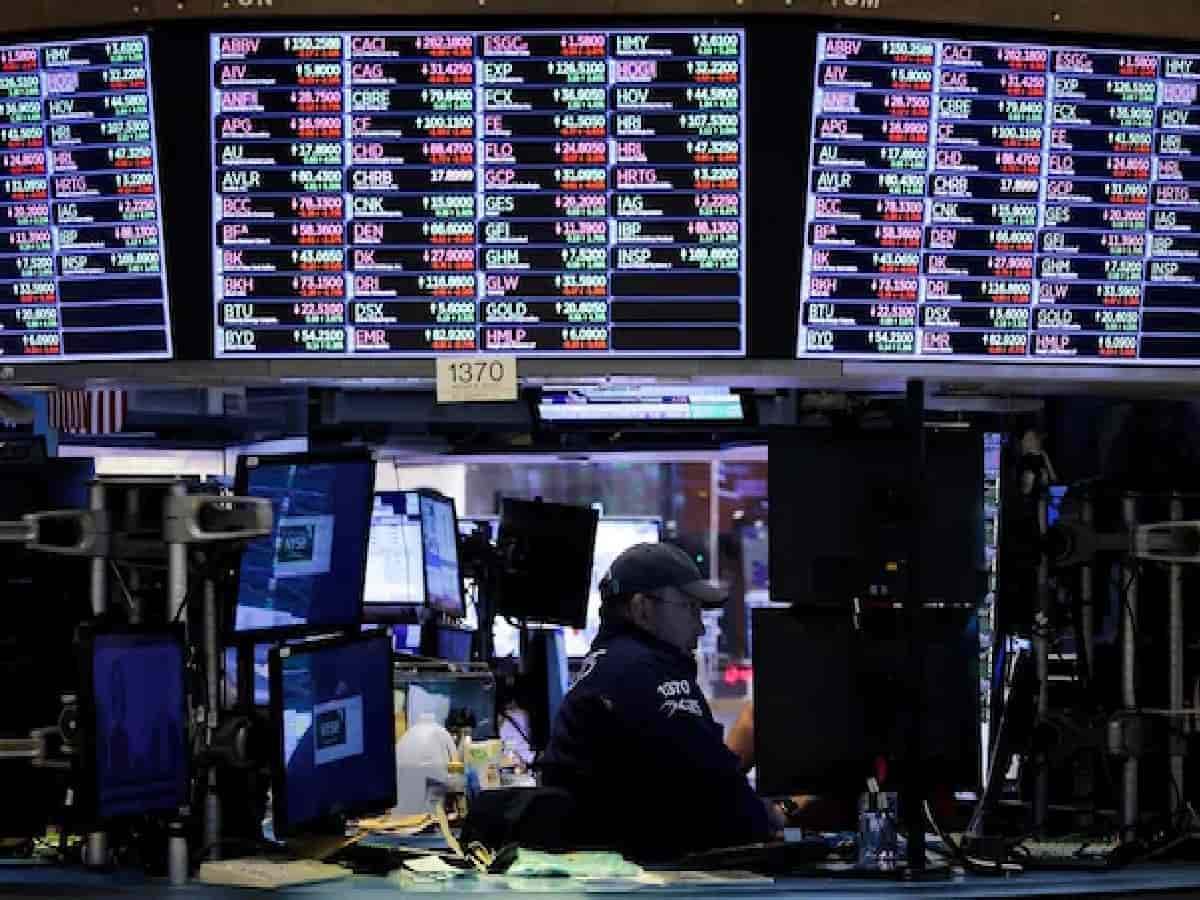
AI Sell-Off Wipes Out ₹560 Lakh Cr on Wall Street; Nasdaq Worst Week in 6 Yrs
A dramatic reassessment of artificial intelligence valuations and infrastructure spending has triggered Wall Street's steepest weekly rout since the onset of the COVID-19 pandemic in March 2020, wiping out nearly $6 trillion—roughly ₹560 lakh crore—in United States stock market wealth over five brutal trading sessions. Closing out Friday's session on November 20, 2026—with global market shockwaves reverberating across Asian and Indian desks on Saturday morning, November 21, 2026—the technology-heavy Nasdaq Composite plunged 1,261.47 points, or 5.28 percent, to 22,617.73, erasing all of its gains for 2026 (now down 2.7 percent year-to-date) and sealing its worst weekly decline in six years. Simultaneously, the Nasdaq 100 tumbled 5.6 percent on Friday—briefly breaching the 20 percent intraday bear-market threshold below its recent record peak—while the benchmark S&P 500 dropped 3.70 percent to 6,910.39 for its seventh consecutive daily loss, the index's longest losing streak since 2020. The blue-chip Dow Jones Industrial Average shed 949.73 points, or 1.93 percent, to settle at 48,147.33, leaving both the S&P 500 and Dow Jones more than 10 percent below their all-time highs in official market correction territory. The rout accelerated on Friday as heavy profit-taking hit semiconductor leaders—led by a 14 percent plunge in Nvidia, alongside double-digit drops in AMD (-13.3%), Micron (-13.9%), and Broadcom (-12.2%)—and as Anthropic (ticker: ANT) surrendered much of its first-day gains following Thursday's blockbuster Nasdaq IPO debut, reviving classic Wall Street warnings that mega-listings often coincide with speculative market tops. As the CBOE Volatility Index (VIX) surged to 35.89, its highest reading since April 2025, global investors fled riskier assets—pressuring Bitcoin, precious metals, and emerging markets while driving inflows into US Treasuries (pushing the 10-year yield down 11 basis points to 4.93 percent) and prompting traders to dial back bets on a December Federal Reserve rate hike. For retail equity investors, mutual fund SIP holders, IT sector professionals, and market watchers across Unnao, Lucknow, Kanpur, Mumbai, Ahmedabad, Bengaluru, Hyderabad, New Delhi, and New York, the sell-off marks a pivotal reality check on when massive AI capital expenditures will translate into sustainable corporate profits.
US Stock Market AI Rout (Nov 20–21, 2026): Weekly Scorecard & Market Reaction
To bring together Friday's closing index levels, the scale of the weekly market capitalization wipeout, and the cross-asset shifts across bonds, volatility, and semiconductor leaders, the table below summarizes the verified market data:
| Market Indicator / Asset Class | Closing Level & Weekly Performance (As of Nov 20, 2026) | Key Market Driver & Significance |
| Total US Market Value Lost | Nearly $6 trillion (~₹560 lakh crore) wiped out over the past week (including ~$2.4 trillion on Friday alone). | Weekly wealth erosion exceeds India's entire annual GDP as investors reprice AI growth expectations. |
| Nasdaq Composite & Nasdaq 100 | Nasdaq Composite fell 5.28% (-1,261.47 pts) to 22,617.73 on Friday (down ~10% for the week; -2.7% YTD). Nasdaq 100 plunged 5.6% on Friday, briefly touching a 20% intraday bear-market drop from its record peak. | Worst weekly performance for both indices since the March 2020 pandemic crash. |
| S&P 500 & Dow Jones Industrial Average | S&P 500 dropped 3.70% to 6,910.39 (7th straight daily loss; down 8.6% for the week). Dow Jones fell 1.93% (-949.73 pts) to 48,147.33. | Both benchmarks are now down 10%+ from record highs, placing Wall Street officially in a market correction. |
| AI & Chip Leaders (Nvidia, Anthropic, AMD) | Nvidia tumbled 14% on Friday (down 22% for the week) amid leadership and regulatory scrutiny; Anthropic (ANT) slid nearly 9% toward its $83 IPO price on day two of Nasdaq trading; Micron (-13.9%), AMD (-13.3%), Broadcom (-12.2%) sank. | Investors questioned return on massive AI capex, slower data-center construction, and tighter project financing. |
| Volatility (VIX), Bonds & Fed Rate Odds | VIX fear gauge jumped 26.2% to 35.89 (highest since April 2025); 10-year US Treasury yield fell 11 bps to 4.93%; gold fell 2.8% to $3,523.20/oz alongside declines in Bitcoin and emerging markets. | Futures traders scaled back expectations for a 0.25% Federal Reserve interest rate hike in December. |
Why Data Center Bottlenecks and Anthropic's IPO Sparked an AI Repricing
For nearly three years, relentless enthusiasm over generative artificial intelligence powered US equity benchmarks to successive records, even as tech giants committed hundreds of billions of dollars toward chips and server farms. This week, however, investor psychology shifted sharply from euphoria to skepticism. Market participants grew increasingly alarmed by three converging headwinds: massive capital expenditure outpacing near-term revenue returns, physical bottlenecks slowing down data-center construction (including power-grid and component constraints), and tightening financing availability for new AI infrastructure projects. When Anthropic—whose record-setting IPO raised $107 billion at a $1.5 trillion valuation—listed on the Nasdaq on Thursday and subsequently gave back nearly 9 percent on Friday, it drained liquidity from legacy semiconductor names and crystallized fears that AI valuations had run ahead of near-term earnings reality. As Richard Saperstein, Chief Investment Officer at Treasury Partners, noted in remarks cited by CNBC, investors are actively re-evaluating pure-play AI spending—though he added that established cloud hyperscalers that already own vast data-center footprints stand to benefit relatively from construction slowdowns, alongside cybersecurity firms positioned to gain from rising digital threats.
Market Correction or Prolonged Bear Market? What Historical Data Show
The global ripple effects of Wall Street's ₹560 lakh crore weekly wipeout were felt immediately across international asset classes, dragging down Bitcoin, industrial and precious metals, and emerging-market equities while driving safe-haven flows into US Treasury bonds and the Japanese yen. Simultaneously, the equity turmoil prompted interest-rate traders to pare back bets on a 25-basis-point rate hike by the Federal Reserve in December—a shift that Neil Dutta of Renaissance Macro Research cautioned could complicate inflation control if the central bank is forced onto the sidelines by falling stocks. Still, market historians urge investors to distinguish between a sharp valuation reset and an economic collapse: Chris Larkin, Managing Director of Trading and Investing at E*Trade from Morgan Stanley, pointed out that out of 15 S&P 500 corrections of 10 percent or more from record highs since 1983, only five ultimately deepened into full-fledged bear markets, suggesting that a painful washout in overextended tech multiples does not automatically signal a prolonged recession.




